Matricola - Core HR System of Record with Effective-Dated History and Approvals
HRIS Core for an Italian Fashion Retailer
Designed and built a clickable core HR system for a Milan fashion retail chain with about 2,400 employees in 138 stores: every employee record with effective-dated history, lifecycle events from hire to exit with their approval chain, mandatory notices and payroll status, and a dashboard of what HR has to act on today.
Most of our work is under NDA. Per agreement, we can share the work but not the company details - all names and identifying information shown here have been changed.
Impact
Dashboard, My approvals, the directory, the employee profile with 8 tabs and the events list with its event quick view. Every one of the 32 demo employees opens their own profile.
Events waiting longer than the client's 3-working-day approval target are marked amber on the dashboard and in the events list, so stuck promotions, hires and exits stand out before payroll cut-off.
Each tax code is computed with the real check character and compared with the recorded name, birth date, place and gender, and the profile shows the result next to the code.
17 locations including the head office and distribution centre, 23 lifecycle events across 10 event types, 16 mandatory notices and 7 residence permits at different stages.
The Problem
Filobruno's HR records lived in three places: the payroll provider's employee file, a spreadsheet per region kept by the area HR partners, and paper folders in each store. A promotion agreed by an area manager could take two payroll cycles to reach the payslip, nobody could produce a reliable headcount by store on a given date, leavers kept their Microsoft 365 accounts for weeks, residence permits expired unnoticed and a data subject access request took HR most of a week.
Our Solution
Matricola is the single HR system of record from hire to exit. Every employee field is stored with the date it applies from, every hire, transfer, promotion, leave and termination is an event with its before and after, approval chain and checks, and approved events produce the mandatory notice data and the changes sent to payroll, the identity provider and the benefits platform.
The Challenge: One Record for Every Employee, Under Italian Law
Retail HR in Italy runs on a national collective agreement, strict notice and right-to-work rules and tight limits on sensitive data, with most changes raised by store and area managers on their phones and checked by HR before payroll.
Records in Three Places
Payroll, regional spreadsheets and store folders each held part of the truth. A change agreed in a store travelled by email to HR and then to the external payroll consultant, and nothing showed where it was stuck.
History That Has to Hold
Headcount on a date, a manager on a date and a salary on a date all depend on effective dating. A change from a date and a correction of a past value are different things, and both have to stay visible in the record's history.
Italian Employment Rules on Every Event
Grades map to CCNL Commercio levels, fixed-term contracts have limits on length and extensions, hires must be notified through UniLav before the start date, and resignations generally go through the Ministry of Labour's online procedure before HR can process them.
Permits and Sensitive Data
Employing a non-EU national without a valid residence permit is a criminal offence under D.Lgs. 286/1998. Health, disability and diversity data fall under GDPR Article 9, the Workers' Statute restricts remote monitoring, and medical fitness letters had been filed next to contracts.
Our Approach: From Employment Rules to a Clickable HR Core
Spec and Rules Research
Mapped 10 user roles, 36 screens (30 staff screens and 6 mobile-first self-service screens), 5 slide-over panels and the data model for positions, job architecture, effective-dated personal and job records, contracts, right to work, lifecycle events, workflows, mandatory notices, a segregated restricted store and retention. Wrote down the rules the design follows: CCNL Commercio, contract types, UniLav notices, the online resignation procedure, the Libro Unico del Lavoro, Codice Fiscale validation, the Immigration Act, GDPR and the Italian Privacy Code, D.Lgs. 81/2008, the Workers' Statute and Law 68/1999.
Clickable Demo on a Production UI Kit
Built 5 key screens on a production dashboard kit, signed in as the HR director: the dashboard with KPIs, events by stage, starters and leavers with what is missing, compliance watch, headcount trend and integration health; My approvals with before and after, checks and Approve, Reject or Send back with a required comment; the directory with filters, card view and bulk actions; the employee profile with 8 tabs, record history and the correct-or-change choice; and the events list. All actions run on local state.
What a Production Build Adds
Integration with the payroll provider (such as Zucchetti or TeamSystem), SCIM 2.0 provisioning to Microsoft Entra ID or Okta, the benefits platform (such as Edenred or Jointly), qualified e-signature (such as Namirial or InfoCert), PEC and the SAP S/4HANA store master data. Server-side scope by role, a segregated restricted store with its own keys, a hash-chained audit log, retention runs, and the remaining screens: My team, new hire, org chart, contracts, documents, compliance, reports, sync monitor, settings and employee self-service. Fixed-term limits and retention periods are confirmed with the labour consultant before go-live.
Why It Works: Every Change Has a Date, a Chain and a Check
Every Change Shows Before and After
An event lists each field before and after with its effective date, the reason, the approval chain with comments and skipped steps explained (for example "Area manager is the requester"), and checks such as grade within band. A salary above the grade maximum adds the HR director step.
What Is Missing Before the Start Date
The dashboard lists everyone starting or leaving in the next 14 days with what is still open: mandatory notice not filed, contract unsigned, right to work unverified or the online resignation reference missing. Permits, fixed-term ends, notices and privacy requests sit in a compliance watch.
Downstream Changes Are Visible
Each event shows its mandatory notice status and due date, the payroll batch it will join and the identity and benefits changes it triggers, such as an Entra ID account disabled at 23:59 on the last working day, so leavers no longer keep their accounts.
Sensitive Fields Stay Controlled
IBAN and permit numbers are masked, Codice Fiscale search is for HR roles only, and health, disability and diversity data live in a restricted store that the HR director cannot open. The design has no location or activity tracking and no free-text fields for opinions.
Related case studies
View all: HR & payroll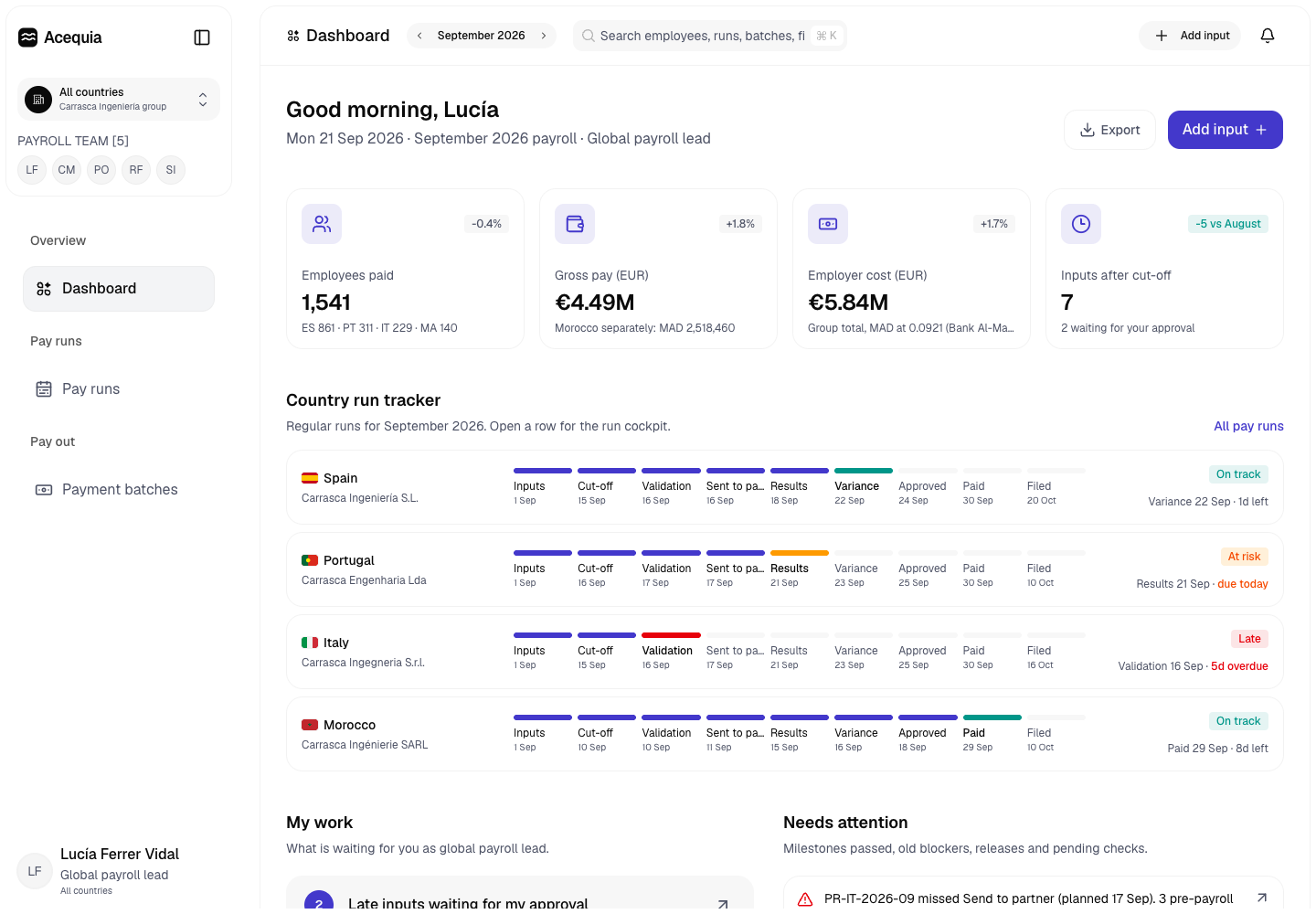
Acequia - Multi-country Payroll Console Over Four Local Engines
Designed and built a clickable payroll orchestration console for a Madrid engineering group paying about 1,550 people in Spain, Portugal, Italy and Morocco: one tracker for every country's run from input cut-off to paid and filed, validation and variance review before approval, and payment batches that only a second person can release.
Bobbin - Biometric-Free Leave and Time Attendance for a Textile Mill
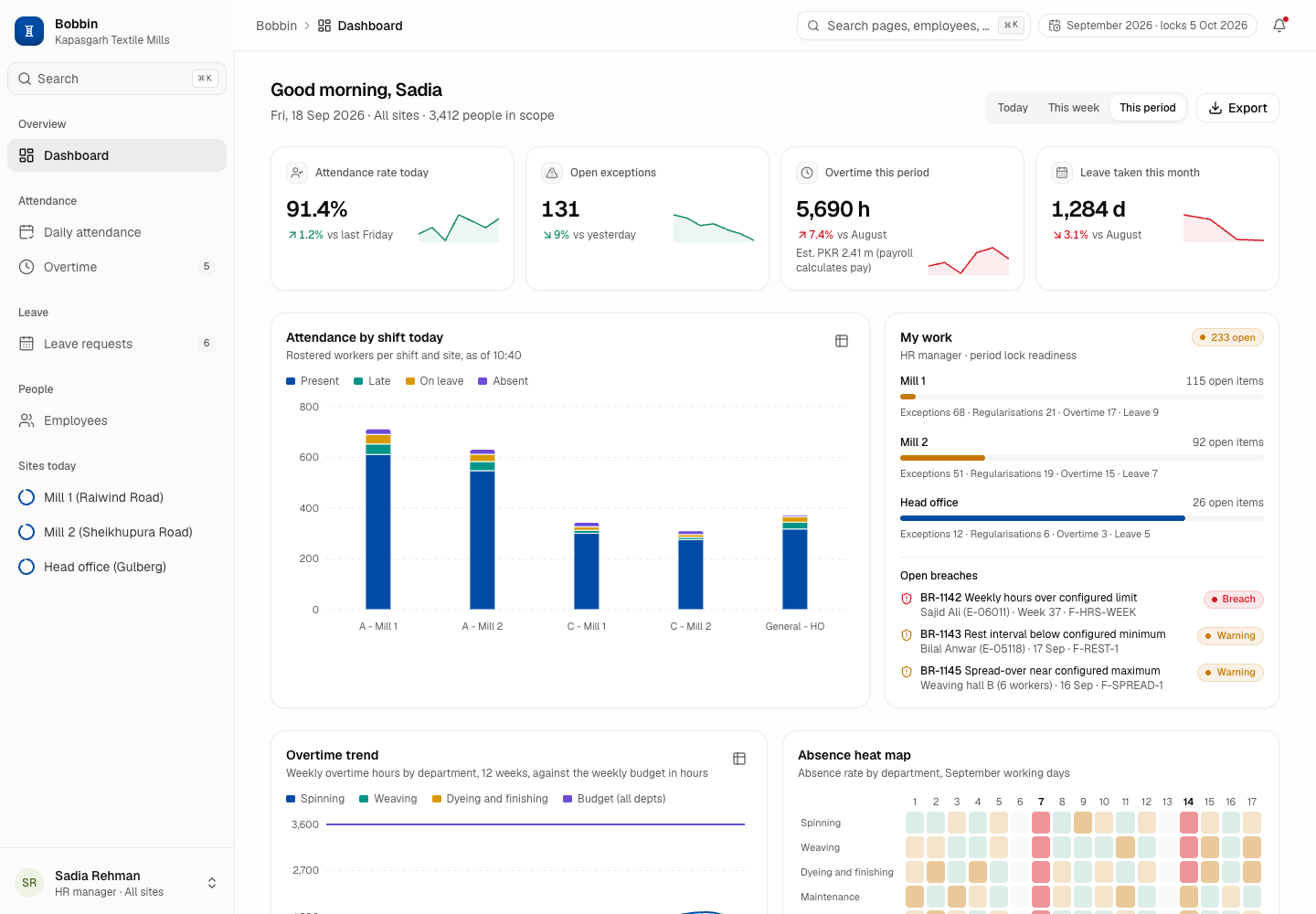
Designed and built a clickable leave and time attendance system for a Lahore spinning and weaving company: badge, rotating QR and geofenced mobile punches instead of fingerprints, each day worked out against the shift pattern, overtime approved and confirmed before payroll, and leave requests routed with balances and team coverage in view.
Enterprise Software Engineering - Human + AI
Contact Us
© 2026 - Copyright. All Rights reserved Oceanlab
Location
Global Headquarters
21 Merchant Road, 3rd Floor, Singapore 058267
Main corporate office and leadership operations
North America Office
548 Market Street, PMB 12345, San Francisco, CA 94104
Client operations and business development
India Office
402 Shivalik Shilp II, SG Highway, Ahmedabad 380015
Engineering and delivery center

Enterprise Software Engineering - Human + AI
Contact Us
Locations
Global Headquarters
21 Merchant Road, 3rd Floor, Singapore 058267
Main corporate office and leadership operations
North America Office
548 Market Street, PMB 12345, San Francisco, CA 94104
Client operations and business development
India Office
402 Shivalik Shilp II, SG Highway, Ahmedabad 380015
Engineering and delivery center
© 2026 - Copyright. All Rights reserved Oceanlab