Bobbin - Biometric-Free Leave and Time Attendance for a Textile Mill
Attendance, Overtime and Leave for a Pakistani Textile Manufacturer
Designed and built a clickable leave and time attendance system for a Lahore spinning and weaving company: badge, rotating QR and geofenced mobile punches instead of fingerprints, each day worked out against the shift pattern, overtime approved and confirmed before payroll, and leave requests routed with balances and team coverage in view.
Most of our work is under NDA. Per agreement, we can share the work but not the company details - all names and identifying information shown here have been changed.
Impact
Dashboard, daily attendance with the attendance day panel, overtime, leave requests, the employee list and the employee record with its month calendar.
No fingerprints, face images or templates. Badges carry a card number, QR codes rotate at the kiosk, and a mobile punch records one location fix at the moment of the punch, never continuous tracking.
Mill workers and head office staff are checked against different Punjab rule sets. Hours limits, rest intervals and overtime premiums are configured, cited rules such as F-HRS-WEEK, never hard-coded numbers.
26 employees across 2 mills and the head office in 9 departments, on 4 shifts, with 20 leave requests, 16 overtime requests, 6 leave types and 9 staff users.
The Problem
Kapasgarh's 3,400 people were tracked by fingerprint readers at the mill gates, paper muster rolls kept by line supervisors and a leave spreadsheet per department. The readers failed on spinning workers' cracked, cotton-dusted fingers, so supervisors marked people present by hand. Overtime was agreed verbally, leave balances disagreed between HR and the departments, and HR spent the first week of every month reconciling three sources before payroll could run.
Our Solution
Bobbin records who came to work by badge, rotating QR code or geofenced mobile punch, works out each day against the shift pattern, runs overtime from pre-approval to confirmed hours and leave from request to balance, and locks a clean monthly timesheet for payroll. Every legal limit it checks is a configured rule with a citation and the name of the person who verified it.
The Challenge: Proving Who Worked, and for How Long
About 3,000 factory workers across two mills on three rotating shifts, and 400 office, sales and procurement staff in Gulberg and on the road, all under Punjab labour law. The company could not quickly show a labour inspector that working hours and overtime stayed within the law.
Fingerprints That Failed on the Floor
Readers could not read the fingers of spinning workers, supervisors marked attendance by hand, and nobody could prove afterwards who had been on the floor. The board also wanted to stop holding workers' fingerprints at all.
Two Laws Across Three Sites
Labour is a provincial subject, so Kapasgarh follows Punjab's texts. Mill workers fall under the Factories Act 1934 and head office staff generally under the Punjab Shops and Establishments Ordinance 1969, each with its own hours, overtime, weekly holiday and leave rules.
Overtime and Leave Kept Off the Record
Overtime was agreed verbally and totalled at month end, and leave balances in department spreadsheets did not match HR's. Night shifts that cross midnight and a weekly A, B, C rotation made each worker's day harder to count by hand.
Holidays Set by the Moon
Eid and other Islamic holidays depend on moon sighting and are confirmed only days before. HR re-keyed them by hand each year, and any day or leave request already calculated over the old date had to be fixed.
Our Approach: From Punjab Labour Rules to a Clickable System
Spec and Rules Research
Mapped 9 user roles from factory worker to compliance officer, 38 screens (30 staff, 6 employee self-service and 2 kiosk) and the data model for punches, attendance days, shift patterns, overtime rules, the leave ledger, holidays, pay periods and the statutory rule library. Wrote down the rules the design follows: the Factories Act 1934 and the Punjab Shops and Establishments Ordinance 1969 as applied in Punjab, standing orders, EOBI and PESSI registrations, gazetted and moon-sighting holidays, and the principles of the draft Personal Data Protection Bill.
Clickable Demo on a Production UI Kit
Built 6 key screens on a production dashboard kit: the dashboard with attendance by shift and site, period lock readiness per site, open breaches, a 12-week overtime trend against budget and an absence heat map; daily attendance with the day panel, Regularise day and Recalculate; overtime with four stages and a request modal that warns on the weekly limit; leave requests with balances, team overlap and the approval chain; and the employee list and record. All actions run on local state.
What a Production Build Adds
Integration with the HRIS for employee master data, HID badge readers through a local gateway at each mill, the gate controllers, Google Maps geofences, push, WhatsApp Business and SMS notifications, Microsoft Entra ID sign-in with employee code and PIN for workers, and the payroll export. An append-only audit of every change, counsel's verification of every statutory value before go-live, and the remaining screens: the live Today board, punch log, exceptions, team calendar, badges, timesheet lock, compliance reports, settings, and the Urdu and English mobile and kiosk apps.
Why It Works: Facts First, Rules Configured
Presence Without Biometric Data
Each employee has the punch methods that fit their job: badge at the gate for mill workers, QR kiosk or geofenced mobile for office and field staff. The punch photo option some systems offer is deliberately left out.
Every Day Shows Its Working
The attendance day panel lists the punches, the expected shift with its grace period and break, lateness, worked time and overtime rounded to 15-minute blocks under a named rule version. Raw punches are never edited; corrections go through regularisation.
Overtime Is Never Dropped Silently
Overtime worked without a request lands in Worked, awaiting confirmation. Hours can be confirmed at fewer than worked, with a reason, but never more, and requests carry warnings for the weekly limit, rest interval and night-work restrictions.
Limits as Cited, Verified Rules
Bobbin ships with no statutory numbers. Each limit is a configured rule with its law, section, value and verifier, an unverified rule cannot be used to lock a period, and provisional Eid dates are confirmed or moved with the affected days recalculated.
Related case studies
View all: HR & payroll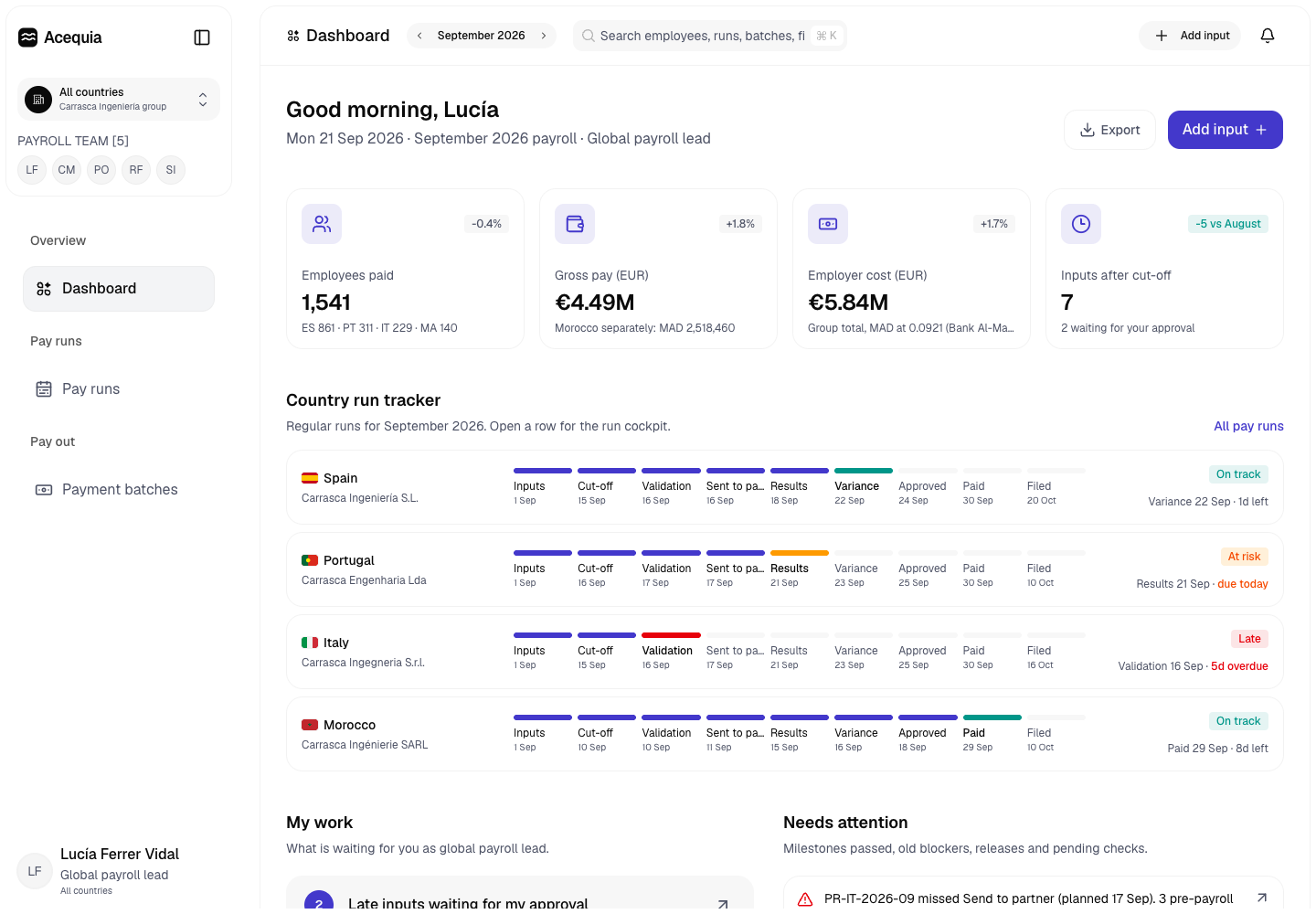
Acequia - Multi-country Payroll Console Over Four Local Engines
Designed and built a clickable payroll orchestration console for a Madrid engineering group paying about 1,550 people in Spain, Portugal, Italy and Morocco: one tracker for every country's run from input cut-off to paid and filed, validation and variance review before approval, and payment batches that only a second person can release.
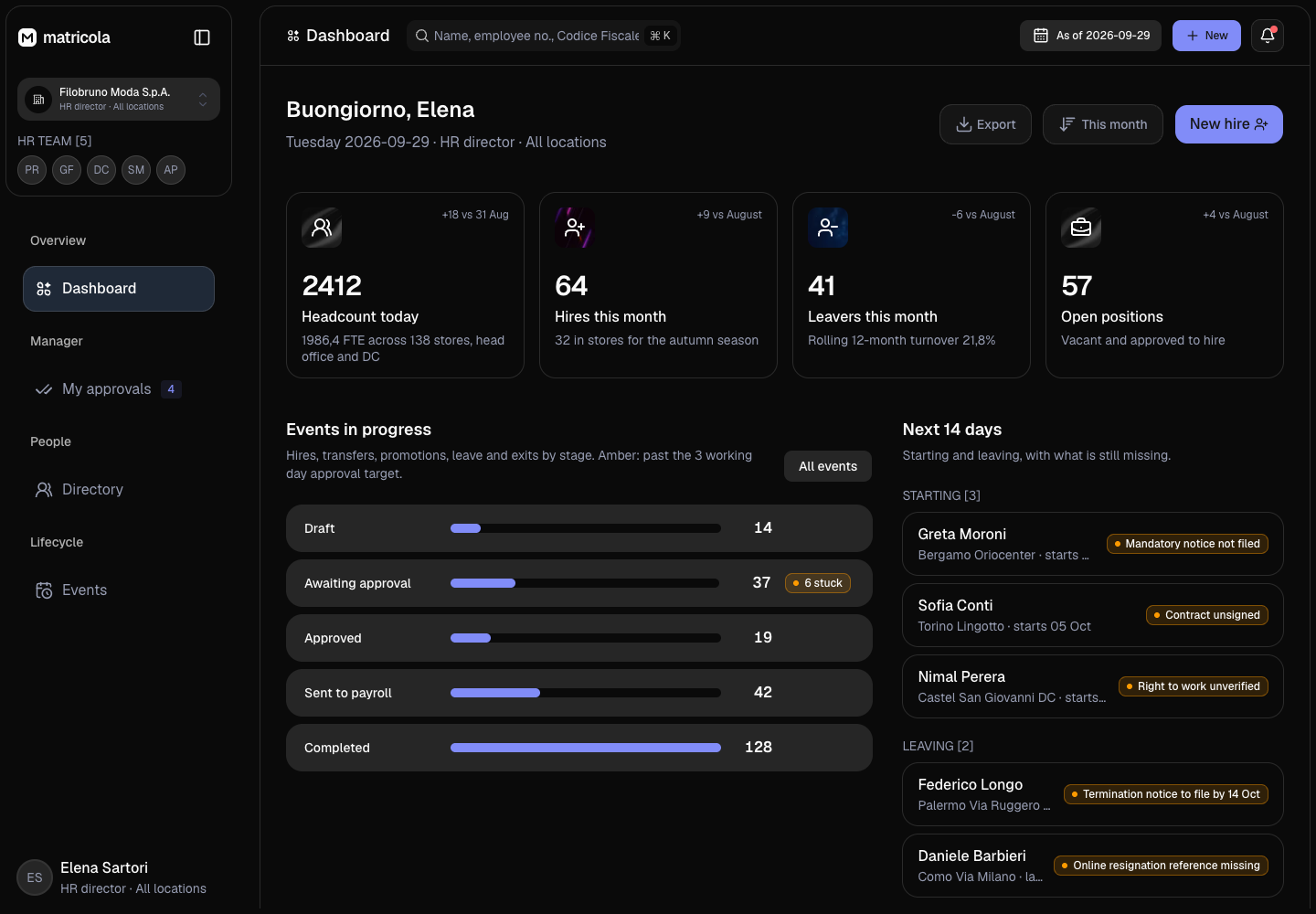
Matricola - Core HR System of Record with Effective-Dated History and Approvals
Designed and built a clickable core HR system for a Milan fashion retail chain with about 2,400 employees in 138 stores: every employee record with effective-dated history, lifecycle events from hire to exit with their approval chain, mandatory notices and payroll status, and a dashboard of what HR has to act on today.
Enterprise Software Engineering - Human + AI
Contact Us
© 2026 - Copyright. All Rights reserved Oceanlab
Location
Global Headquarters
21 Merchant Road, 3rd Floor, Singapore 058267
Main corporate office and leadership operations
North America Office
548 Market Street, PMB 12345, San Francisco, CA 94104
Client operations and business development
India Office
402 Shivalik Shilp II, SG Highway, Ahmedabad 380015
Engineering and delivery center

Enterprise Software Engineering - Human + AI
Contact Us
Locations
Global Headquarters
21 Merchant Road, 3rd Floor, Singapore 058267
Main corporate office and leadership operations
North America Office
548 Market Street, PMB 12345, San Francisco, CA 94104
Client operations and business development
India Office
402 Shivalik Shilp II, SG Highway, Ahmedabad 380015
Engineering and delivery center
© 2026 - Copyright. All Rights reserved Oceanlab