Keelson - Performance and OKR Platform with the Works Agreement Built In
Performance Management for a Berlin Software Scale-Up
Designed and built a clickable performance platform for a 520-person Berlin SaaS company with a works council: OKRs on an alignment tree with weekly check-ins, a manager review workspace with an AI summary the manager must edit before submitting, and calibration on a 9-box with a reason logged for every change.
Most of our work is under NDA. Per agreement, we can share the work but not the company details - all names and identifying information shown here have been changed.
Impact
Home, OKR tree, objective detail, the manager review workspace and the calibration session. Every one of the 22 demo objectives opens its own detail page with key results, check-ins and a progress chart.
The AI draft reads only the written review inputs, links each sentence to its source, never fills a rating field, and blocks submission while inserted text is still unchanged.
Calibration shows rating distributions by gender, age band, working time and parental leave only for groups of at least 5 people. Smaller groups are suppressed.
4 company, 5 department, 8 team and 5 individual objectives with 45 key results, 35 employees in 6 departments, a 6-phase review cycle and a 17-person calibration session.
The Problem
Havelgrund grew from 140 to 520 people in three years and its performance process did not keep up. OKRs lived in a spreadsheet updated once a quarter, managers copied peer comments into documents by hand, calibration ran on a slide with sticky notes, ratings reached employees by email on different days, and 1:1 notes sat in personal pages the report never saw. When the newly elected works council asked what data was collected, who could see it and how ratings were decided, HR could not answer from one place.
Our Solution
Keelson covers the whole performance loop in one app: company, team and individual OKRs on an alignment tree with weekly check-ins, a three-column manager review workspace with an optional AI summary that stays the manager's own work, and calibration sessions with a 9-box, guideline bands and a change log. Every setting the works agreement covers shows the agreement version that governs it.
The Challenge: Performance Data Under a Works Agreement
In Germany, performance software is generally treated as a technical device that can monitor employees, so how Havelgrund collects, shows and rates performance has to follow a works agreement with its Betriebsrat, as well as data protection and equal treatment law.
Co-Determination on Every Setting
Under section 87(1) no. 6 BetrVG the works council generally co-determines systems able to monitor performance, and section 94 covers assessment principles. Templates, rating scales and calibration rules cannot be used until they are agreed, and the product must collect no activity data such as logins, commits or messages.
AI That Must Not Decide
AI that evaluates workers is generally listed as high-risk under the EU AI Act, and GDPR Article 22 rules out ratings made by automated means alone. A pilot with a generic writing tool ended with managers pasting text in unchanged, and the works council asked for it to stop.
Fair Ratings Without Exposing People
The AGG prohibits discrimination, so a calibration panel needs to see whether ratings skew by gender, age, part-time work or parental leave, but only in aggregate and never in a way that identifies one person in a small team.
Who Sees What
Individual objectives, shared and private 1:1 notes, feedback, reviews and improvement plans each have different audiences. Two improvement plans had been discussed in a public channel by mistake, and every view now has to respect the viewer's role and reporting line.
Our Approach: From a Works Agreement to a Clickable Platform
Spec and Rules Research
Mapped 8 roles, from employee and manager to HR business partner, works council member and DPO, 38 screens and the data model for objectives, key results, check-ins, 1:1s, feedback, versioned templates and rating scales, review cycles, AI summaries, calibration sessions and improvement plans. Wrote down the rules the design follows: BetrVG sections 82, 83, 87, 94 and 102, the GDPR and BDSG, the AGG and the EU AI Act.
Clickable Demo on a Production UI Kit
Built 5 key screens on a production dashboard kit: Home with the active cycle and a to-do list that changes with the viewing role, the OKR tree with an Unaligned column and quick view, objective detail with a check-in modal that updates key results, the manager review workspace with the AI summary panel, and the calibration session with drag and drop on a 9-box, a distribution view and a fairness check. All actions run on local state.
What a Production Build Adds
Integration with the HRIS (such as Personio), SSO and SCIM provisioning through Okta or Microsoft Entra ID, Slack or Teams reminders, calendar-linked 1:1s, team-level metrics from Jira, Linear or Looker, AI summaries in an EU region with no training on customer data, e-signature for improvement plans and release to compensation planning. Plus role-based visibility, an append-only audit log, scheduled retention runs and the remaining 33 screens.
Why It Works: The Manager Stays the Author
AI Drafts Stay in Their Own Panel
Before first use, a notice says what the assistant reads and what it does not do: no ratings, no tone or sentiment analysis, no messages or activity data. The draft is split into strengths, areas to develop and contributions, and each sentence highlights the inputs it came from.
Submission Rules You Cannot Skip
Inserted text stays highlighted until the manager edits it, and submit is blocked with "Edit the drafted text so it is your own assessment, or remove it." The manager also confirms the review is their own, and the employee is told AI assisted.
Every Rating Change Has a Reason
In calibration, moving a person between boxes or changing a rating needs a reason, which goes into the change log with who proposed it. Guideline bands such as Exceeds 15 to 25% are outlined amber when a group falls outside them, with no forced quotas.
The Agreement Is on the Screen
Screens governed by the works agreement link to the clause, such as BV-2025-03 version 2, clause 5.2 on the review template, which also shows when the works council agreed it. Potential is marked for development planning only, and 1:1 notes are never pulled into a review.
Related case studies
View all: HR & payroll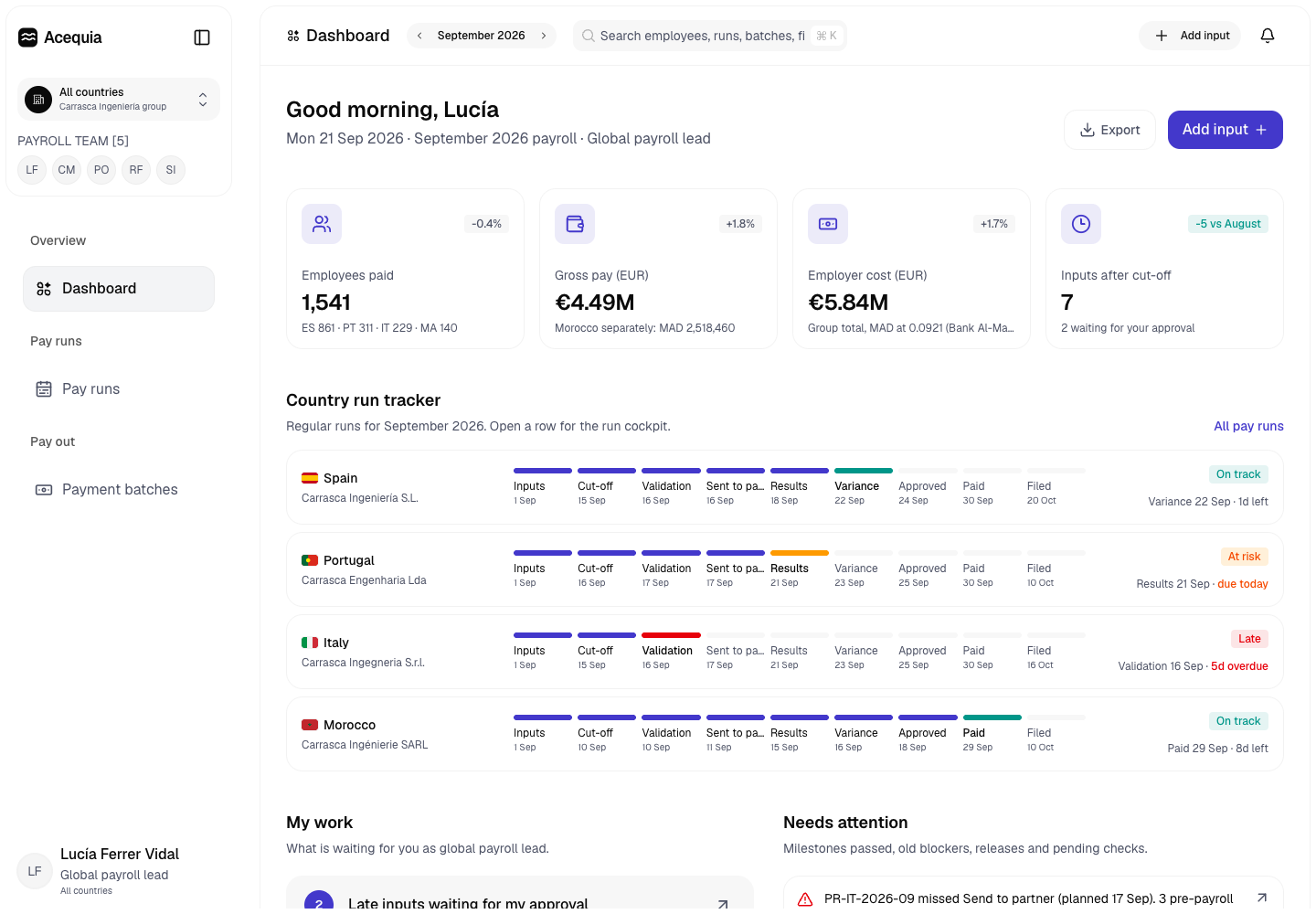
Acequia - Multi-country Payroll Console Over Four Local Engines
Designed and built a clickable payroll orchestration console for a Madrid engineering group paying about 1,550 people in Spain, Portugal, Italy and Morocco: one tracker for every country's run from input cut-off to paid and filed, validation and variance review before approval, and payment batches that only a second person can release.
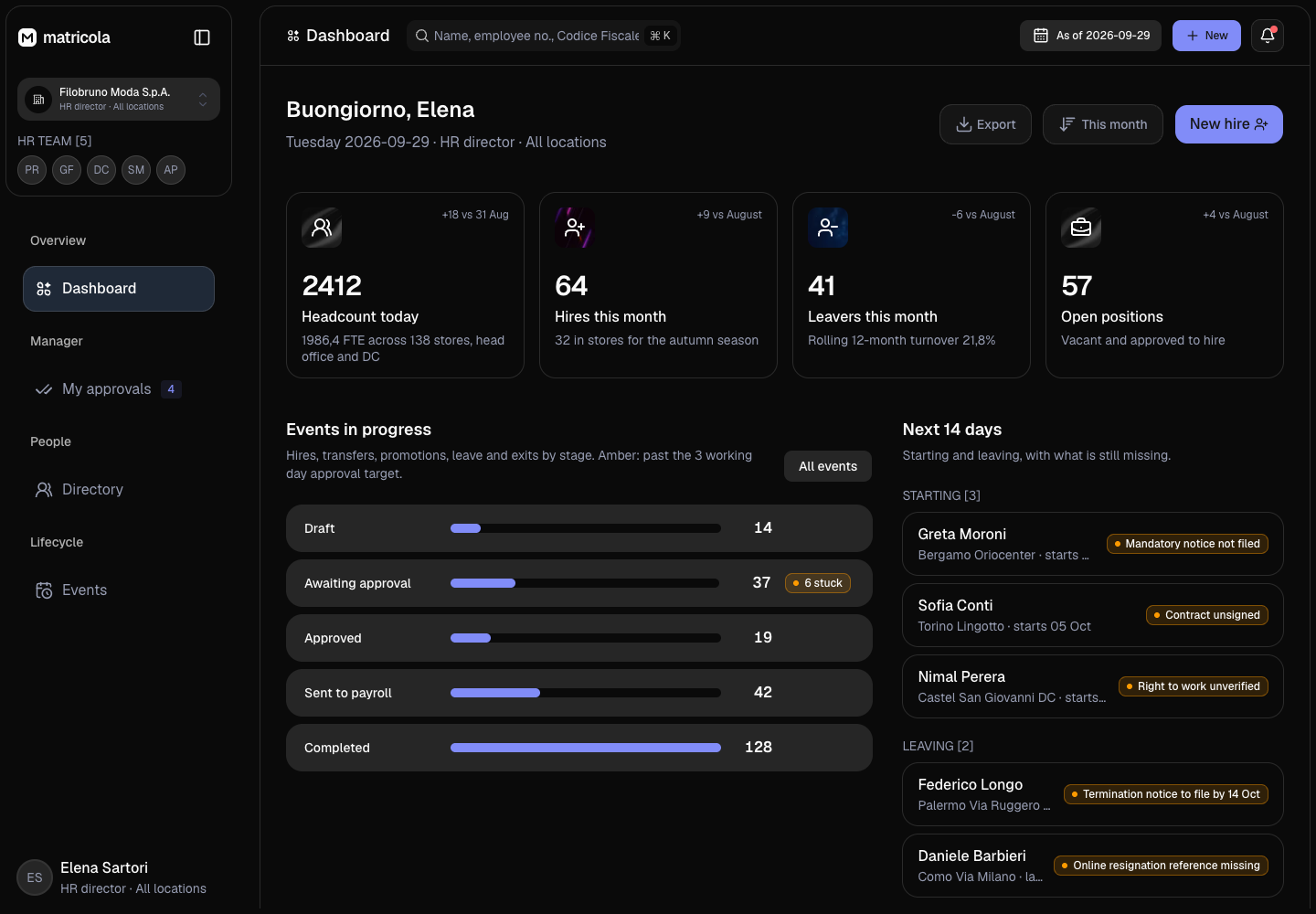
Matricola - Core HR System of Record with Effective-Dated History and Approvals
Designed and built a clickable core HR system for a Milan fashion retail chain with about 2,400 employees in 138 stores: every employee record with effective-dated history, lifecycle events from hire to exit with their approval chain, mandatory notices and payroll status, and a dashboard of what HR has to act on today.
Enterprise Software Engineering - Human + AI
Contact Us
© 2026 - Copyright. All Rights reserved Oceanlab
Location
Global Headquarters
21 Merchant Road, 3rd Floor, Singapore 058267
Main corporate office and leadership operations
North America Office
548 Market Street, PMB 12345, San Francisco, CA 94104
Client operations and business development
India Office
402 Shivalik Shilp II, SG Highway, Ahmedabad 380015
Engineering and delivery center

Enterprise Software Engineering - Human + AI
Contact Us
Locations
Global Headquarters
21 Merchant Road, 3rd Floor, Singapore 058267
Main corporate office and leadership operations
North America Office
548 Market Street, PMB 12345, San Francisco, CA 94104
Client operations and business development
India Office
402 Shivalik Shilp II, SG Highway, Ahmedabad 380015
Engineering and delivery center
© 2026 - Copyright. All Rights reserved Oceanlab