Hidamari - Employee Wellbeing Platform for Stress Checks and Long Working Hours
Privacy-First Wellbeing Platform for Japanese Employers
Designed and built a clickable staff console for a Tokyo HR-tech company's employee wellbeing platform: run the annual stress check, read group analysis that never shows a group under 10 people, follow physician interviews and track long working hours, with each piece of health information kept with the people allowed to see it.
Most of our work is under NDA. Per agreement, we can share the work but not the company details - all names and identifying information shown here have been changed.
Impact
Dashboard, stress check campaigns, campaign detail with its Progress, Results, Consented results, Interviews and Settings tabs, group analysis with the heatmap cell detail, and long-hours tracking.
Units under 10, such as Legal and compliance and the Tokyo DC office, are combined into their parent unit, and an analysis filter is disabled if it would create a smaller group.
Workers over 80 hours of overtime and holiday work in a month are tracked with their fatigue self-check and can request a physician interview, and research and development workers over 100 hours are marked as mandatory interviews.
One tenant with 26 org units, 60 employees, 9 staff users, 11 stress check campaigns, 11 physician interviews and 26 long-hours cases.
The Problem
Minamikaze's customers ran the stress check on paper or through a questionnaire vendor, tracked long working hours in attendance spreadsheets and handled harassment reports by email to HR. HR could not see who had finished the stress check without also seeing answers they were not allowed to see, high-stress workers avoided asking for a physician interview because the request went through their manager, and group analysis arrived months later as a PDF in which small teams were sometimes identifiable.
Our Solution
Hidamari gives HR and health staff one console to run stress check campaigns, follow completion as counts only, read group analysis by unit against national values, and track long working hours from the attendance system. Individual results stay with the stress check implementer, every view of them is recorded, and the employer sees an individual's results only after that worker agrees.
The Challenge: Health Data Each Person May See
Japanese employers must offer a yearly stress check under the Industrial Safety and Health Act, and the law decides who may see what: the worker, the implementer, HR, managers and the health committee all see different parts of the same data.
Completion Without the Answers
HR has to chase people who have not answered, but people with authority over hiring, dismissal, promotion or transfer must not handle individual results. The stress check is carried out by an implementer, usually the industrial physician or a public health nurse.
Consent Only After Results
Results go to the worker first. The employer may receive them only with the worker's consent, which cannot be asked for before the worker has seen them, and nobody may be treated unfavourably for not taking the check, not sharing or requesting an interview.
Small Groups That Identify People
Employers are expected to analyse results by group and improve working conditions. The MHLW manual advises generally not to report groups of fewer than 10 people, and a logistics company has small office teams next to large warehouse shifts.
Long Hours and Scarce Physician Time
A worker whose overtime and holiday work exceeds 80 hours a month and who shows fatigue may request a physician interview, and some categories must be interviewed regardless. Industrial physicians visit each workplace only a few hours a month and spent that time finding files.
Our Approach: From Japanese Workplace Health Rules to a Clickable Console
Spec and Rules Research
Mapped 11 roles, from employee and HR administrator to implementer, industrial physician, consultation officer and auditor, and 41 screens across a mobile-first employee app and the staff console. Defined data tiers for individual health data, consented results, group data, consultations and anonymous pulse answers, and wrote down the rules the design follows: the Stress Check Program, long working hours interviews, APPI special care-required personal information and harassment consultation duties.
Clickable Demo on a Production UI Kit
Built 5 key screens of the staff console on a production dashboard kit: the dashboard with KPIs and a Needs attention list by role, the campaign list, the campaign detail with a Viewing as switch between implementer and HR administrator, group analysis with the heatmap and total health risk chart, and long-hours tracking with the bulk hours notification panel. A workplace switcher filters every screen, and all actions run on local state.
What a Production Build Adds
The 14-screen employee app, the physician workspace, pulse check-ins, programmes, EAP bookings, the consultation desk and the labour office report. Integrations with SmartHR, KING OF TIME or Jinjer, Microsoft Entra ID or Google Workspace sign-on, LINE WORKS, Teams or Slack notifications, Zoom or Teams interviews, an EAP provider and e-Gov filing, hosted in the AWS Tokyo region with health data in a separate encrypted schema and an append-only audit log.
Why It Works: Each Piece of Health Data Stays With the Right Person
HR Sees Counts, Never Scores
The campaign Progress tab shows completion by workplace, daily answers and a not-yet-answered list for reminders, with no scores anywhere. Results open only for the implementer, under a banner saying the view is recorded, and HR sees only the results workers chose to share.
Groups Are Protected by Default
The heatmap compares each unit's job demands, control, supervisor support and co-worker support with national values, and a unit under 10 people shows as combined into its parent. The minimum group size starts at 10 and cannot be set lower.
Every Role Sees Its Own Next Step
Needs attention changes by role: interviews this week for the physician, unscheduled interview requests for health staff, turning amber after 7 days and red after 14, and closing campaigns, overdue improvement actions and labour office reports for HR.
Long Hours Followed From the Source
Hours come from the attendance system with the last sync time shown. Each row shows three months of hours, the 2 to 6 month average, the fatigue self-check, the date notified and the interview status, so HR can notify workers in bulk and assign a physician from one table.
Related case studies
View all: Mental health & wellness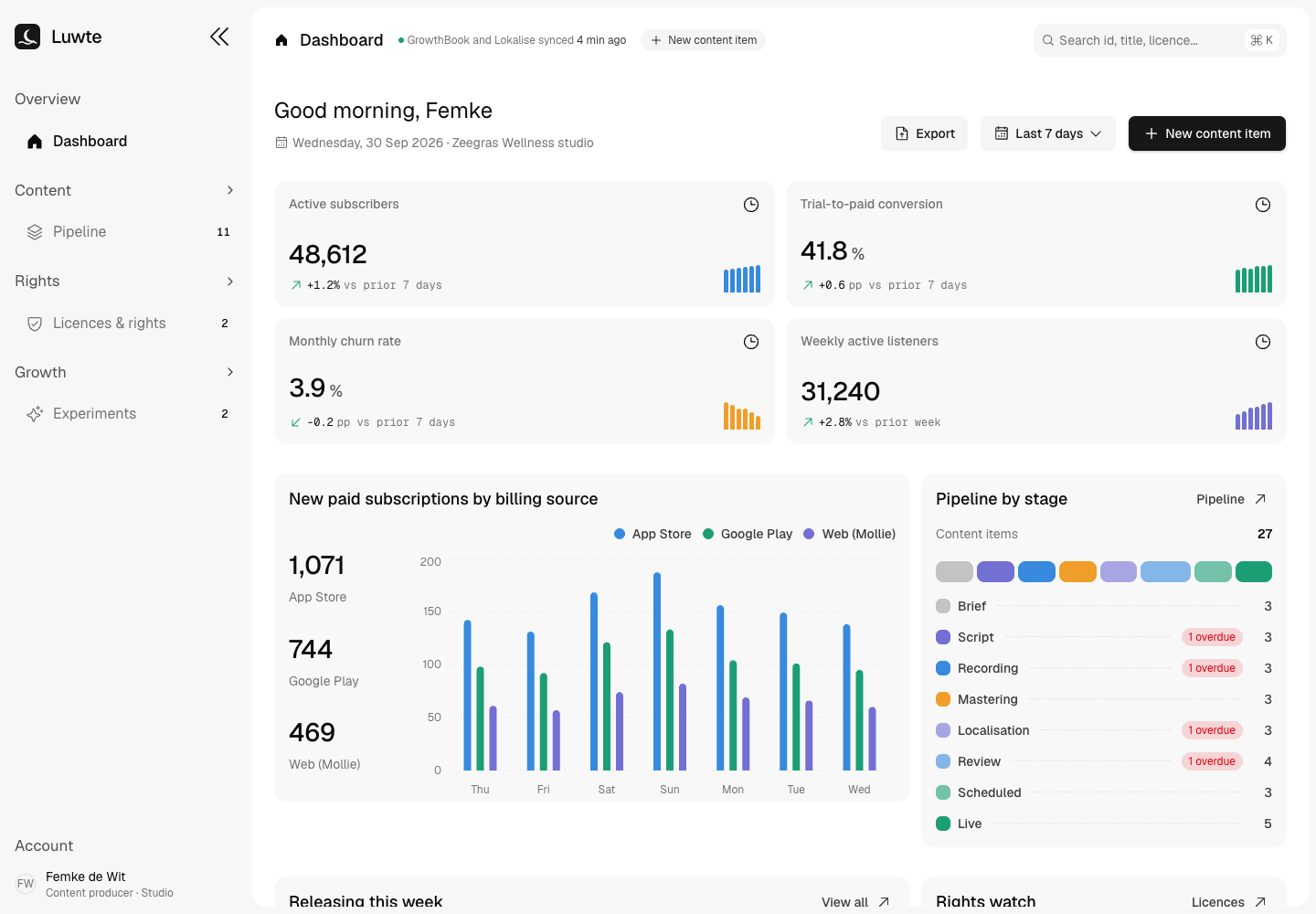
Luwte - Meditation and Sleep App with a Content Studio and Ethical Growth Guardrails
Designed and built a clickable content studio console for a Dutch meditation and sleep subscription in four languages: a pipeline that takes every session from brief to release, mastering checks against the house loudness standard, a rights register that warns before licences run out, and growth experiments that cannot start without an ethics review.
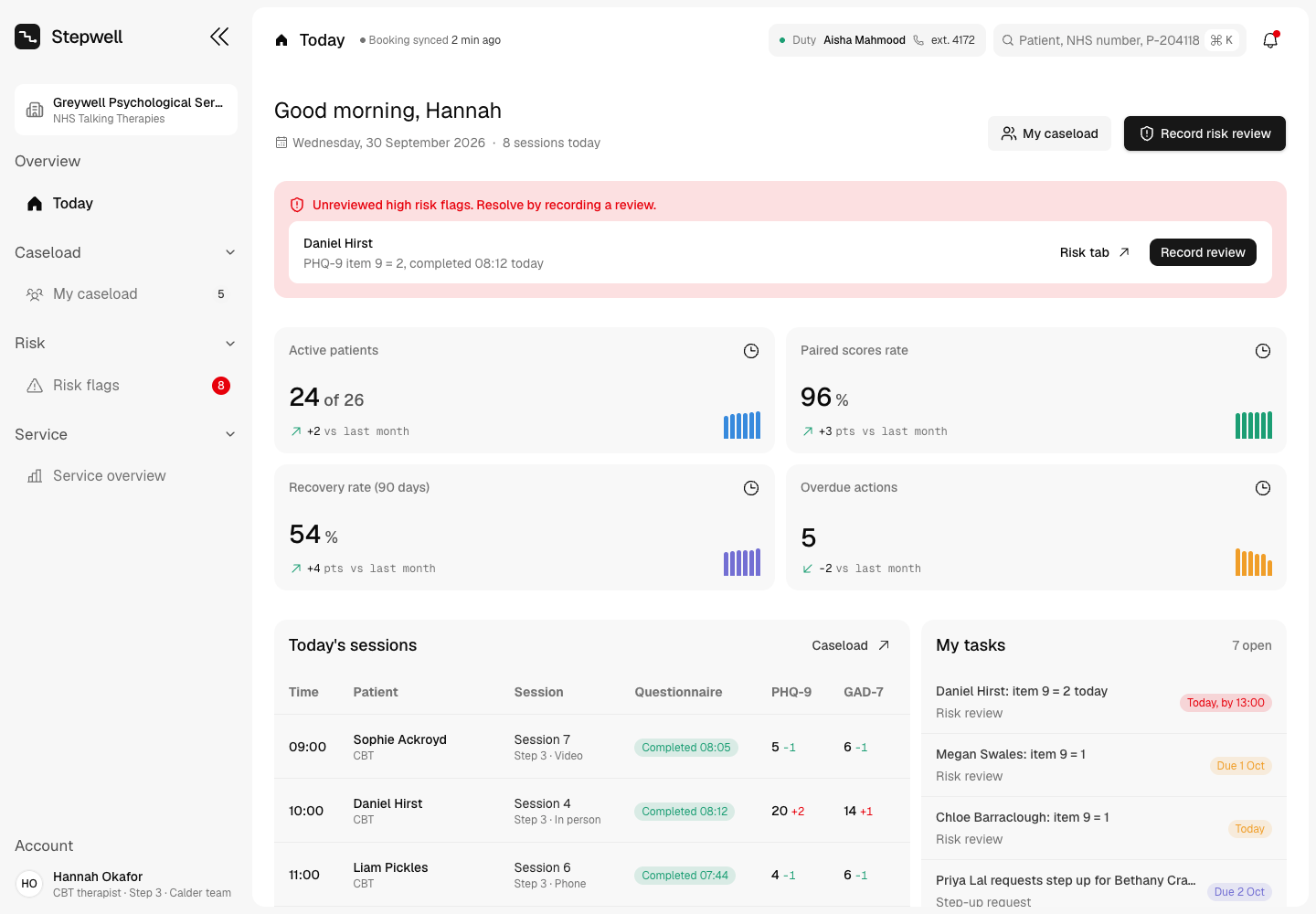
Stepwell - Care Team Dashboard for an NHS Talking Therapies Service
Designed and built a clickable care team dashboard for an NHS Talking Therapies provider in England: each clinician's caseload with risk flags and session-by-session outcome measures, a same-day risk review workflow, and a service view of waiting times and recovery rates against the national standards.
Enterprise Software Engineering - Human + AI
Contact Us
© 2026 - Copyright. All Rights reserved Oceanlab
Location
Global Headquarters
21 Merchant Road, 3rd Floor, Singapore 058267
Main corporate office and leadership operations
North America Office
548 Market Street, PMB 12345, San Francisco, CA 94104
Client operations and business development
India Office
402 Shivalik Shilp II, SG Highway, Ahmedabad 380015
Engineering and delivery center

Enterprise Software Engineering - Human + AI
Contact Us
Locations
Global Headquarters
21 Merchant Road, 3rd Floor, Singapore 058267
Main corporate office and leadership operations
North America Office
548 Market Street, PMB 12345, San Francisco, CA 94104
Client operations and business development
India Office
402 Shivalik Shilp II, SG Highway, Ahmedabad 380015
Engineering and delivery center
© 2026 - Copyright. All Rights reserved Oceanlab