Heatlamp - Forecast-Driven Crew Scheduling with Fair Workweek Rules Built In
Shift Scheduling for a US Burger Franchisee
Designed and built a clickable crew scheduling system for a franchisee running 41 quick-service burger restaurants in Oregon, Seattle and New York City: labour against sales by daypart, a week schedule that checks predictive scheduling, rest and minors' rules before it can be published, and a change log that prices every edit to a posted schedule.
Most of our work is under NDA. Per agreement, we can share the work but not the company details - all names and identifying information shown here have been changed.
Impact
Dashboard, week schedule with its shift editor and change impact panel, change log and premiums, compliance alerts with the alert detail panel, and team member detail with 7 tabs.
Latest end time and school-day hours for 14 and 15 year olds, the school-week limit, positions barred for that age band, rest under 10 hours, weekly overtime, stale availability and open shifts. Publish stays blocked while any blocking alert is open.
Oregon, Seattle and New York City, each versioned with its citation. A change to a posted shift is evaluated against the store's own rule set to show the premium it triggers.
One Beaverton store's full crew, 5 of them minors, plus 15 stores in 5 areas, 4 schedule weeks, 16 schedule changes and 16 compliance alerts.
The Problem
Fernwick's general managers built schedules in a spreadsheet every Thursday night, guessing labour from last year's sales. Swaps were agreed by text and never recorded, nobody logged whether a short-notice change owed predictability pay, and under-age crew working past curfew only showed up in payroll weeks later. Labour ran four to six points above the brand's target in slow dayparts while the lunch rush went short.
Our Solution
Heatlamp turns the sales forecast into required headcount by position and daypart, builds each store's week schedule around availability, skills and age, and checks it against the store's jurisdiction rule set and the minors' rules before it can be published. After posting, every change shows who it affects, whether consent is needed and the premium it creates, ready for payroll.
The Challenge: Scheduling Under Three Rulebooks
Fernwick's 41 stores sit under Oregon's statewide predictive scheduling law, Seattle's Secure Scheduling Ordinance and New York City's Fair Workweek Law, on top of federal and state child labor rules for a crew where around a fifth are aged 14 to 17.
Schedules Built From Memory
Labour was guessed from last year's sales and a manager's memory of who could work the grill. Schedules went up on the back-office wall and in a group chat, so nobody could compare scheduled hours with what the forecast actually needed.
Different Rules in Every City
Each law sets its own notice period, change premiums, rest between shifts, consent rules and duty to offer hours to existing staff first. Whether Seattle's ordinance even covers a franchisee depends on how employees are counted across the franchise.
Minors on the Kitchen Line
Under the FLSA, 14 and 15 year olds may generally work no more than 3 hours on a school day and 18 in a school week, only until 7 p.m. outside summer, and not on open-flame cooking or manual fryers. Oregon, Washington and New York add stricter limits and permits of their own.
Records Nobody Could Produce
A complaint to the Seattle or New York City labour agency would have needed proof of when each schedule was posted, which changes the worker agreed to in writing and which open hours were offered to existing staff. Fernwick had none of it.
Our Approach: From Scheduling Law to a Clickable Schedule
Spec and Rules Research
Mapped 9 user roles, from crew member and shift leader to HR compliance lead and payroll administrator, and 40 screens across the manager console, a mobile-first crew app and account activation. Defined the data model for stores, forecasts, labour standards, shifts, schedule changes, consents, minor records, timecards and payroll exports, and wrote down the rules the design follows: Oregon, Seattle and NYC predictive scheduling, FLSA child labor and overtime rules, state minor and break rules, and record keeping.
Clickable Demo on a Production UI Kit
Built 5 key screens on a production dashboard kit: the dashboard with labour %, premium pay, coverage and today by daypart, the week schedule with a live rules engine, fix buttons and a publish flow, the change log with premium status and consent records, compliance alerts with evidence and suggested fixes, and team member detail with the minors tab. Everything runs on seeded mock data.
What a Production Build Adds
Integration with the restaurant POS (such as Oracle MICROS Simphony, NCR Aloha or PAR Brink) for sales and punches, weather data, the HRIS, ADP or Paychex payroll export, push and Twilio SMS, Okta or Entra ID sign-on and school calendar imports. A schedule solver, the crew app, timecards, reports and settings, an append-only audit log, and counsel entering and verifying every statutory value before go-live.
Why It Works: The Rules Check Comes Before the Post
Nothing Publishes With a Blocking Alert
The alerts rail splits blocking rules from warnings, each with its citation and a fix button that edits the shift and re-checks it. Publish stays disabled until blocking alerts are cleared and asks for approval when labour is above the 27% threshold.
Every Change Prices Itself
Editing a published shift opens a change impact panel with the change type, notice given, rule and citation, who initiated it, whether written consent is needed and the premium estimate. In the change log, worker-requested swaps and call-outs show no premium, with the exemption cited.
Age Bands Instead of Birth Dates
Crew carry a 14-15, 16-17 or 18+ chip, never a date of birth. A minor's own tab shows the rule set applied, the employment certificate, hours against each limit and the date their rules change on a birthday.
Labour Against the Target Band
The dashboard tracks labour % against the 22% to 25% band, shows scheduled against required headcount per position for each daypart in amber or red, and lists what needs attention today, from call-outs to unconfirmed premiums.
Related case studies
View all: HR & payroll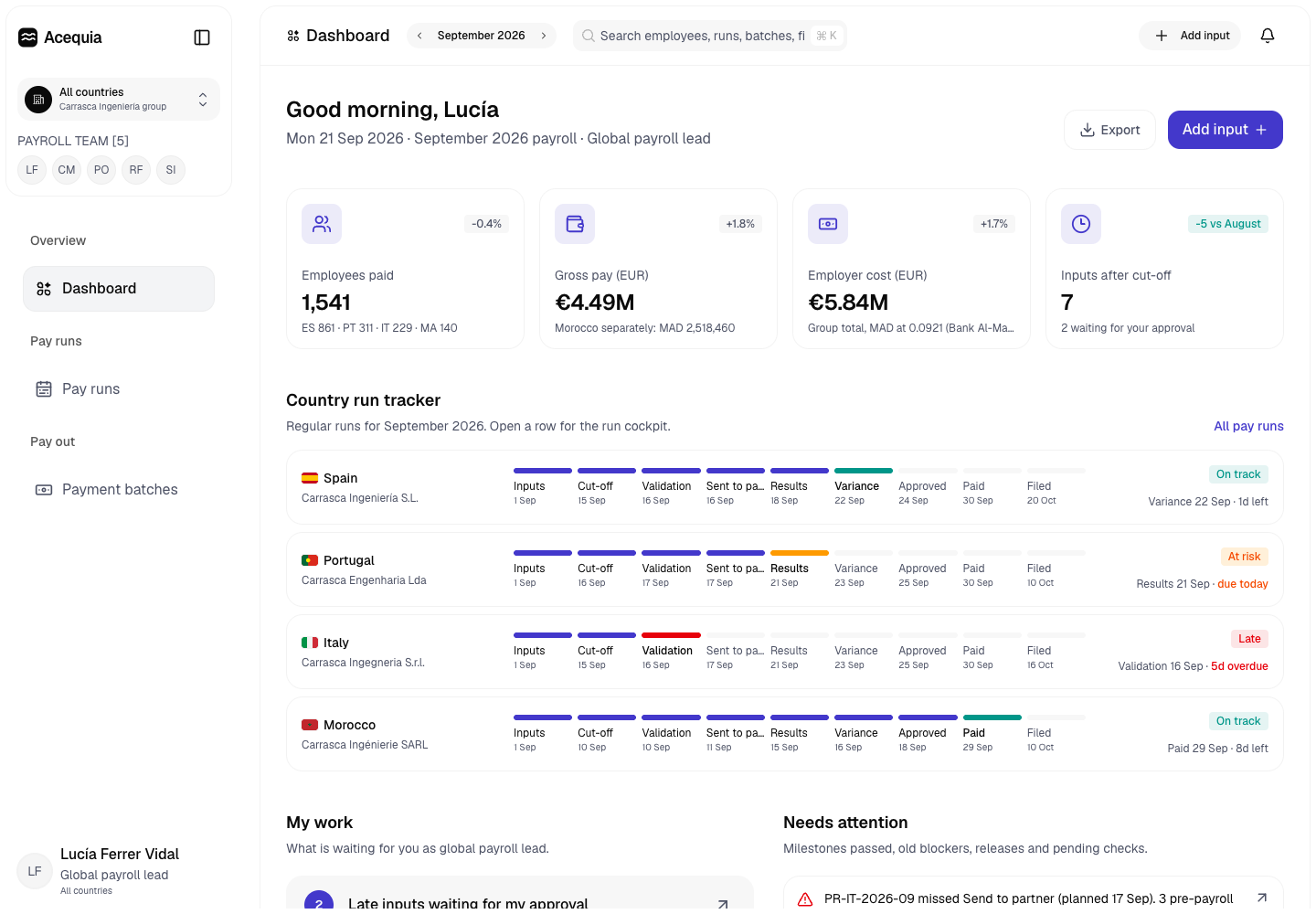
Acequia - Multi-country Payroll Console Over Four Local Engines
Designed and built a clickable payroll orchestration console for a Madrid engineering group paying about 1,550 people in Spain, Portugal, Italy and Morocco: one tracker for every country's run from input cut-off to paid and filed, validation and variance review before approval, and payment batches that only a second person can release.
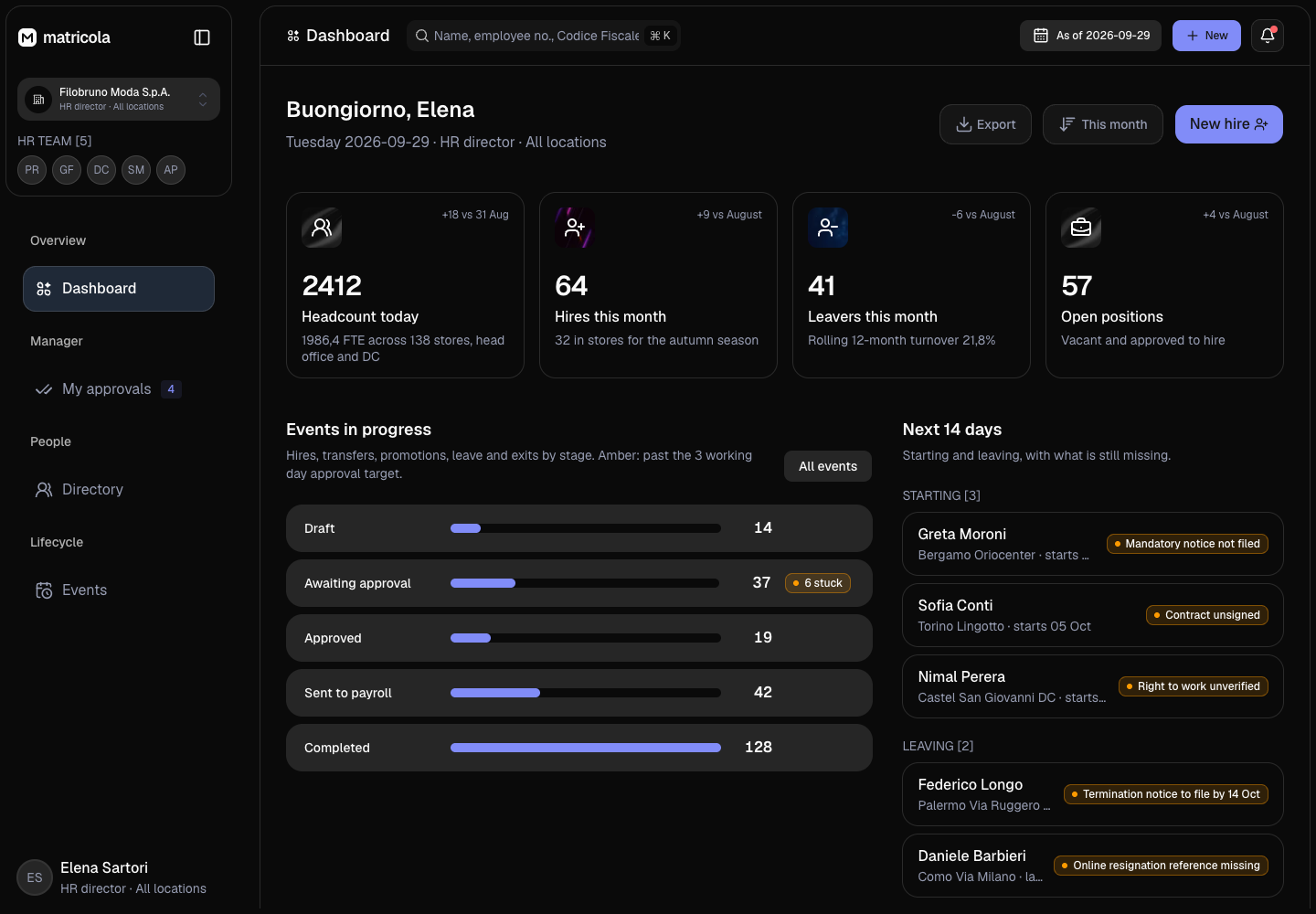
Matricola - Core HR System of Record with Effective-Dated History and Approvals
Designed and built a clickable core HR system for a Milan fashion retail chain with about 2,400 employees in 138 stores: every employee record with effective-dated history, lifecycle events from hire to exit with their approval chain, mandatory notices and payroll status, and a dashboard of what HR has to act on today.
Enterprise Software Engineering - Human + AI
Contact Us
© 2026 - Copyright. All Rights reserved Oceanlab
Location
Global Headquarters
21 Merchant Road, 3rd Floor, Singapore 058267
Main corporate office and leadership operations
North America Office
548 Market Street, PMB 12345, San Francisco, CA 94104
Client operations and business development
India Office
402 Shivalik Shilp II, SG Highway, Ahmedabad 380015
Engineering and delivery center

Enterprise Software Engineering - Human + AI
Contact Us
Locations
Global Headquarters
21 Merchant Road, 3rd Floor, Singapore 058267
Main corporate office and leadership operations
North America Office
548 Market Street, PMB 12345, San Francisco, CA 94104
Client operations and business development
India Office
402 Shivalik Shilp II, SG Highway, Ahmedabad 380015
Engineering and delivery center
© 2026 - Copyright. All Rights reserved Oceanlab