Fairlead - AI Resume Screening Where a Recruiter Makes Every Decision
Evidence-Based Graduate Screening for a New York Fintech
Designed and built a clickable AI-assisted screening tool for a New York City fintech's Technology Graduate Programme: blind resumes with quoted evidence against a short list of job-relevant criteria, a recruiter who advances, holds or rejects with reasons, a second review of risky rejects, and a candidate request inbox - with no auto-reject, no overall score and no ranking.
Most of our work is under NDA. Per agreement, we can share the work but not the company details - all names and identifying information shown here have been changed.
Impact
Dashboard, review queue, candidate review, second review and candidate requests. Every one of the 27 demo screenings, including the 3 in the alternative process, opens its own review.
Each criterion has its own status - found, partial, not found or unclear - with the quoted resume text behind it. The queue is always oldest application first, and only a person can reject.
A 10% random sample of rejects, a reject where the AI found every must-have, an "Other" reason, 2 or more overrides, or a parse quality warning. Nothing reaches the ATS until the second review is done.
3 graduate tracks with 13 criteria, 9 blind resumes, 9 second reviews, 13 candidate requests across all 6 request types and 10 staff users.
The Problem
Marbury Lane's graduate recruiters read 14,000 to 18,000 resumes a cycle by hand in the ATS, around 90 seconds each, with no shared criteria beyond a job description. An internal re-review of 400 rejected resumes found a second reviewer would have advanced about one in five, school names visibly swayed decisions, and nobody could show why a candidate was turned down. A vendor ranking tool trialled in 2024 was dropped: its 0 to 100 match score could not be explained, and counsel saw it as an automated employment decision tool with no bias audit behind it.
Our Solution
Fairlead sits beside the applicant tracking system. It parses each resume, hides identity details for blind review, and extracts quoted evidence against at most 5 job-relevant criteria per track. A recruiter checks that evidence against the resume, can change any status with a reason, and records the decision. Around that core sit second review of risky rejects, the candidate notice and request process, and a version record of the configuration every screening ran under.
The Challenge: AI Speed Without a Black Box
Screening thousands of graduate applications is exactly where AI helps, and exactly where US hiring law and fairness rules are strictest. The team wanted the speed of AI extraction without handing the decision, or the explanation, to a model.
Local Law 144 Applies Anyway
Because recruiters decide, Fairlead may fall outside New York City's definition of an automated employment decision tool, but counsel chose to treat it as in scope. That means an independent bias audit no more than a year old, a public summary and notice to candidates at least 10 business days before AI screening, with a way to ask for an alternative process or an accommodation.
Criteria That Stay Job-Related
Under Title VII every criterion must relate to the job. Each one is tied to a written job analysis section confirmed by a hiring manager, and school prestige, graduation year, employment gaps, address and affinity organisations can never become criteria.
Blind Review on Messy Resumes
Names, schools, photos, contact details and years must be hidden while degree level and subject stay visible. Two-column layouts and scanned pages confuse the parser, and a resume may volunteer criminal history or past pay, which New York rules keep out of screening.
Every Decision Has to Be Explained
Candidates can ask why they were turned down, ask to correct their data or appeal, and Colorado's new law adds notice, explanation and correction duties for Colorado residents applying to the remote data track. The answer must come from the recruiter's statuses, not the AI's, and arrive before its deadline.
Our Approach: From Hiring Rules to a Clickable Screening Tool
Spec and Rules Research
Mapped 9 staff roles plus candidates and an independent auditor, 34 screens across staff and public candidate pages, and the data model for programmes, versioned criteria sets, screening configurations, blind resumes, evidence, decisions, overrides, candidate requests and a separate compliance store for demographic data. Wrote down the rules the design follows: NYC Local Law 144, Title VII and the four-fifths rule, ADA accommodation, the Fair Chance Act, salary history limits and Colorado SB 26-189.
Clickable Demo on a Production UI Kit
Built 5 key screens on a production dashboard kit, signed in as a senior recruiter: the dashboard with pipeline and active configuration, the review queue with must-have chips and Pick up next, the split-screen candidate review with colour-matched evidence highlights and reject reason codes, second review with the AI and first reviewer side by side, and the candidate request inbox with an explanation draft built from the recruiter's statuses. All actions run on local state.
What a Production Build Adds
Integration with the ATS (such as Greenhouse or Workday Recruiting), a resume parser such as Textkernel, evidence extraction with Anthropic Claude via Amazon Bedrock, ServiceNow for accommodations, Okta sign-in and SendGrid email. Then the compliance pages for adverse impact monitoring and the bias audit export, the model registry and change requests, the criteria editor, the public candidate pages and an append-only audit log.
Why It Works: Evidence for a Person to Judge
Every Quote Is in the Resume
Evidence cards show 1 to 3 quotes and a one-line rationale per criterion, and clicking a highlight jumps between resume and card. A quote that fails the verbatim check is dropped and the status becomes unclear, so the recruiter knows to read the original.
Disagreeing With the AI Is Logged
The recruiter's status defaults to the AI's, and changing it asks for a short reason that is recorded as an override. Rejects need reason codes tied to must-haves marked not found, and the bar under the cards says plainly that the AI does not recommend a decision.
A Queue That Is Not a Ranking
The queue shows a screening reference, waiting time and must-have chips, never a name, school, photo or score. Coverage is a filter, not a sort order, and candidates who chose the alternative process arrive with no AI evidence at all.
Versions on Every Screening
Each review shows the configuration, criteria set, parser and prompt it ran under, and the dashboard shows the active configuration and the bias audit that covers it. Recruiters never see demographic data, even in aggregate; that stays with compliance.
Related case studies
View all: Recruiting & staffing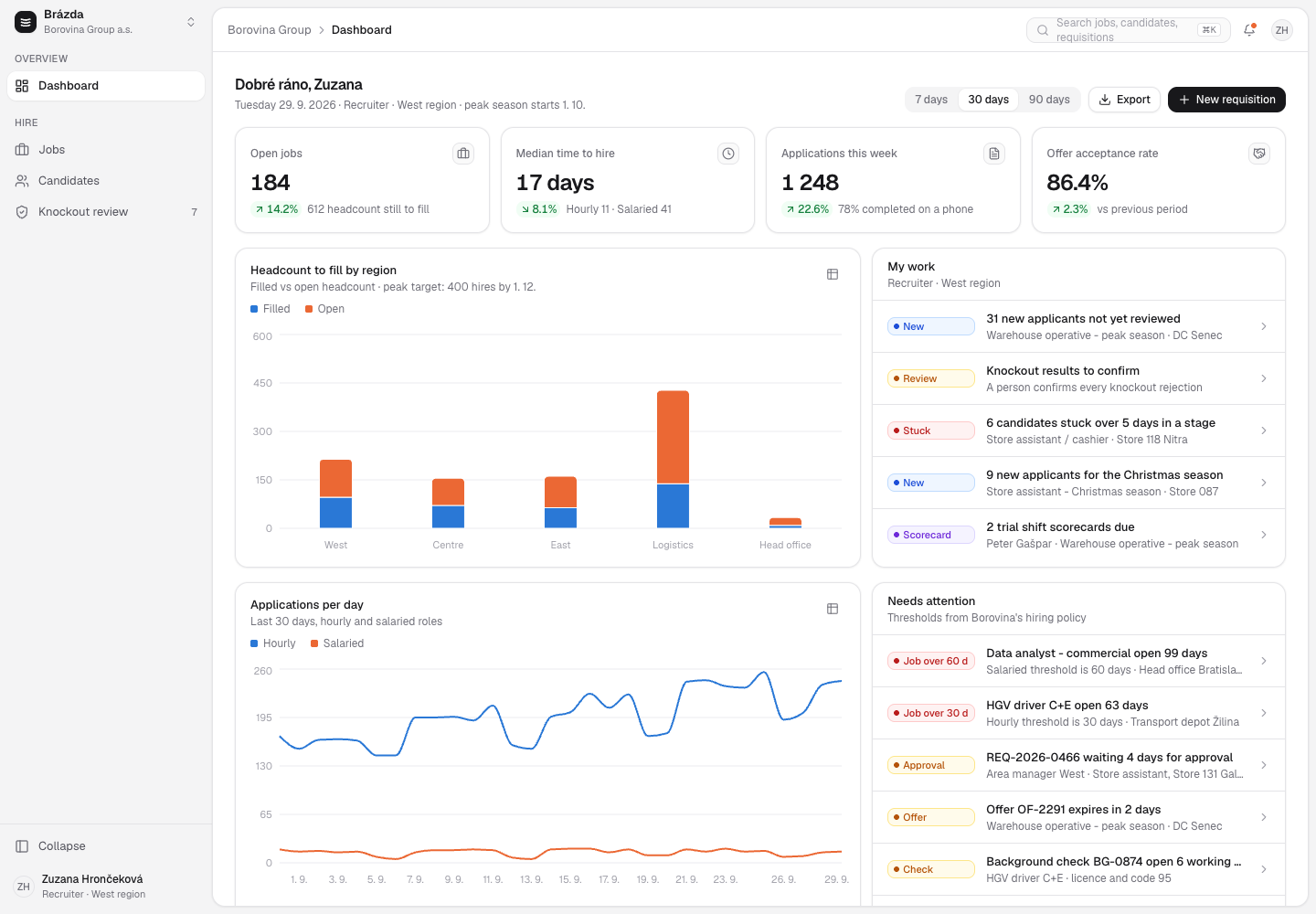
Brázda - Applicant Tracking System for High-Volume Hourly Hiring
Designed and built a clickable applicant tracking system for a Bratislava retail and logistics group that hires about 3,500 store, warehouse and driver staff a year: a hiring dashboard, jobs with pay ranges on every posting, a per-job pipeline board with no ranking or AI sort, candidate profiles with consent and retention, and a knockout review where a person confirms every rejection.
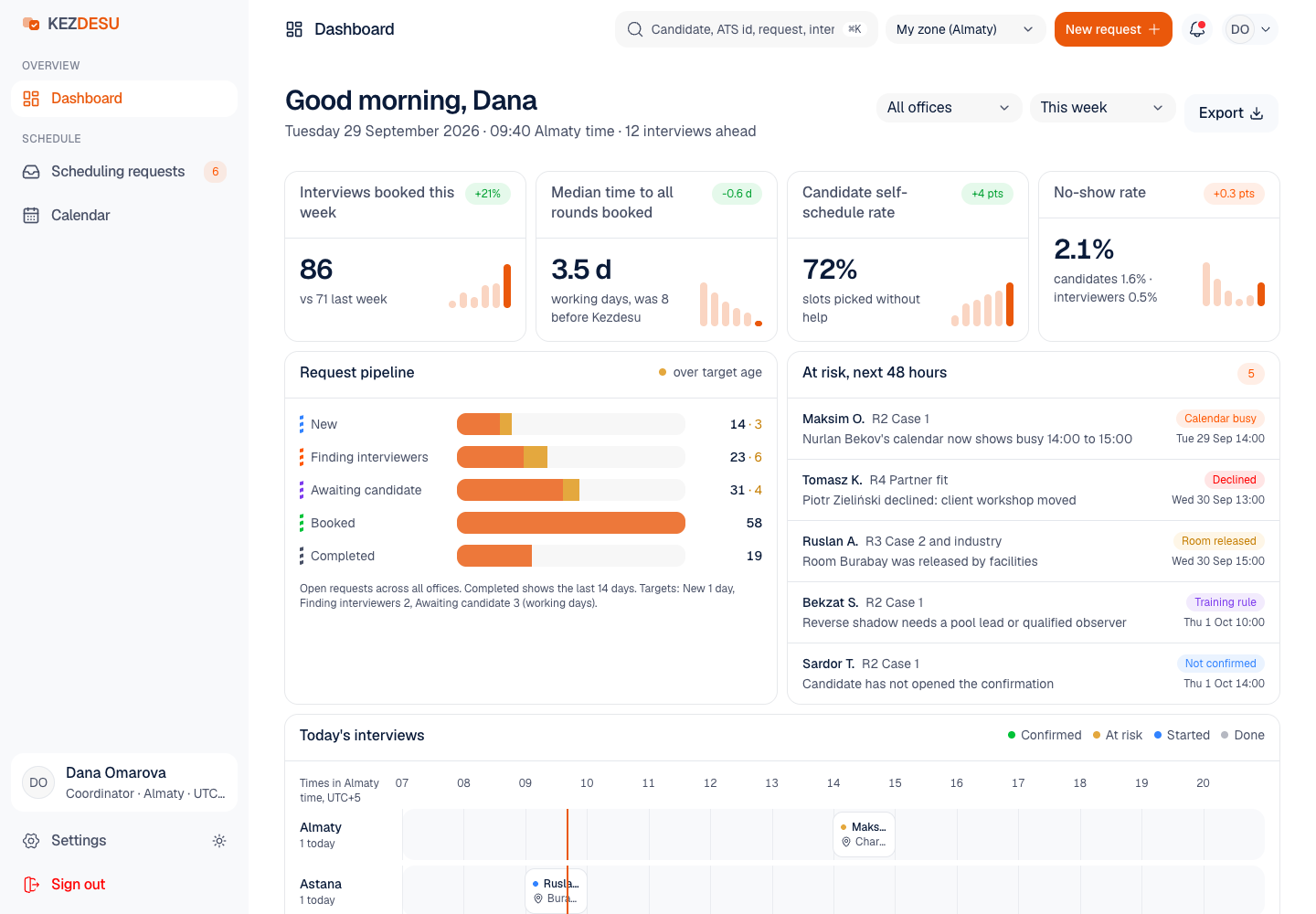
Kezdesu - Interview Scheduling Platform for Multi-Round Consulting Interviews
Designed and built a clickable interview scheduling platform for an Almaty consulting firm with six offices: a scheduling queue fed by the ATS, a workbench that builds interview panels from skill-based pools within load limits, free/busy availability in the candidate's own time zone, and interview detail with reminders, at-risk alerts and private adjustments.
Enterprise Software Engineering - Human + AI
Contact Us
© 2026 - Copyright. All Rights reserved Oceanlab
Location
Global Headquarters
21 Merchant Road, 3rd Floor, Singapore 058267
Main corporate office and leadership operations
North America Office
548 Market Street, PMB 12345, San Francisco, CA 94104
Client operations and business development
India Office
402 Shivalik Shilp II, SG Highway, Ahmedabad 380015
Engineering and delivery center

Enterprise Software Engineering - Human + AI
Contact Us
Locations
Global Headquarters
21 Merchant Road, 3rd Floor, Singapore 058267
Main corporate office and leadership operations
North America Office
548 Market Street, PMB 12345, San Francisco, CA 94104
Client operations and business development
India Office
402 Shivalik Shilp II, SG Highway, Ahmedabad 380015
Engineering and delivery center
© 2026 - Copyright. All Rights reserved Oceanlab