Busola - Skills Inventory and Developmental Assessment Platform
Skills Assessment Platform for a Romanian Engineering Employer
Designed and built a clickable skills inventory and assessment platform for a 22,000-person Romanian engineering and IT services company: a team skill matrix that separates confirmed from self-rated levels, a validation queue for managers, and reskilling programmes tracked against a target of moving 3,000 people into cloud, data and AI roles.
Most of our work is under NDA. Per agreement, we can share the work but not the company details - all names and identifying information shown here have been changed.
Impact
Console dashboard, team skill matrix, validation queue, reskilling programmes and programme detail with curriculum, participants and outcomes tabs. Picked from the 42 screens in the spec.
Not yet to Expert for every skill, held three ways: self-rated, manager-validated and assessed. A self-rating alone is never a confirmed level and always shows as a hollow marker.
Organisation views are aggregated only. Groups under 5 people are suppressed, so no one's individual result can be read from a unit or location report.
Reskilling programmes with 210 participants and RON budgets, a 12-person team rated on 8 skills against 9 role profiles, and 13 validation requests in waiting, done and returned states.
The Problem
Feleac wants to move about 3,000 of its 22,000 staff out of legacy application support, manual testing and on-premise infrastructure into cloud, data and machine learning roles. Its skills data lived in a CV database last updated at hiring, a spreadsheet per practice lead and unchecked certificate lists, so resourcing managers phoned around for a week to staff a bid and the reskilling target had no baseline.
Our Solution
Busola gives every employee a skill profile built from self-assessment, evidence, manager validation and practical assessments on one six-level scale. Managers validate claims one at a time against the skill's level descriptors and see their team's matrix, and L&D tracks reskilling programmes and organisation gaps from aggregated data only.
The Challenge: Measuring Skills Without Policing People
A skills inventory only works if employees trust it enough to rate themselves honestly. At Feleac that meant building an assessment platform that is useful to planners and managers without becoming a monitoring or performance tool.
No Trusted Source of Skills
Skills lived in three places and none was current. When a client asked for twelve Azure data engineers nobody could answer quickly, and L&D could not say whether bulk-bought cloud courses changed anyone's level.
Employees Wary of Being Tested
Some engineers feared a skills test would be used against them at review time. Feleac's policy is that results are developmental and never used on their own for pay, promotion or dismissal, and the product has to show that everywhere.
Employee Data Under GDPR and Romanian Law
Every claim and result is personal data under the GDPR, with Romania's Law 190/2018 adding conditions on processing and monitoring in employment. Consent is generally not a reliable basis between employer and employee, and the Labour Code requires evaluation criteria to be set out and employees consulted.
AI Treated as High Risk
The EU AI Act lists AI that evaluates workers as high risk. Feleac treats Busola's skill inference as if the deployer duties apply: human oversight, logging and informing workers. GDPR Article 22 rules out decisions based solely on automated processing.
Our Approach: From Skills Policy to a Clickable Platform
Spec and Rules Research
Mapped 8 user roles, from employee and people manager to L&D, workforce planner, calibration facilitator and DPO, and 42 screens across the employee app, manager view and console. Defined the data model for skills, role profiles, claims, evidence, validations, items, labs, blueprints, calibration and reskilling programmes, and the rules it follows: GDPR, Law 190/2018, the Labour Code, the EU AI Act and SFIA mapping.
Clickable Demo on a Production UI Kit
Built 5 key screens on a production dashboard kit: the console dashboard with coverage trend, reskilling target and top organisation gaps, the team skill matrix with solid confirmed and hollow self-rated cells coloured against the required level, the validation queue with level descriptors side by side, and reskilling programmes with curriculum, participants and outcomes. All actions run on local state.
What a Production Build Adds
Microsoft Entra ID sign-on, HR data from SAP SuccessFactors or Workday, LMS links over LTI 1.3 and xAPI, Credly and vendor certificate checks, hands-on cloud labs, EU-hosted AI skill inference with employee review, the employee app with assessments and gap reports, a full audit log, and a DPIA and employee consultation before launch.
Why It Works: Developmental by Design
Confirmed and Self-Rated Never Blur
In the team matrix a confirmed level is a solid cell and a self-rating alone is hollow, each coloured against the level the person's role needs. Readiness counts only confirmed levels, so a manager sees what is known and what is claimed.
Every Claim Decided on Its Own
The validation queue has no bulk validate. Each claim shows the self-rated, requested and current confirmed levels, the evidence the employee chose to link and the skill's descriptors for the levels around it, and validating at a different level needs a reason.
Aggregated by Default
The console works on aggregates for all units, with groups under 5 people suppressed. Individual participant rows in a reskilling programme are visible only to its owners in L&D.
Nothing Is Monitored
Busola reads only what the employee links and never scans email, chat, commits or repositories. AI-inferred skills stay suggestions until the employee accepts, corrects or rejects them, and assessments use no webcam proctoring or emotion analysis.
Related case studies
View all: Higher ed & corporate learning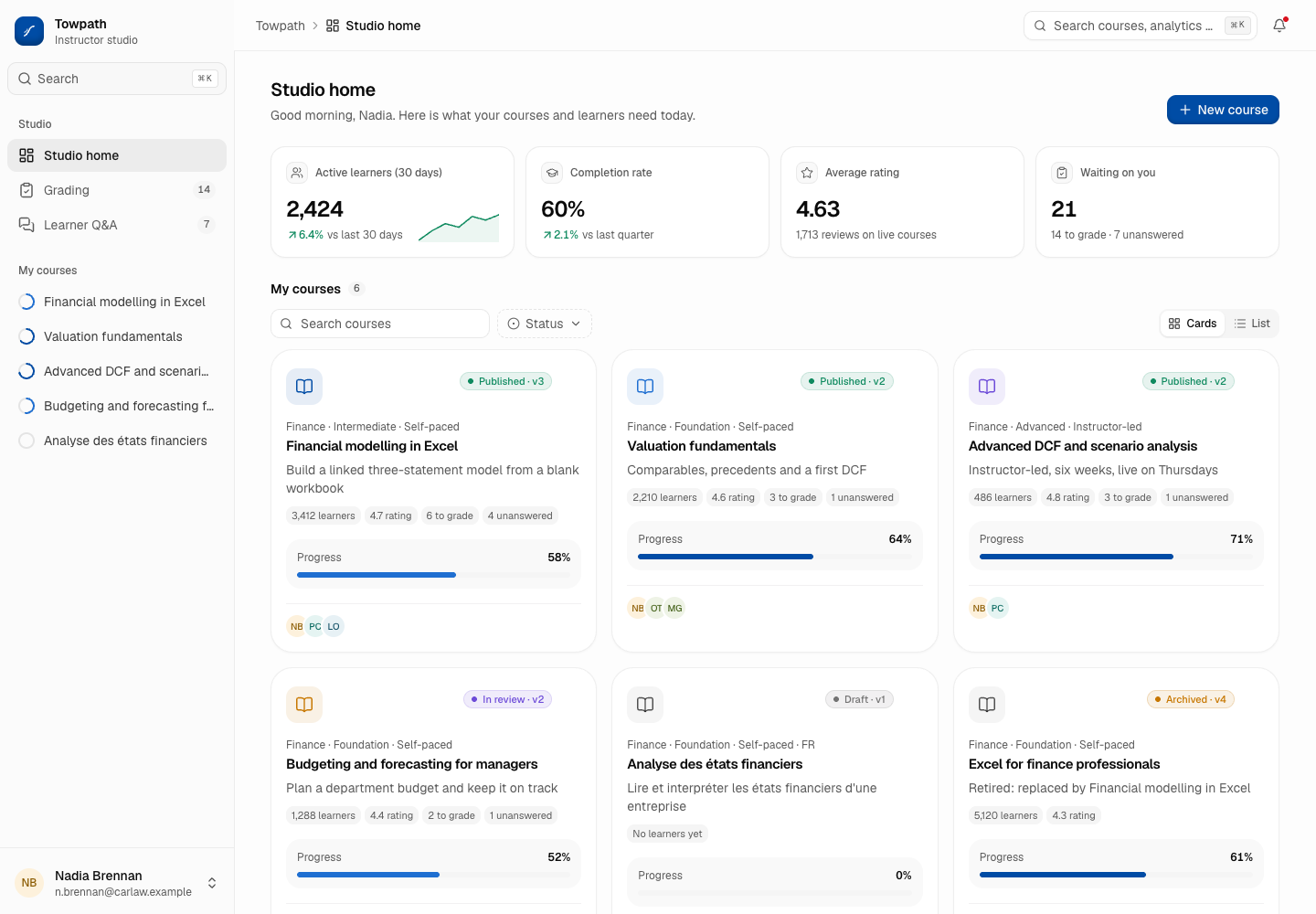
Towpath - Course Platform (LMS) for Professional Learning
Designed and built a clickable instructor studio for a Toronto provider of online finance, data and project management courses: course building with an accessibility gate before review, course analytics on aggregates only, a grading queue against a business-day target and learner Q&A across every course.
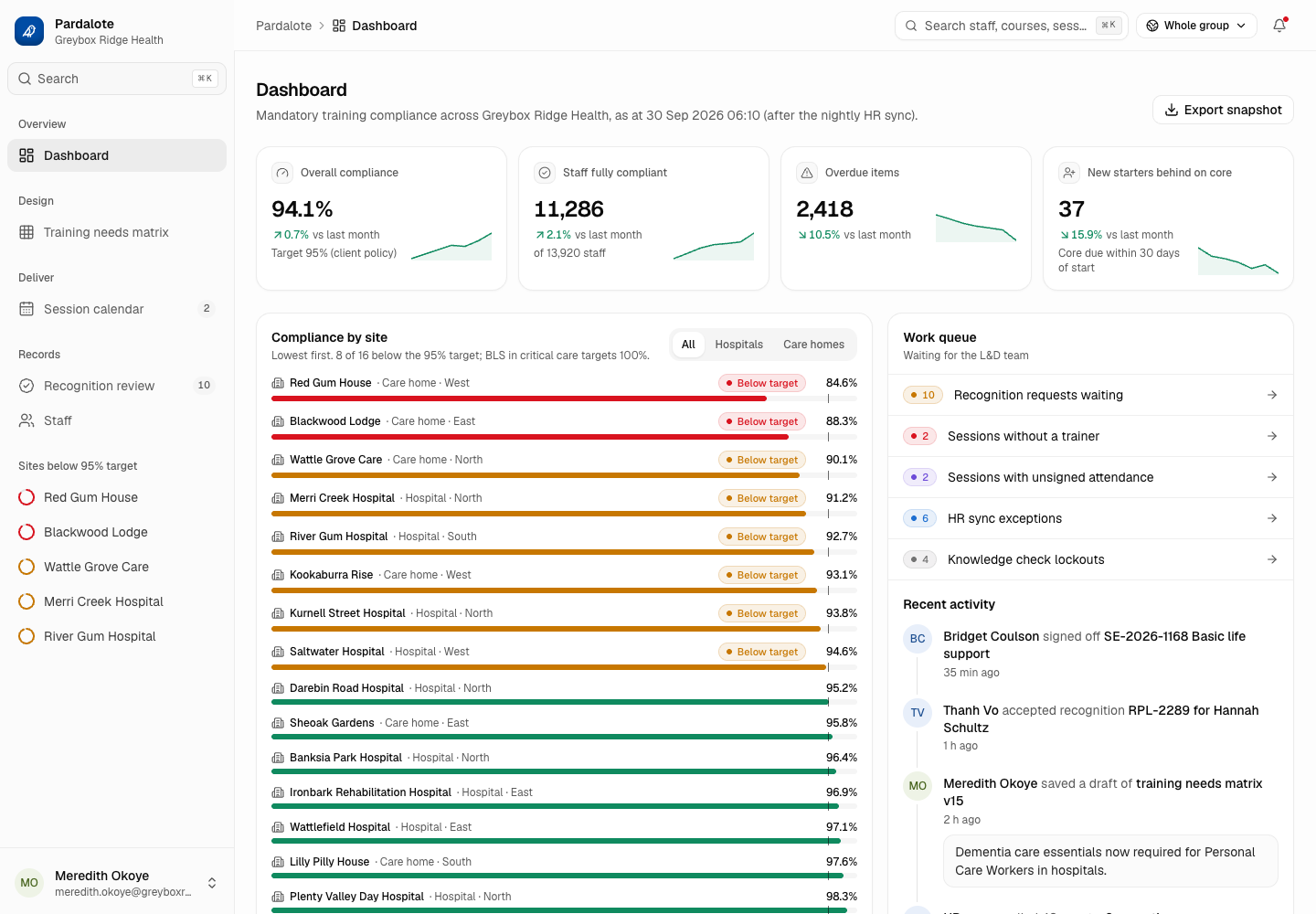
Pardalote - Mandatory Training Platform with Role-Based Requirements and Audit-Ready Evidence
Designed and built a clickable L&D console for a Melbourne hospital and aged care group with about 14,000 staff: a training needs matrix that decides who must do what, live compliance by site and course, a session calendar for face-to-face practicals, recognition of prior learning and a staff record that shows why every requirement exists.
Enterprise Software Engineering - Human + AI
Contact Us
© 2026 - Copyright. All Rights reserved Oceanlab
Location
Global Headquarters
21 Merchant Road, 3rd Floor, Singapore 058267
Main corporate office and leadership operations
North America Office
548 Market Street, PMB 12345, San Francisco, CA 94104
Client operations and business development
India Office
402 Shivalik Shilp II, SG Highway, Ahmedabad 380015
Engineering and delivery center

Enterprise Software Engineering - Human + AI
Contact Us
Locations
Global Headquarters
21 Merchant Road, 3rd Floor, Singapore 058267
Main corporate office and leadership operations
North America Office
548 Market Street, PMB 12345, San Francisco, CA 94104
Client operations and business development
India Office
402 Shivalik Shilp II, SG Highway, Ahmedabad 380015
Engineering and delivery center
© 2026 - Copyright. All Rights reserved Oceanlab