Beffroi - Proctored Exams and Credential Platform with Human Integrity Review
Exam and Credential Platform for a Brussels Certification Body
Designed and built a clickable staff console for a Brussels body that certifies procurement and supply chain professionals: an eligibility queue with rule checks per route, an application review with evidence and referee, and a proctoring review queue where flags are prompts for a human, never an automatic fail.
Most of our work is under NDA. Per agreement, we can share the work but not the company details - all names and identifying information shown here have been changed.
Impact
Dashboard, eligibility applications queue, application review, proctoring review queue and session review. Every one of the 22 demo applications and 16 flagged sessions opens its own review screen.
SPP by experience (24 months), degree plus experience (12 months), member route (18 months and active membership) and SSCP (60 months, 36 in management). Qualifying months are months worked times the share of relevant work.
7 flag types from software, check-in agents and centre proctors. A review can only be recorded once each flag has a verdict, and only an integrity panel can void a result or impose a sanction.
From 20 countries, with 22 applications across 3 queue tabs, 16 flagged online and centre sessions, 4 eligibility routes and 8 staff users in 6 roles.
The Problem
SIPS grew from a paper exam in two Belgian cities to about 40,000 exams a year in more than 30 countries, and its tools did not keep up. Eligibility evidence arrived by email, accommodations were agreed in inbox threads nobody could find on exam day, the item bank lived in spreadsheets, and the proctoring vendor sent flags as a CSV. Some candidates were failed on a flag alone, which led to complaints and a finding that the process lacked a proper hearing.
Our Solution
Beffroi covers the candidate journey from eligibility to booking, the exam, results, appeals and the credential, and the certification body's own work behind it. The build shows the staff console: an eligibility queue that checks each route's rules against declared roles and evidence, and an integrity queue where reviewers judge every flag against the recording and the candidate's approved adjustments.
The Challenge: High-Stakes Exams, Fair Decisions
A professional credential is only worth something if the exam is secure and every decision about a candidate can be defended. Beffroi has to keep exam content safe, treat health and biometric data as special category data, and make sure no candidate loses a result to software alone.
Eligibility Judged From Loose Evidence
Each credential has its own routes, from experience only to degree or membership routes, with minimum months of relevant work and, for SSCP, management experience. Officers read employer letters and CVs from email and worked out the months by hand.
Flags Treated as Findings
GDPR Art. 22 generally gives people the right not to be subject to a decision based solely on automated processing. Proctoring software can only raise flags; a human reviewer has to look at the evidence, and a misconduct outcome needs a hearing by people who did not investigate.
Special Category Data in the Flow
Accommodation requests carry health data and optional face matching is biometric data, both under GDPR Art. 9. Reviewers need to know that a candidate may use a screen reader or take rest breaks, without ever seeing the diagnosis behind it.
Candidates and Centres in Many Countries
Online and test centre sessions run across time zones, with recordings and identity checks handled by processors outside SIPS. Deadlines are SIPS service targets in Belgian working days, and transfers outside the EEA need a GDPR Chapter V safeguard.
Our Approach: From Certification Rules to a Clickable Console
Spec and Rules Research
Mapped 16 roles, from candidate and item writer to integrity panel member and public verifier, and 51 screens across the staff console, candidate portal, test centre portal and a public verification page. Defined the data model for candidates, applications, items, forms, sessions, cases, results and credentials, and wrote down the rules the design follows: GDPR and the Belgian data protection law of 2018, the Nowak ruling on exam answers, ISO/IEC 17024, the AERA, APA and NCME testing standards and a modified Angoff standard setting method.
Clickable Demo on a Production UI Kit
Built 5 key staff screens on a production dashboard kit: the dashboard with 4 KPIs, booked seats for the next 14 days, work queues by role and items past SIPS targets, the applications queue with waiting-time colours, the application review with a roles timeline, evidence viewer, rule checks, referee and decision modals, the proctoring review queue, and the session review with webcam and screen on one timeline, per-flag verdicts and a recommendation. All actions run on local state.
What a Production Build Adds
Integration with a remote proctoring provider (such as Proctorio or Meazure Learning), test centre networks like Pearson VUE, identity checks through Veriff or Onfido, Mollie or Adyen payments with Bancontact and iDEAL, Open Badges credentials through Credly or Accredible, QTI 3.0 item import and export, and EU-region storage for recordings. Staff SSO with Microsoft Entra ID, an audit log of every decision, and the remaining screens: item bank, form assembly, standard setting, cases, results release, credentials, the candidate and centre portals and public verification.
Why It Works: Humans Decide, the Screen Shows Why
Flags Are Prompts, Not Findings
The review queue says so on screen. Each flag gets a verdict of explained, not relevant or concern, and the recommendation is no concern, technical issue with a free retake, or refer to case. Results stay held until a human has looked.
Allowed Behaviour Is Visible
Approved adjustments such as 25% extra time, rest breaks or a screen reader appear next to the evidence, and a flag raised during an approved break is marked as permitted behaviour. Reviewers see the adjustment, never the health document behind it.
Eligibility Checked Rule by Rule
The application review turns each declared role into qualifying months, checks every rule of the route version fixed at submission, and shows the referee's status. Decisions use reasons from a fixed list, so outcomes can be reported and appealed.
Bias and Access Kept in Check
Candidate names stay hidden in the review queue until a session is opened. Recordings and documents carry the viewer's name as a watermark, every view is logged, and a reviewer can ask for a second reviewer before recording a decision.
Related case studies
View all: Higher ed & corporate learning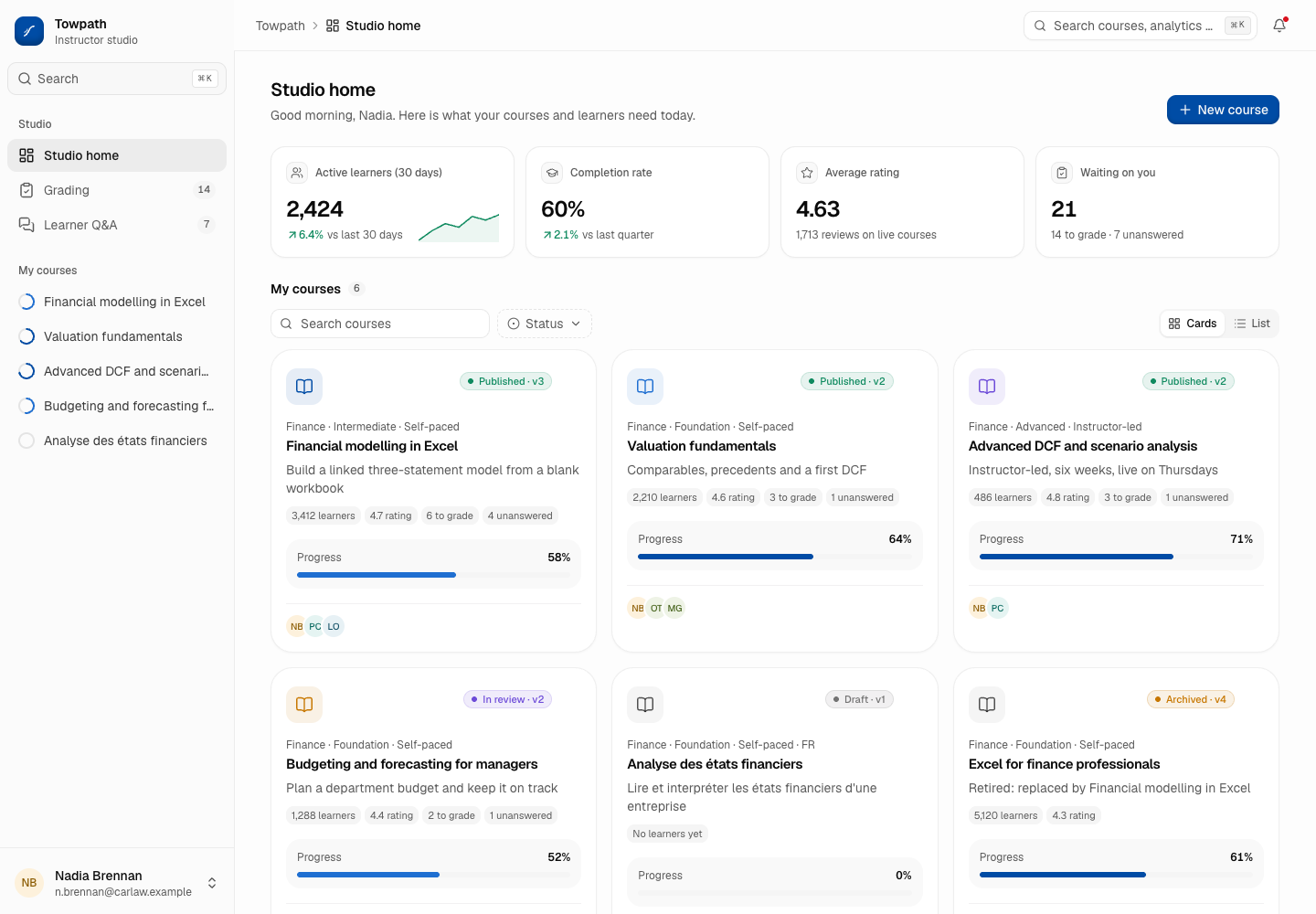
Towpath - Course Platform (LMS) for Professional Learning
Designed and built a clickable instructor studio for a Toronto provider of online finance, data and project management courses: course building with an accessibility gate before review, course analytics on aggregates only, a grading queue against a business-day target and learner Q&A across every course.
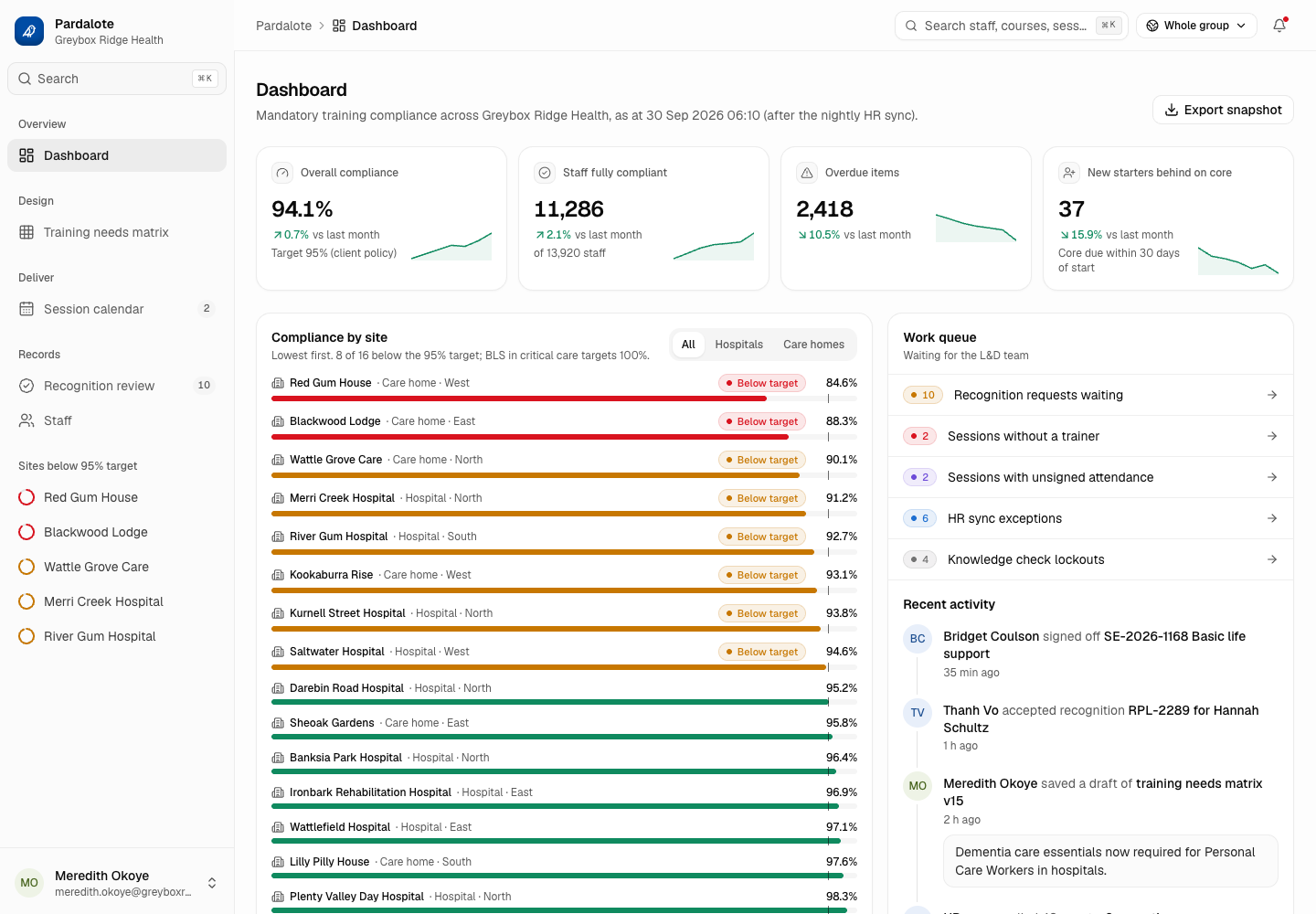
Pardalote - Mandatory Training Platform with Role-Based Requirements and Audit-Ready Evidence
Designed and built a clickable L&D console for a Melbourne hospital and aged care group with about 14,000 staff: a training needs matrix that decides who must do what, live compliance by site and course, a session calendar for face-to-face practicals, recognition of prior learning and a staff record that shows why every requirement exists.
Enterprise Software Engineering - Human + AI
Contact Us
© 2026 - Copyright. All Rights reserved Oceanlab
Location
Global Headquarters
21 Merchant Road, 3rd Floor, Singapore 058267
Main corporate office and leadership operations
North America Office
548 Market Street, PMB 12345, San Francisco, CA 94104
Client operations and business development
India Office
402 Shivalik Shilp II, SG Highway, Ahmedabad 380015
Engineering and delivery center

Enterprise Software Engineering - Human + AI
Contact Us
Locations
Global Headquarters
21 Merchant Road, 3rd Floor, Singapore 058267
Main corporate office and leadership operations
North America Office
548 Market Street, PMB 12345, San Francisco, CA 94104
Client operations and business development
India Office
402 Shivalik Shilp II, SG Highway, Ahmedabad 380015
Engineering and delivery center
© 2026 - Copyright. All Rights reserved Oceanlab