Batey - Sales Enablement Hub with Medical, Legal and Regulatory Review
Sales Enablement Hub for a Medical Device Maker
Designed and built a clickable sales enablement hub for a San Juan medical device manufacturer: one library of approved sales material per product, market and language, a medical, legal and regulatory (MLR) review workspace with signed approvals, and expiry and IFU checks that pull outdated material before reps can use it.
Most of our work is under NDA. Per agreement, we can share the work but not the company details - all names and identifying information shown here have been changed.
Impact
Dashboard, content library, content detail with 6 tabs, review queue and the split-screen review workspace. Every one of the 28 demo content items and 13 review jobs opens its own page.
Medical, legal and regulatory review every piece, plus a market regulatory reviewer for each Latin American market. Each signature records the signer, time, method and meaning, and Release stamps an approval code per market.
Approved material expires 24 months after approval, turns amber inside 60 days and red inside 14, and can only be extended through a re-review. Review jobs run against a 5 working day SLA, or 10 when they propose new claims.
28 content items in English and Spanish for 6 products in 3 families, 18 claims with their references, 13 review jobs across every status, 10 reviewer annotations and 24 users in 6 markets.
The Problem
Tabonuco's sales material lived in a shared drive, three SharePoint sites and the reps' own email. Reps in Mexico kept presenting a Sella deck with a US-only indication, and a Rinde brochure was still handed out eight months after the IFU it quoted had been revised. Medical, legal and regulatory review ran on emailed PDFs with comments in four places, so nobody could prove which version was approved, by whom, or when approval ran out.
Our Solution
Batey holds every piece of material Tabonuco's roughly 180 field sellers may use, and releases it only after medical, legal and regulatory review for the right product, market and language. Content owners see each item's versions, claims and expiry, reviewers annotate and sign in one workspace, and material that quotes a superseded IFU or nears expiry is flagged before it reaches a clinician.
The Challenge: Promoting Devices Inside Their Labeling
Tabonuco sells peripheral balloon catheters, a vascular closure device and a wound therapy system in the United States, Puerto Rico, Mexico, Colombia, Chile and the Dominican Republic. Material used to promote a device is generally treated as labeling, so every slide has to match what each market's regulator cleared or approved.
Indications That Differ by Market
A 510(k) clearance and a PMA approval each come with a specific indications for use statement, and COFEPRIS, INVIMA, the ISP and DIGEMAPS register their own. A claim that is on-label in the US can be off-label in Mexico, so a US approval can never release a piece there.
Approvals Nobody Could Prove
Review comments sat in emails and PDFs in four places. The design had to support Part 11-style controls in case Tabonuco's quality team treats MLR records as FDA-required: unique accounts, a time-stamped audit trail and signatures that record who signed, when and what the signature means.
Labeling That Changes Under the Content
Instructions for use are controlled documents in Tabonuco's quality system, and they get revised. Any deck or brochure quoting an older revision has to be found and re-reviewed, and approved material has to expire on time rather than circulate for years.
Field Use That Must Be Traceable
Journal reprints given to clinicians are generally reportable under Open Payments, gifts can raise Anti-Kickback Statute issues, and Tabonuco follows the AdvaMed Code. Answering which clinicians received reprints last year took three weeks and was still incomplete.
Our Approach: From Promotion Rules to a Clickable Hub
Spec and Rules Research
Mapped 12 user roles, from territory managers and clinical specialists to MLR reviewers, medical affairs, compliance and the clinician who opens a shared link without logging in. Planned 41 screens across the staff console, an offline tablet app for reps and a public recipient page, and the data model for indications per market, claims, content versions, review jobs, shares, transfers of value, certifications and devices. Wrote down the rules the design follows: FDA promotional labeling, 510(k) and PMA indications, controlled IFUs, Latin American registrations, the AdvaMed Code, Open Payments, the Anti-Kickback Statute and market privacy laws.
Clickable Demo on a Production UI Kit
Built 5 key screens on a production dashboard kit: the dashboard with 4 KPIs, review pipeline, my work and a needs attention list; the content library with status pills, 7 filters, expiry colour bands, a quick view panel and bulk re-review or withdraw; content detail with versions, version compare, claims, review history, translations, usage and activity; the review queue with SLA tracking; and the review workspace with numbered claims, annotations, checklist, signing and release. All actions run on local state.
What a Production Build Adds
The 13-screen offline rep app with presenter mode, tracked shares and a 14-day sync lock, the clinician page, training and certification, coaching, guardrail flags, transfers of value and the audit log, in English and Spanish. Integrations with the CRM (such as Salesforce), the NPPES NPI Registry, document control for IFUs (such as Greenlight Guru), Microsoft Entra ID sign-in, Jamf or Intune for tablets, S3 and CloudFront, Mux or Vimeo, Postmark or SendGrid and the aggregate spend vendor.
Why It Works: Nothing Reaches the Field Unreviewed
Claims Linked to Their Evidence
Every claim comes from a claims library, tied to the product's indication in each market and to references with page and figure. In the review workspace each claim is numbered and highlighted on the slide, and reviewers mark it supported, needs change or not allowed.
Approval Is Per Market, Never Inherited
Approval codes such as TMD-US-SEL-0412 v3 carry the market, and Latin American markets add their own regulatory reviewer. The demo's withdrawn Mexico edition of the Sella deck shows why: it carried the US indication, which the COFEPRIS registration does not include.
Drift Caught Before Reps See It
The dashboard lists material quoting a superseded IFU revision, live items expiring within 14 days with no re-review started, jobs over SLA, reps using a product they are not certified on and tablets that have not synced. Extend expiry stays disabled until a re-review completes.
Signatures That State Their Meaning
Approve opens a signing panel with SSO re-authentication or a password and the meaning of the signature, such as Approved as medically accurate. Approve with changes lets the coordinator make small fixes without another round, Request changes and Reject need a reason, and Release only unlocks once every role has approved.
Related case studies
View all: Sales & CRM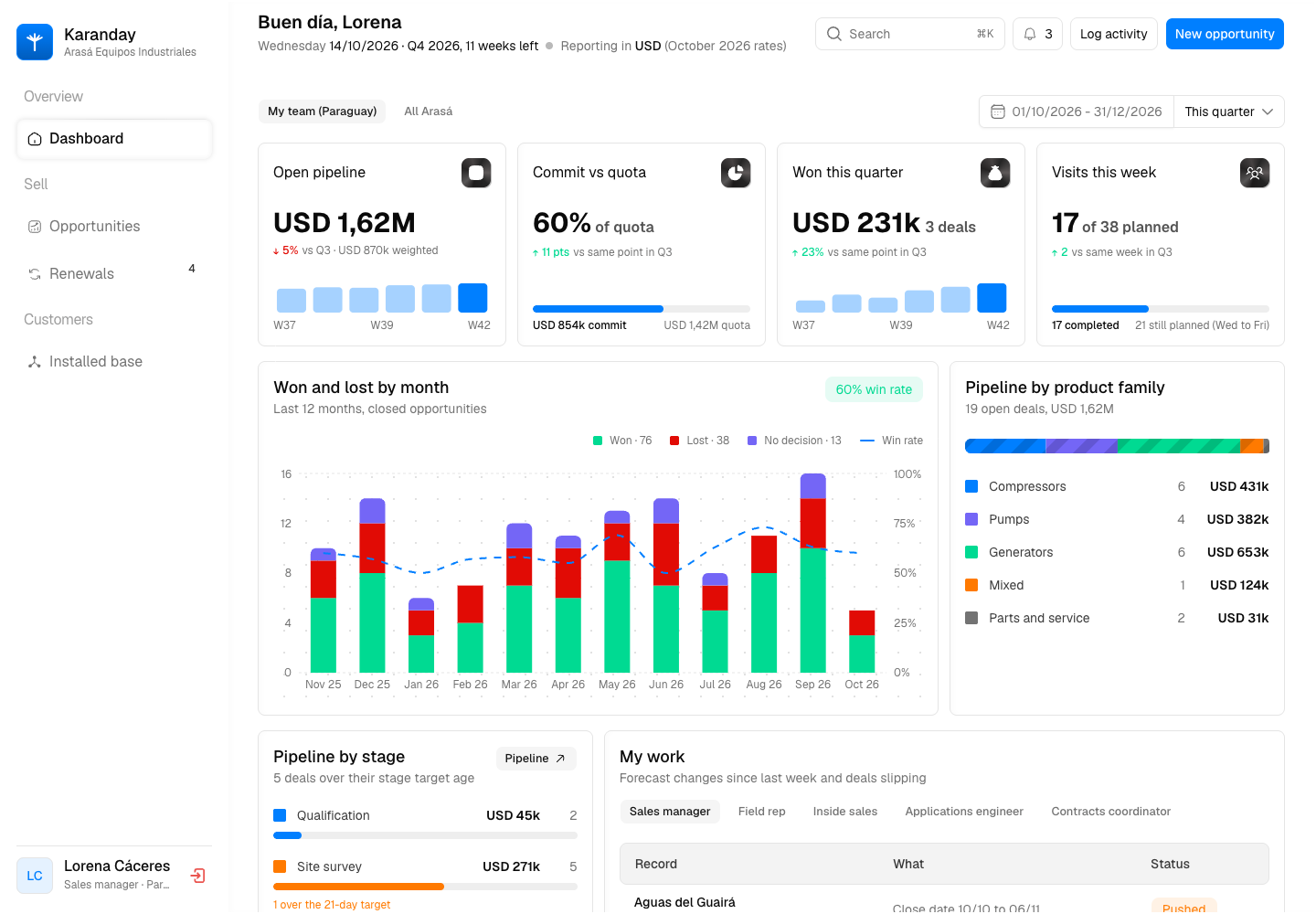
Karanday - Custom CRM for Industrial Equipment Sales and Service Renewals
Designed and built a clickable CRM for an Asunción distributor of compressors, pumps and generators selling across Paraguay and southern Brazil: a pipeline whose stages follow how capital equipment is really sold, opportunity detail with technical sizing and CPQ quote hand-offs, a service contract renewals pipeline and an installed base that flags units due for replacement.
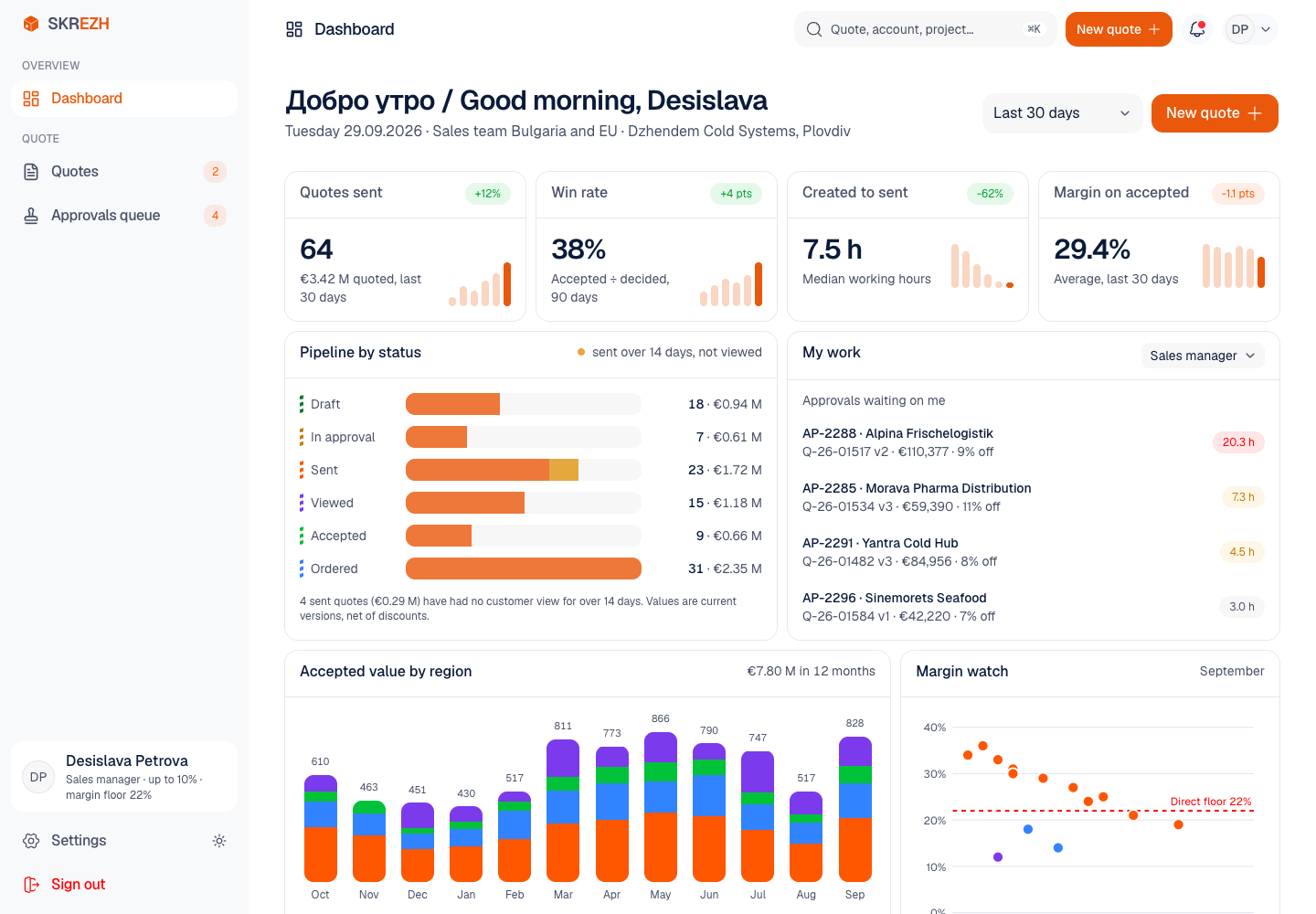
Skrezh - Configure, Price and Quote Platform for Modular Cold Rooms
Designed and built a clickable configure-price-quote platform for a Plovdiv maker of modular cold rooms and refrigeration units: a configurator that sizes the cooling and checks safety rules as you edit, a quote workspace with live pricing, margin and VAT treatment, and an approvals queue driven by a fixed discount matrix.
Enterprise Software Engineering - Human + AI
Contact Us
© 2026 - Copyright. All Rights reserved Oceanlab
Location
Global Headquarters
21 Merchant Road, 3rd Floor, Singapore 058267
Main corporate office and leadership operations
North America Office
548 Market Street, PMB 12345, San Francisco, CA 94104
Client operations and business development
India Office
402 Shivalik Shilp II, SG Highway, Ahmedabad 380015
Engineering and delivery center

Enterprise Software Engineering - Human + AI
Contact Us
Locations
Global Headquarters
21 Merchant Road, 3rd Floor, Singapore 058267
Main corporate office and leadership operations
North America Office
548 Market Street, PMB 12345, San Francisco, CA 94104
Client operations and business development
India Office
402 Shivalik Shilp II, SG Highway, Ahmedabad 380015
Engineering and delivery center
© 2026 - Copyright. All Rights reserved Oceanlab