Quire - Information Rights Platform for FOI, EIR and Subject Access Requests
Public Records Requests for an English County Council
Designed and built a clickable information rights platform for an English county council: triage that classifies each request as FOI, EIR or SAR, a statutory clock counted in UK working days, a request log and detail page with the clock always in view, and a redaction workspace where every redaction carries its exemption code.
Most of our work is under NDA. Per agreement, we can share the work but not the company details - all names and identifying information shown here have been changed.
Impact
Dashboard, triage, request log, request detail with 6 tabs and the redaction workspace. Each of the 28 demo requests opens its own detail page, and 3 records open for redaction.
Counted from receipt, skipping weekends and every UK bank holiday, with 40 days after an extension and one calendar month for SARs. Clarification, fee and ID pauses show on every request.
7 FOIA exemptions, 4 EIR exceptions and 1 DPA 2018 exemption. The picker only offers codes for the request's regime, so an FOI code cannot be used on an EIR request.
7 waiting in triage, 15 FOI, 4 EIR and 2 SAR, with 14 collected records, 16 redactions, 18 staff users across 11 departments and 20 requesters.
The Problem
Wealdmoor's information governance team ran about 2,400 FOI and EIR requests and 380 subject access requests a year from a shared mailbox and a 14-tab spreadsheet. Deadlines were counted by hand, departments were chased by email, and redaction was done with black boxes in a PDF editor that twice left the text underneath selectable. In 2025 only 81% of FOI requests were answered within 20 working days and the ICO opened monitoring on the council's timeliness.
Our Solution
Quire takes a request from the web form, email, post or WhatDoTheyKnow to the response and the disclosure log. Triage suggests FOI, EIR, SAR, a split or business as usual with the matching rules highlighted, the clock is computed from the working days calendar, and redactions are made in the product with the exemption code printed on each one before they are burned in.
The Challenge: Three Regimes, One Clock Each
An English council answers requests under the Freedom of Information Act, the Environmental Information Regulations and UK GDPR at the same time. Each has its own deadline, its own exemptions and its own review route, and the same letter can fall under more than one.
The Right Regime From Day One
Environmental information such as flooding, planning, highways and waste falls under the EIR, a request for your own file is a SAR under UK GDPR, and 'when is my bin collected' is not a request at all. One email can ask for both personal data and a policy, and needs splitting before any clock starts.
Deadlines Counted by Hand
FOIA and the EIR give 20 working days excluding weekends and UK bank holidays, the EIR allows 40 for complex requests, and a SAR has one calendar month. Clarification, fees notices and identity checks pause or restart the clock, and these were often counted wrongly.
Records Scattered Across Departments
Information owners in Highways, Children's Services or Finance supplied records as forwarded email threads and zip files, with no shared target date and no record of where anyone had searched to support a 'not held' answer or the £450 cost limit.
Redaction That Leaked
Every redaction has to name the exemption relied on and be burned in, removing text, hidden layers, comments and metadata. Qualified exemptions such as section 43 need a public interest test, and SAR records must stay hidden from staff without SAR access.
Our Approach: From Information Rights Law to a Clickable Platform
Spec and Rules Research
Mapped 12 roles from IG officer and information owner to the section 36 qualified person, internal reviewer and requester, and 40 screens: 32 for staff and 8 public pages built to GOV.UK Design System patterns. Wrote down the rules the design follows: FOIA sections 10, 12, 14, 17 and 45, the Fees Regulations 2004, the EIR 2004, UK GDPR Article 15, DPA 2018 exemptions, the Data (Use and Access) Act 2025 and the public sector accessibility regulations.
Clickable Demo on a Production UI Kit
Built 5 key screens on a production dashboard kit: the dashboard with KPI cards, clock strip and needs attention list, triage with the suggested classification, validity check and duplicates, the request log with filters and quick view, the request detail with clock card, progress rail and cost estimate, and the redaction workspace with find and redact by term or pattern, consistency hints and a burn-in panel. All actions run on local state.
What a Production Build Adds
Record collection from Microsoft 365 through Microsoft Graph and Purview eDiscovery, Objective ECM or Civica, and Liquidlogic for social care SARs, OCR for scanned records, GOV.UK Notify and GOV.UK Pay, WhatDoTheyKnow intake, the GOV.UK bank holidays feed and disclosure log publishing to the council website. Staff auth by role, a full audit log, the response builder, approvals, internal reviews, ICO cases, reports and the public request form and requester portal.
Why It Works: The Clock and the Reason Always in View
Classification Shows Its Reasons
Triage highlights the words that matched a rule, such as 'emails about me' for SAR or 'flood defence' for EIR, checks the FOIA validity points and shows the clock start and due date for the chosen type before the officer confirms. Mixed requests are split rather than guessed.
Every Deadline Is Computed
The due date, working days used and days left come from the working days calendar, not from a typed date. The clock strip groups open requests by days remaining, and paused clocks are listed separately so they are never counted as running.
Redactions Explain Themselves
Each redaction shows its code on the page, its reason, who proposed it and whether it is agreed. Consistency hints flag a name redacted on one page but missed on another, and burn-in lists the metadata it will strip and waits until every proposed redaction is agreed or removed.
SAR Data Stays Restricted
Users without SAR permission see 'Restricted SAR' in place of the subject and requester in the request log and on the detail page, and records stay hidden. The demo's persona switcher shows the same requests as an IG officer, team leader, approver or DPO.
Related case studies
View all: GovTech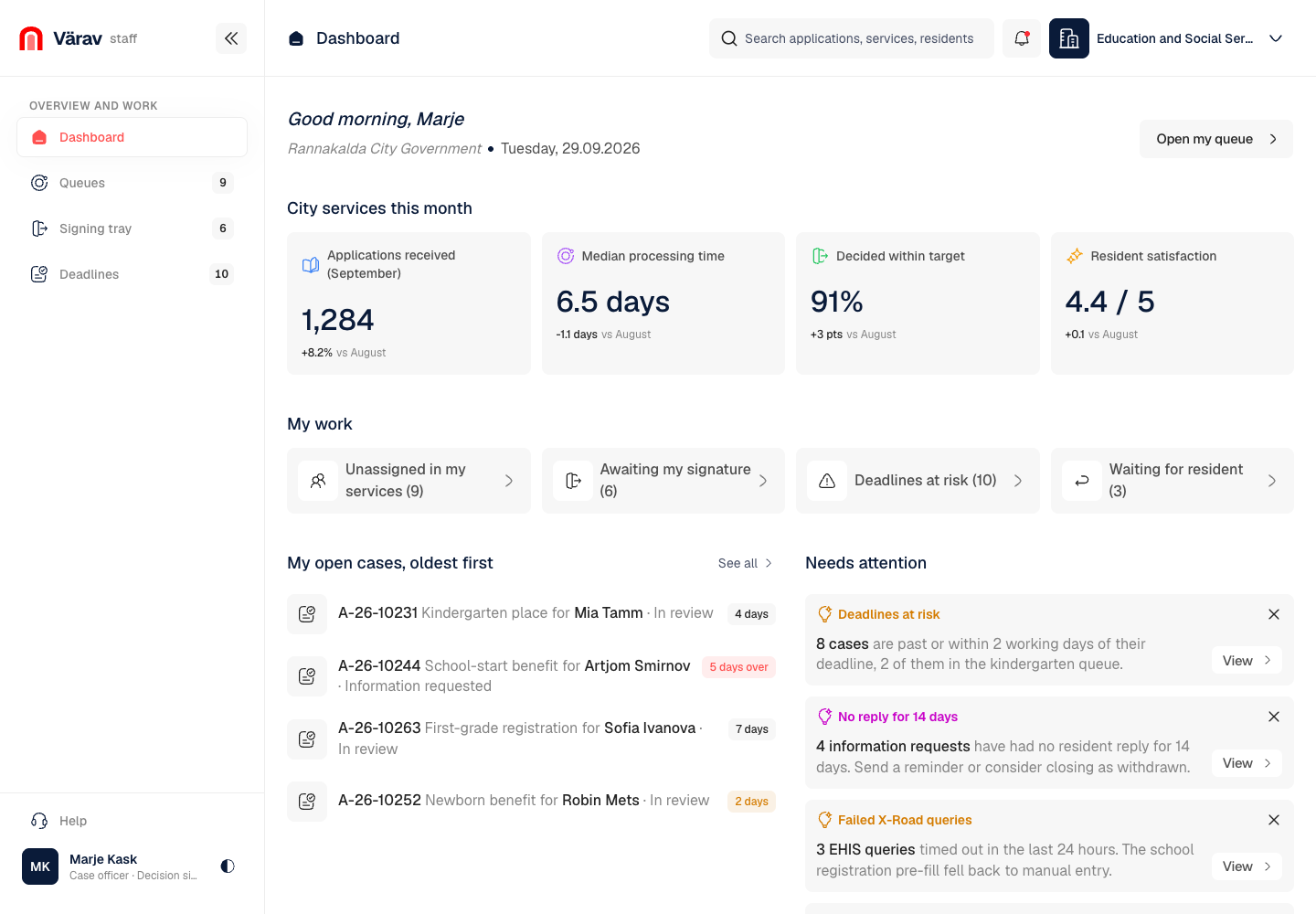
Värav - Citizen Services Portal Built on Estonia's eID and X-Road
Designed and built a clickable staff console for an Estonian city's resident services portal: service queues with eligibility results, case detail with register data pulled over X-Road, decision drafting with lawful reasons and appeal information, batch signing with eID and deadline tracking - so residents are never asked for data the state already holds.
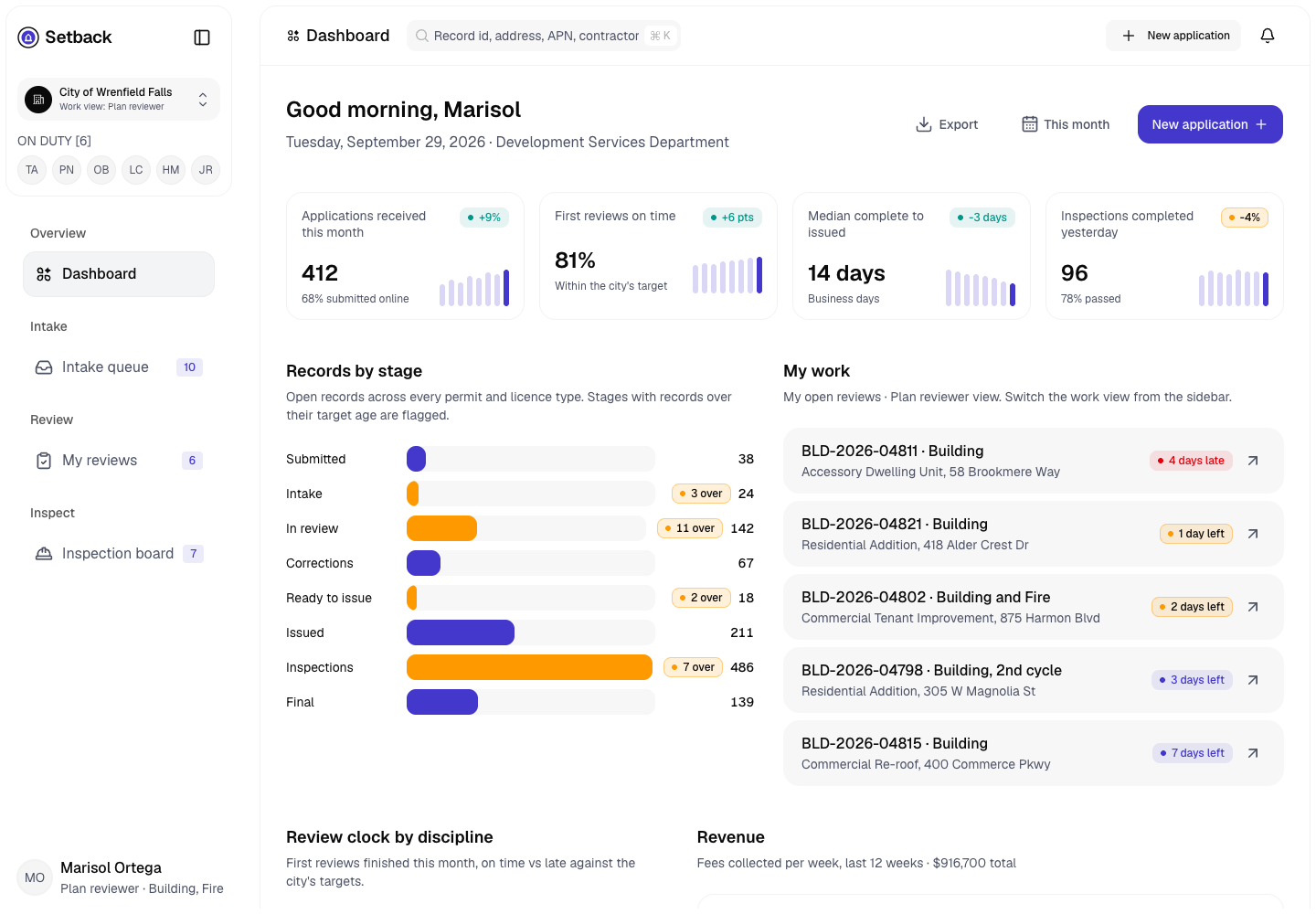
Setback - Permitting and Licensing Platform with Parallel Plan Review
Designed and built a clickable permitting and licensing platform for a US city's development services department: completeness checks before the review clock starts, building, zoning, fire and public works reviews running in parallel against city targets, an inspection board that checks certifications, and one record for every permit with its parcel, parties, holds, fees and inspections.
Enterprise Software Engineering - Human + AI
Contact Us
© 2026 - Copyright. All Rights reserved Oceanlab
Location
Global Headquarters
21 Merchant Road, 3rd Floor, Singapore 058267
Main corporate office and leadership operations
North America Office
548 Market Street, PMB 12345, San Francisco, CA 94104
Client operations and business development
India Office
402 Shivalik Shilp II, SG Highway, Ahmedabad 380015
Engineering and delivery center

Enterprise Software Engineering - Human + AI
Contact Us
Locations
Global Headquarters
21 Merchant Road, 3rd Floor, Singapore 058267
Main corporate office and leadership operations
North America Office
548 Market Street, PMB 12345, San Francisco, CA 94104
Client operations and business development
India Office
402 Shivalik Shilp II, SG Highway, Ahmedabad 380015
Engineering and delivery center
© 2026 - Copyright. All Rights reserved Oceanlab