Pravah - Accounts Payable Automation with GST, TDS and MSME Rules Built In
Invoice-to-Payment Platform for a Multi-Plant Indian Manufacturer
Designed and built a clickable accounts payable platform for an Indian auto components maker with four plants and a GSTIN in each state: invoice capture with field confidence, three-way matching against POs and goods receipts, GST and TDS per invoice, MSME due dates from the acceptance date, an exceptions queue and GSTR-2B reconciliation.
Most of our work is under NDA. Per agreement, we can share the work but not the company details - all names and identifying information shown here have been changed.
Impact
Dashboard, all invoices, invoice detail with 6 tabs (capture, match, tax, approvals, payment, activity), the exceptions queue and GSTR-2B reconciliation. Every one of the 35 demo invoices opens its own detail page.
Each invoice line is matched to its PO line and goods receipt, within 1% or ₹500 of the PO rate, whichever is lower, and no quantity over receipt. Lines outside it raise an exception with the variance spelled out.
Due dates for micro and small vendors run from the goods receipt date plus agreed days capped at 45, and the invoice shows the sum, e.g. "Accepted 12 Sep 2026 (GRN) + agreed 45 days = 27 Oct 2026".
4 plants with one GSTIN each, 19 staff users, 20 vendors, 35 invoices built from line items, 11 open exceptions and 23 GSTR-2B reconciliation rows with period totals per GSTIN.
The Problem
Vindhya's AP team worked from four plant inboxes, a shared drive of scanned invoices and SAP. Clerks keyed every invoice by hand, matched it to the PO and goods receipt on paper and chased approvals by phone. GSTR-2B mismatches surfaced only at month end, TDS sections were picked from memory, and nobody could see which micro and small vendors were close to the 45-day MSMED limit.
Our Solution
Pravah takes an invoice from arrival to payment in one place. Captured fields show their confidence, every line is matched against the PO and goods receipt within tolerance, GST and TDS are worked out per invoice with the reason, MSME due dates come from the acceptance date, and exceptions and GSTR-2B gaps go to the team that can fix them.
The Challenge: Paying Vendors Under Indian Tax Law
Every purchase invoice at an Indian manufacturer carries GST, often TDS, and for micro and small suppliers a legal payment deadline. With four plants in four states, each with its own GSTIN, the same invoice can be right for one plant and wrong for another.
Input Tax Credit Depends on the Supplier
Under Section 16 of the CGST Act, ITC can generally be claimed only when, among other conditions, the supplier's invoice appears in the buyer's GSTR-2B. Mismatches found at month end meant credit was held back or lost, one GSTIN at a time.
GST Checks on Every Invoice
Intra-state supplies carry CGST and SGST, inter-state supplies IGST. The buyer GSTIN must be the receiving plant's, e-invoice obliged suppliers must print an IRN and signed QR, and reverse charge supplies such as goods transport have to be flagged.
TDS Sections From Memory
Deductions under 194C, 194J and 194Q depend on what is bought, the vendor's constitution, yearly thresholds and PAN status, and the Income-tax Act 2025 renumbers the sections. Clerks picked them from memory.
MSME Payments With a Legal Clock
The MSMED Act caps payment terms for micro and small enterprises at 45 days from acceptance, with compound interest on late payments, and Section 43B(h) generally disallows the expense until paid if payment is late. The clock starts when the goods are accepted, recorded on the goods receipt, not on the invoice date.
Our Approach: From AP and Tax Rules to a Clickable Platform
Spec and Rules Research
Mapped 11 roles from AP clerk and approver to treasury, tax team, vendor master and the vendor's own portal login, 43 screens across staff, vendor portal and public onboarding, and the data model for vendors, invoices, POs, goods receipts, match results, approval rules, TDS sections, GSTR-2B records and payment runs. Wrote down the rules the design follows: GST input tax credit and the Invoice Management System, e-invoicing, e-way bills, place of supply, TDS, the MSMED Act and Section 43B(h), vendor checks and the DPDP Act.
Clickable Demo on a Production UI Kit
Built 5 key screens on a production dashboard kit: the dashboard with KPIs, invoice pipeline, MSME strip, cash out for 4 weeks and role-based work lists, all invoices with bulk hold and release, invoice detail with the invoice image beside captured fields, three-way match, tax and approval route, the exceptions queue with resolution types, and GSTR-2B reconciliation with the mismatch panel. A plant switcher filters every list and KPI, and all actions run on local state.
What a Production Build Adds
Integration with the ERP (such as SAP S/4HANA, Oracle Fusion or TallyPrime), invoice OCR, a GST Suvidha Provider for e-invoice checks and GSTR-2B downloads, PAN, Udyam and penny-drop bank checks, bank host-to-host payment files and TRACES. Staff auth by role with separation of duties, an append-only audit log, and the remaining screens: inbox, approvals, vendors and onboarding, TDS, payment proposals and runs, MSME due dates, reports, settings and the vendor portal.
Why It Works: Every Rule Shown on the Invoice
Low Confidence Is Confirmed, Not Guessed
Each captured field shows its confidence, and low-confidence fields are outlined amber until a person confirms them. Validation messages sit beside the field, such as a buyer GSTIN from the wrong plant or a missing IRN from an e-invoice obliged supplier.
Matching and Tax With Their Reasons
The match tab shows GRN and invoiced quantity, PO and invoice rate and the variance for every line. The tax tab gives the tax type from place of supply, ITC eligibility with any blocked-credit reason, and the suggested TDS section with why, such as "194C · vendor is a company · 2%".
Exceptions Go to the Team That Can Fix Them
Seven reason types, from price variance to vendor issue, each routed to AP, procurement, stores, tax or vendor master. Age turns amber after 2 working days and red after 3, and resolving needs a resolution type that fits the reason.
GSTR-2B Gaps Before ITC Is Claimed
Per GSTIN and return period, purchase records are matched to what suppliers reported, split into matched, partial, books only and 2B only, with a recommended IMS action. The mismatch panel shows both records, the fields that differ, match candidates and the supplier's filing history.
Related case studies
View all: Accounting & tax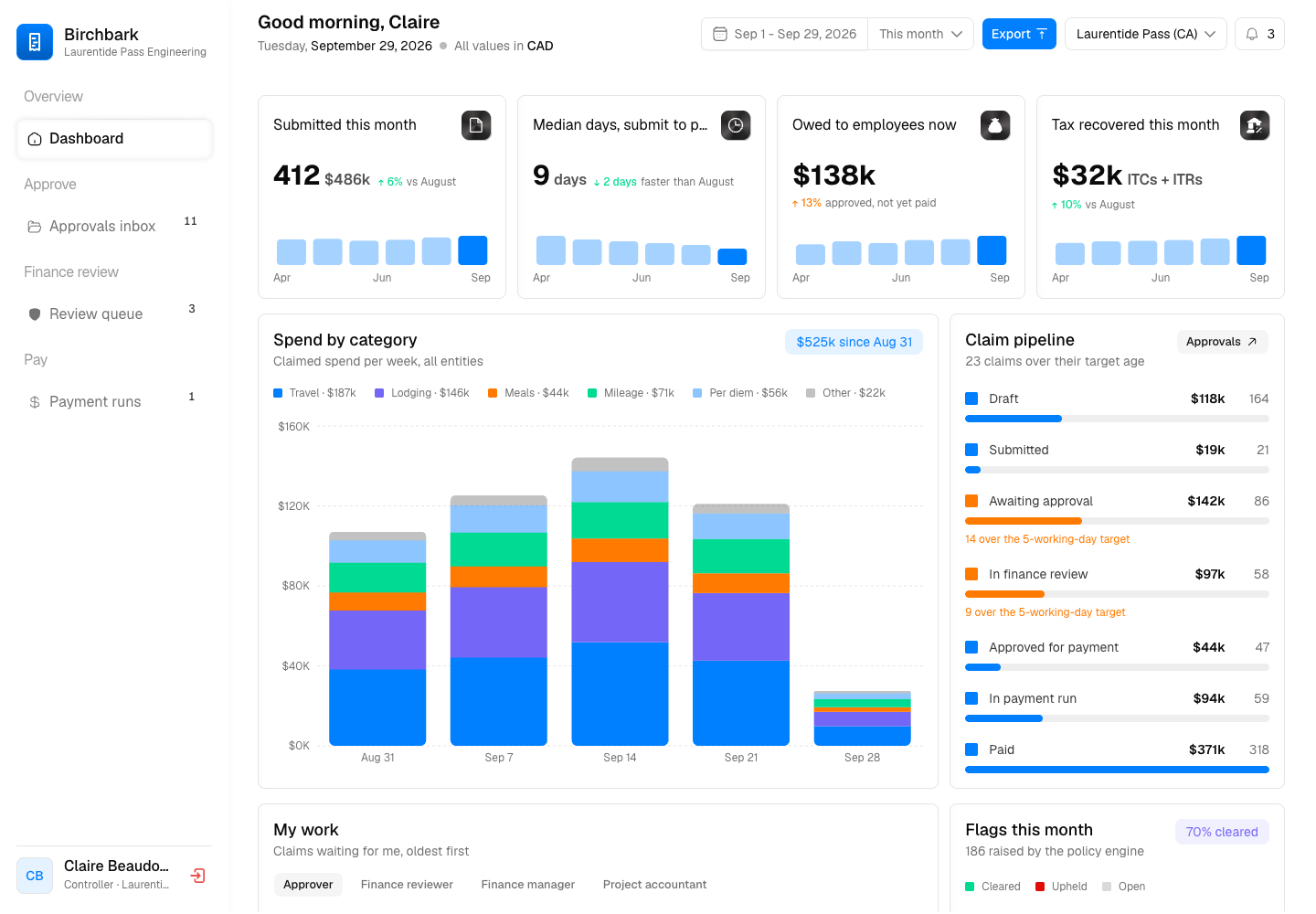
Birchbark - Expense Management with GST/HST and QST Recovery Built In
Designed and built a clickable expense management platform for a Canadian consulting engineering firm: approvers decide claims line by line with policy flags, finance audits flagged and sampled claims, GST/HST and QST are read from each receipt for input tax credits, and approved claims are reimbursed in EFT payment runs.
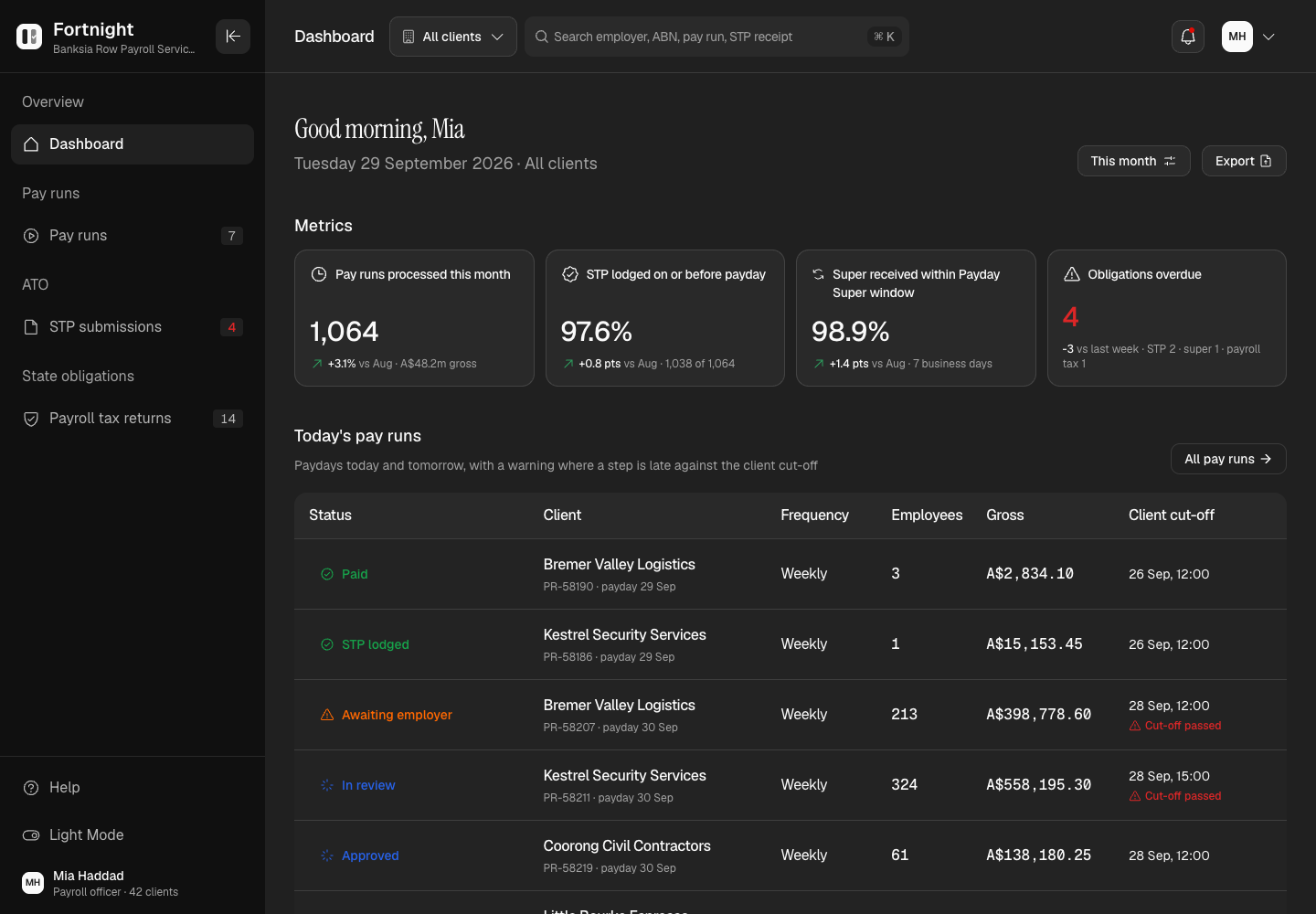
Fortnight - Payroll Tax and Filing Workbench for an Australian Payroll Bureau
Designed and built a clickable filing workbench for a Brisbane payroll bureau that runs payroll for about 380 Australian employers: a pay run board with cut-off timers, a pay run review with automated checks and a four-eyes rule, STP Phase 2 lodgments with plain-English ATO guidance, and state payroll tax returns with group apportionment.
Enterprise Software Engineering - Human + AI
Contact Us
© 2026 - Copyright. All Rights reserved Oceanlab
Location
Global Headquarters
21 Merchant Road, 3rd Floor, Singapore 058267
Main corporate office and leadership operations
North America Office
548 Market Street, PMB 12345, San Francisco, CA 94104
Client operations and business development
India Office
402 Shivalik Shilp II, SG Highway, Ahmedabad 380015
Engineering and delivery center

Enterprise Software Engineering - Human + AI
Contact Us
Locations
Global Headquarters
21 Merchant Road, 3rd Floor, Singapore 058267
Main corporate office and leadership operations
North America Office
548 Market Street, PMB 12345, San Francisco, CA 94104
Client operations and business development
India Office
402 Shivalik Shilp II, SG Highway, Ahmedabad 380015
Engineering and delivery center
© 2026 - Copyright. All Rights reserved Oceanlab