Miqyas - Facility Maintenance Platform with Contract SLA Timers
Maintenance and SLA Platform for a Cairo Facilities Company
Designed and built a clickable maintenance platform for an integrated facilities management company in Cairo: requests from QR codes, phone and BMS alarms triaged against each client's priority matrix, work orders with live SLA timers, and a monthly review of breaches and service credits that recalculates as breaches are agreed.
Most of our work is under NDA. Per agreement, we can share the work but not the company details - all names and identifying information shown here have been changed.
Impact
Dashboard, request inbox with the triage panel, work orders as board and table, work order detail with 7 tabs, and SLA breaches and credits. A request triaged in the inbox appears as a work order on the board.
Response, attendance, make safe and fix, with targets from the client's mall, hospital or corporate template. Putting a job on hold pauses the clock only for reasons the contract allows, such as client access refused.
Credits follow each contract's formula, e.g. 2% of the monthly fee for each full point fix compliance falls below 95%, capped at 10%. Excluding one Shifaa Hospitals breach takes its credit from EGP 48,000 to zero.
19 requests, 23 SLA breaches, 10 client contracts, 12 sites, 24 assets, 14 technicians and 6 vendors across Greater Cairo, Alexandria and the New Administrative Capital.
The Problem
Tabya's helpdesk took requests by phone, WhatsApp groups and email, logged them in a spreadsheet per client and dispatched technicians by phone call. Nobody could prove when a job was reported, attended or finished, so every monthly client meeting became an argument about SLA figures, and two contracts paid service credits Tabya believed it had not earned.
Our Solution
Miqyas covers the whole loop: a shopper, nurse or office worker reports a fault from a QR code on the asset, the helpdesk triages it against the client's contract, a technician or vendor fixes it with evidence, and the contract manager reviews every breach and agrees the month's credit with the figures to back it.
The Challenge: SLAs Nobody Could Prove
Tabya looks after 140 client sites - shopping malls, the non-clinical areas of private hospitals and corporate campuses - with around 260 in-house technicians and 45 subcontract vendors. Every client contract sets its own priorities, clocks and penalties.
No Record of When Anything Happened
Requests arrived by phone, WhatsApp and email, and dispatch happened by phone call. Without a timestamp for report, attendance and completion, SLA figures were whatever each side remembered, and credits were paid on figures Tabya could not check.
Every Contract Has Its Own Clock
Each client sets a priority matrix, response, attendance, make safe and fix targets per priority, 24/7 or business-hours clocks, which on-hold reasons stop the clock and how credits are calculated. All of it is contract policy, not law, and it changes between contract versions.
Inspections and Permits on Paper
Planned maintenance lived in paper logbooks in plant rooms, and a lift inspection certificate lapsed at a mall until the client's insurer asked. Lift, fire, generator and pressure vessel inspections differ by asset and authority, and hazardous work needs a permit to work.
Many Parties, Little Signal
Technicians, vendors, client FM managers and members of the public all touch a job. Vendors quoted by WhatsApp photo and invoiced weeks late, parts left vans without a record, and technicians in basement plant rooms had no signal to update anything.
Our Approach: From Contract Terms to a Clickable Platform
Spec and Rules Research
Mapped 13 roles and 45 screens across the helpdesk console, technician app, vendor portal, client portal and public requester pages, and the data model for versioned contracts, sites, assets, requests, work orders, SLA timers, permits, quotes, approvals, vendor invoices, PPM schedules, statutory inspections and service credits. Wrote down the rules the design follows: Egypt's Personal Data Protection Law No. 151 of 2020, a configurable statutory inspection register instead of hard-coded intervals, ISO 45001 permits to work, app sign-off as a contractual acknowledgement under the E-Signature Law No. 15 of 2004, Egyptian Tax Authority e-invoice references and ISO 41001.
Clickable Demo on a Production UI Kit
Built 5 key screens of the helpdesk console on a production dashboard kit: the dashboard with KPI cards, a live SLA board and SLA compliance by client; the request inbox with duplicate flags and a triage panel where impact and urgency set the priority; the work order board and table; work order detail with progress rail, SLA card, clock history, permits and evidence; and SLA breaches and credits. Triage, holds, exclusions and credit locks carry across screens for the session.
What a Production Build Adds
The offline-first technician app, the vendor, client and requester portals, and the remaining console screens: dispatch board, PPM planner, statutory inspections, assets, vendors, approvals, vendor invoices, van stock, permits, audit log and monthly client reports. Integration with Infobip or Twilio, Firebase, Google Maps, the ETA e-invoicing API, Odoo or SAP Business One, bank payment files and optional BMS alarms, plus role-based approval limits, Arabic right-to-left layout, a data hosting decision under the PDPL and an audit log of every priority change, clock pause, approval and credit.
Why It Works: The Contract Runs the Clock
Timers Read the Contract
Every timer takes its target and clock from the client's contract, and putting a job on hold shows whether the chosen reason pauses the clock. Awaiting parts keeps the clock running unless the contract says otherwise.
Most Urgent Job First
The live SLA board sorts open work orders by time left, green over half, amber under half, red under 10% and black once breached. The top bar counts timers breaching in the next 60 minutes and opens the work orders behind them.
Triage by Matrix, Not by Feel
The agent picks impact and urgency, and the contract's priority matrix sets P1 to P4. Requests naming the same asset or location within 2 hours are flagged as possible duplicates, and a QR scan fills in the site and asset.
Credits Agreed With Evidence
Each breach gets a reason and a decision. Excluding one needs the contract manager, a reason, evidence and a note on client visibility, then compliance and the credit recalculate before the month is locked and sent to finance.
Related case studies
View all: Real estate & PropTech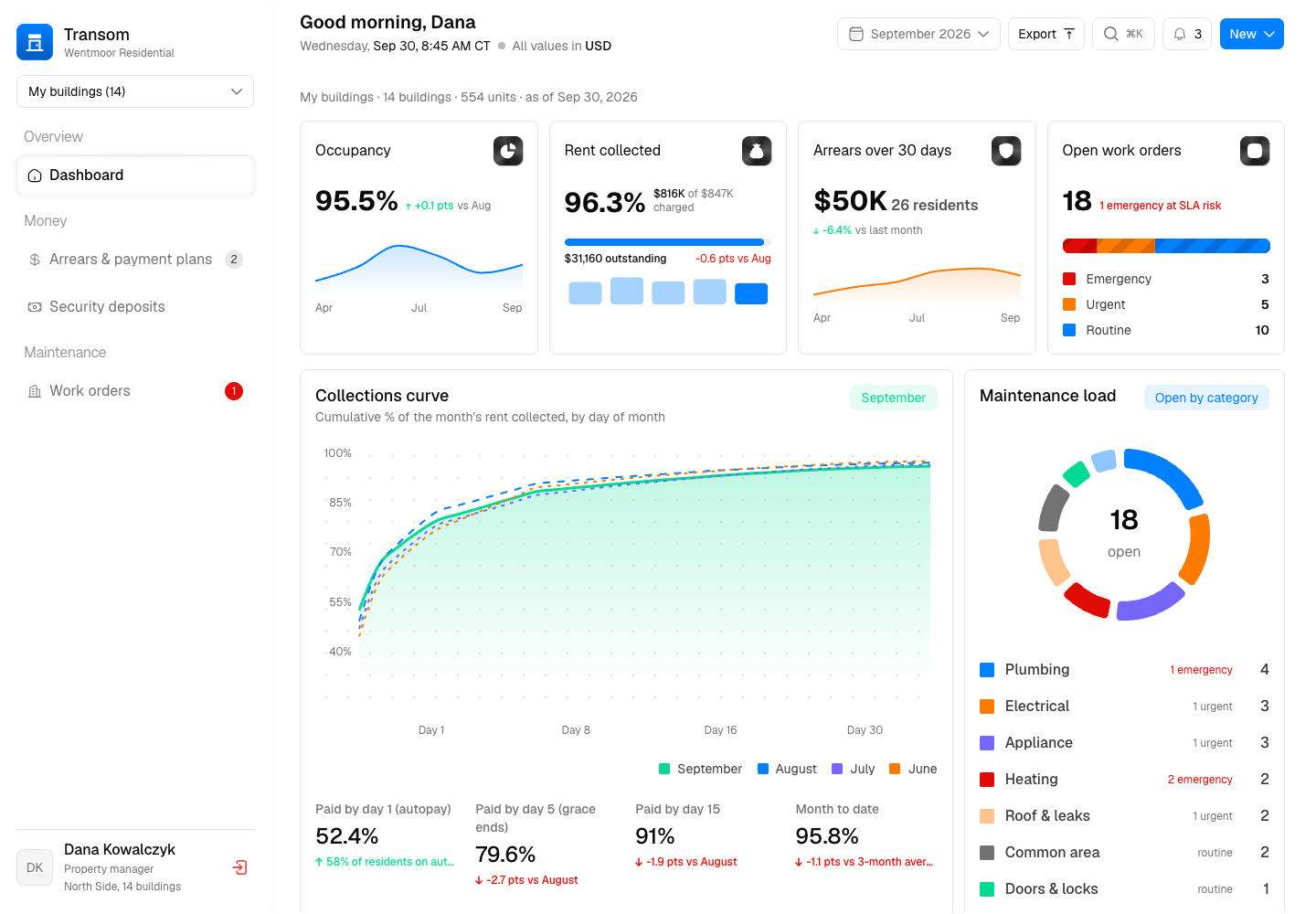
Transom - Property Management Platform and Tenant Portal for Chicago Apartments
Designed and built a clickable property management platform for a Chicago manager of about 4,200 apartments: a dashboard of occupancy, collections and open repairs, arrears worked through the same steps for every resident, security deposits tracked under Chicago and Illinois rules, and work orders with SLA clocks, entry permission and owner approval limits.
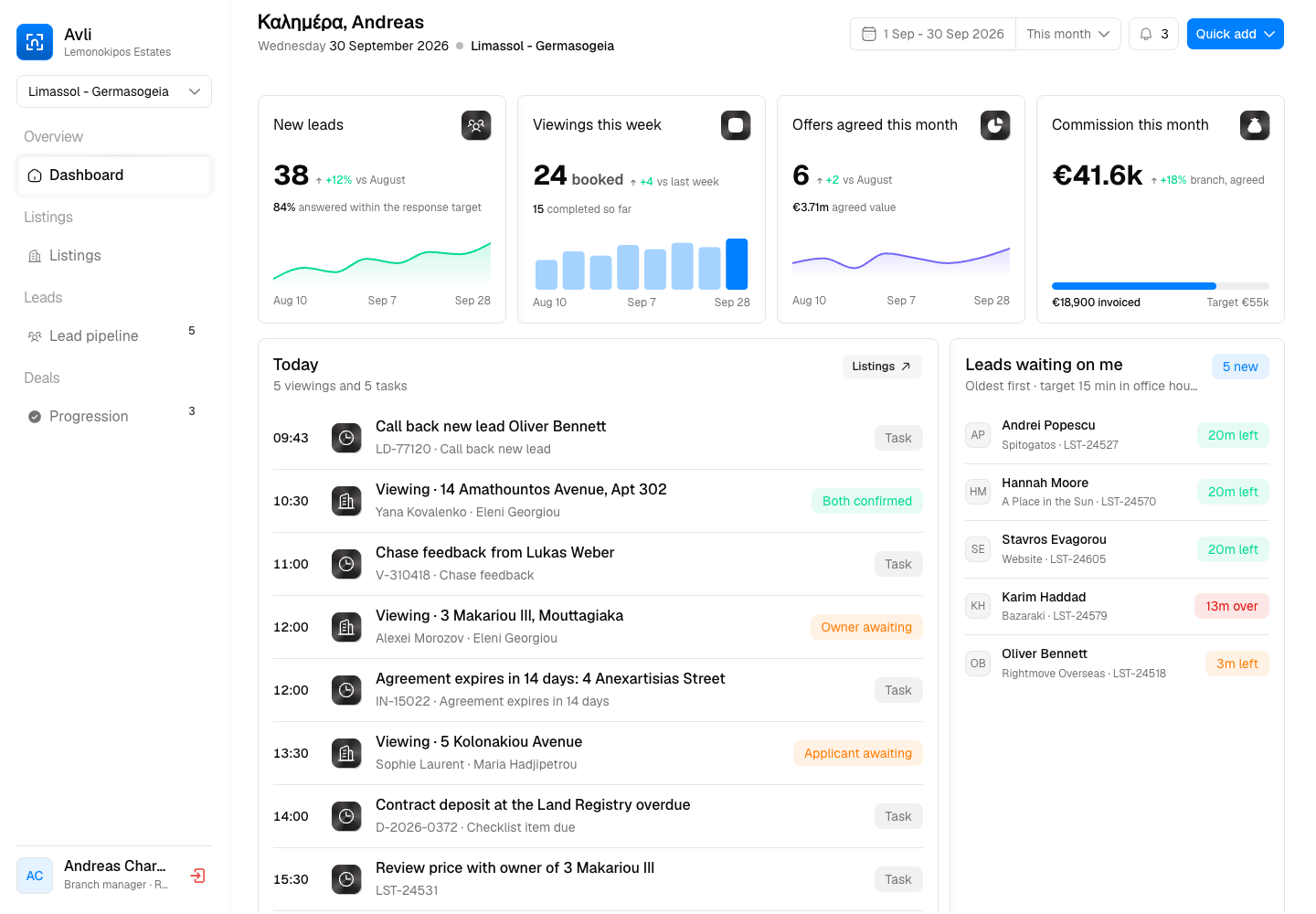
Avli - Listings and Agent CRM for a Cypriot Estate Agency
Designed and built a clickable listings and agent CRM for a Cypriot sales and lettings agency with 22 branches and about 180 agents: listings with EPC and agency agreement checks, portal syndication, a lead pipeline with response timers, offers that wait for AML clearance, and a progression checklist from reservation to transfer of title.
Enterprise Software Engineering - Human + AI
Contact Us
© 2026 - Copyright. All Rights reserved Oceanlab
Location
Global Headquarters
21 Merchant Road, 3rd Floor, Singapore 058267
Main corporate office and leadership operations
North America Office
548 Market Street, PMB 12345, San Francisco, CA 94104
Client operations and business development
India Office
402 Shivalik Shilp II, SG Highway, Ahmedabad 380015
Engineering and delivery center

Enterprise Software Engineering - Human + AI
Contact Us
Locations
Global Headquarters
21 Merchant Road, 3rd Floor, Singapore 058267
Main corporate office and leadership operations
North America Office
548 Market Street, PMB 12345, San Francisco, CA 94104
Client operations and business development
India Office
402 Shivalik Shilp II, SG Highway, Ahmedabad 380015
Engineering and delivery center
© 2026 - Copyright. All Rights reserved Oceanlab