Levada - Non-Custodial DEX Aggregator with Split Routing and an Ops Console
Best-Price Swap App and Routing Ops for an EU DeFi Team
Designed and built a clickable non-custodial DEX aggregator for a Lisbon DeFi team: a swap app that splits trades across liquidity sources and shows every fee before the user signs, gasless limit orders, wallet history with approval revoking, transaction status, and an ops console that watches chain health, quote quality and failure clusters.
Most of our work is under NDA. Per agreement, we can share the work but not the company details - all names and identifying information shown here have been changed.
Impact
Swap, limit orders, history, transaction status and the ops overview. Every one of the 18 demo transactions opens its own status page with a stepper, fees and route.
Larger trades split across up to 3 sources, such as 55% Uniswap v3, 30% Curve and 15% Balancer v2, and the route is compared with each single source on net output after gas.
0.05% on stable-to-stable pairs and 0.15% on others, shown on every quote with price impact, minimum received, network fee and the saving against the best single source.
Swaps, cross-chain moves and limit fills across 5 chains, plus 12 limit orders, 13 tokens including a blocked impersonation token, 6 approvals and 5 failure clusters.
The Problem
Maré Alta's first product was a swap widget that sent every order to one DEX. Users on larger trades lost 1% to 3% to price impact, some lost more to sandwich bots, and support was full of "why did I get less than the quote?". Partners scraped the widget because there was no API, a broken source or scam token needed a code deploy, and nobody could see why transactions failed.
Our Solution
Levada splits each swap across sources such as Uniswap, Curve and Balancer to get the most output after gas and fees, shows every fee and the minimum received before the user signs, and sends transactions through an MEV-protected RPC where one exists. Users sign everything in their own wallet, and an ops console shows chain health, quote quality and failure clusters in one place.
The Challenge: Best Price Without Holding Funds
Levada serves people in the EU but never takes custody, executes orders or receives client funds. Every feature has to keep that position true while protecting users from price impact, MEV, risky approvals and scam tokens.
Staying Software, Not a CASP
MiCA generally requires authorisation for crypto-asset service providers, and how it treats a company running a front end and a routing API is still open. The design keeps Levada non-custodial: user-signed transactions, a non-upgradeable router and no discretionary execution.
Quotes Users Can Trust
A quote has to show the Levada fee, any integrator fee, estimated gas, price impact and the minimum received before signing, while public mempool transactions can be sandwiched up to the user's slippage limit.
Approvals and Tokens That Can Hurt
ERC-20 tokens need an allowance before a contract can move them, and unlimited approvals stay open until revoked. New tokens can carry sell taxes or impersonate well-known ones, so users need a safety label before they buy.
Screening and Personal Data
Every connected wallet and recipient is screened against EU and OFAC lists, and a blocked address must see a neutral message, never the list matched. Under GDPR a wallet or IP address can be personal data, so logs are kept only for a limited period.
Our Approach: From DeFi Rules to a Clickable Aggregator
Spec and Rules Research
Mapped 8 roles from wallet-only swappers to integrator developers, routing engineers, token curators and the compliance lead, 37 screens across the swap app, developer portal and ops console, and the data model for chains, tokens, safety checks, quotes, routes, transactions, limit orders, screening checks and failure clusters. Wrote down the rules the design follows: MiCA, the Transfer of Funds Regulation as an out-of-scope trigger, EU and OFAC sanctions screening, GDPR, fee disclosure, MEV protection, exact-amount approvals and bridge risk.
Clickable Demo on a Production UI Kit
Built 5 key screens on a production web3 dashboard kit: the swap page with live quote, countdown ring, route split and alternatives table, plus route, settings, token safety and review panels; limit orders with expiry and an off-chain or on-chain cancel; history with approvals and a browser-built CSV export; transaction status with a plain-language failure reason; and the ops overview with chain status, banners, quote quality and failure clusters. All actions run on local state.
What a Production Build Adds
The quote engine and pool indexing, wallet connection through WalletConnect and injected wallets, RPC providers with Flashbots Protect or MEV Blocker, Tenderly simulation, Permit2, bridges such as Across and Circle CCTP, CoW Protocol or 1inch limit orders, GoPlus or Blockaid token safety and Chainalysis or TRM screening. Staff SSO with roles, an audit log of every policy and token change, the developer portal with API keys and fee sharing, and the rest of the ops console.
Why It Works: Every Number Before the Signature
The Quote Shows Its Working
Rate, colour-coded price impact, minimum received, network fee and the Levada fee sit on one card with a 15-second refresh ring, and a savings line says how much more the split route gives than the best single source.
Safe Defaults, Explicit Risks
MEV protection is on where the chain has a protected RPC, and turning it off shows a front-running warning. Approvals default to the exact amount, unlimited needs a choice, and high price impact or slippage needs an "I understand" tick before the button enables.
Failures Explained in Plain Language
A failed swap says what happened, such as the price moving more than a 0.1% slippage setting, and that only gas was spent, with Try again ready. Positive slippage returned to the user shows in the fee table.
Ops Sees Problems Before Users Report Them
The ops overview shows each chain's quote rate, latency and error rate, live banners with who posted them, quote win rate against single sources, the trust and safety queue and failure clusters that an operator can take on.
Related case studies
View all: Crypto & DeFi
ChainFlow - On-Chain Lending, Borrowing and Swap Console from Prototype to Production
Unified supply, borrow, swap, vault staking and portfolio analytics into a single multi-chain console - shipped from clickable AI prototype to production in 8 weeks.
Bollard - Institutional Staking Dashboard for Validators, Rewards and Approvals
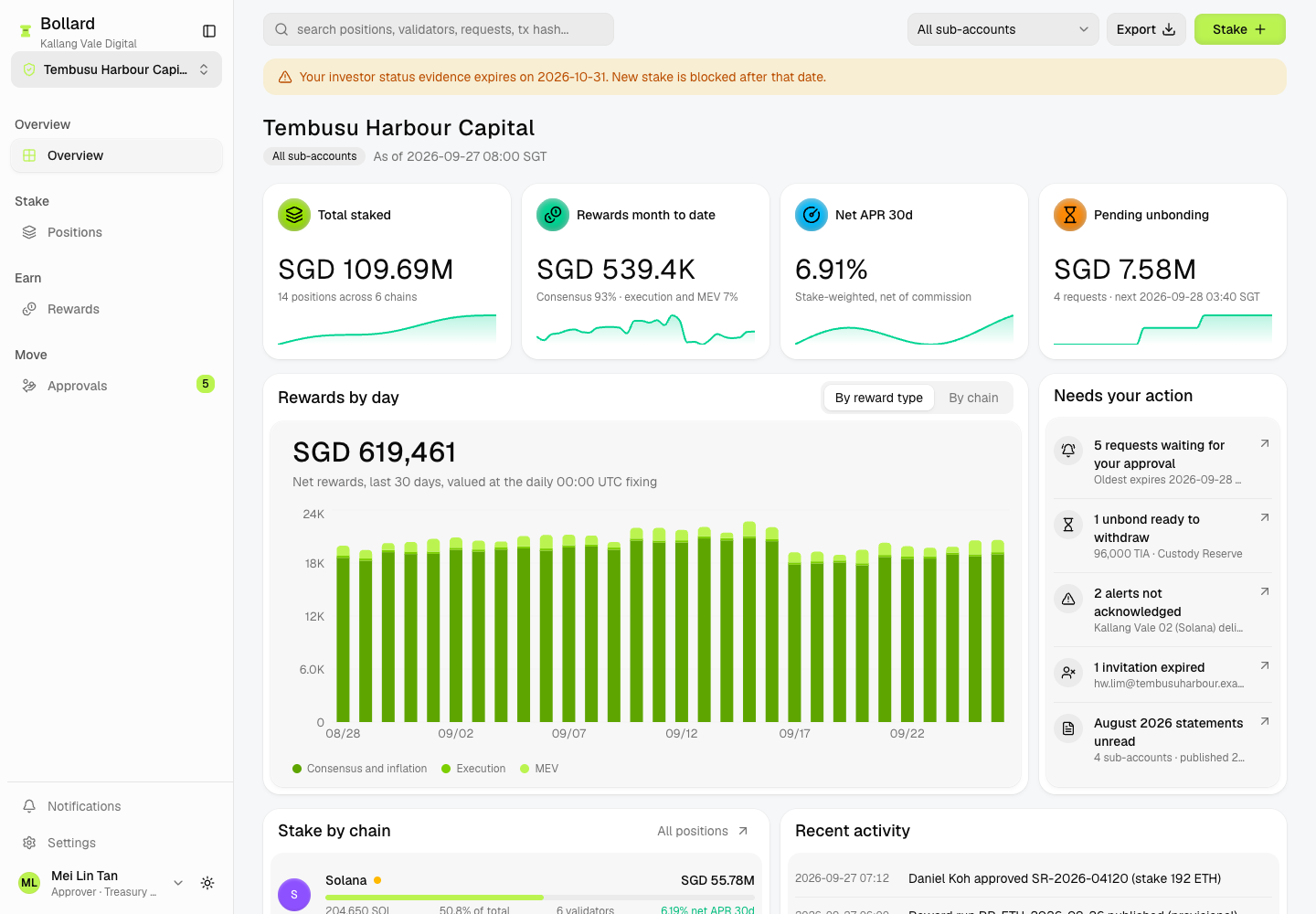
Designed and built a clickable client dashboard for a Singapore staking provider serving funds, family offices and corporate treasuries: positions across six chains, daily rewards split by type with SGD and USD values at receipt, unbonding dates per chain, and an approvals inbox that applies each institution's policy before stake moves.
Enterprise Software Engineering - Human + AI
Contact Us
© 2026 - Copyright. All Rights reserved Oceanlab
Location
Global Headquarters
21 Merchant Road, 3rd Floor, Singapore 058267
Main corporate office and leadership operations
North America Office
548 Market Street, PMB 12345, San Francisco, CA 94104
Client operations and business development
India Office
402 Shivalik Shilp II, SG Highway, Ahmedabad 380015
Engineering and delivery center

Enterprise Software Engineering - Human + AI
Contact Us
Locations
Global Headquarters
21 Merchant Road, 3rd Floor, Singapore 058267
Main corporate office and leadership operations
North America Office
548 Market Street, PMB 12345, San Francisco, CA 94104
Client operations and business development
India Office
402 Shivalik Shilp II, SG Highway, Ahmedabad 380015
Engineering and delivery center
© 2026 - Copyright. All Rights reserved Oceanlab