Kvali - Multilingual Help Centre Studio with a Safety Notice Desk
Help Centre and Knowledge Base for a Georgian Smart-Home Brand
Designed and built a clickable help centre studio for a Tbilisi smart-home device brand selling in five markets: articles and troubleshooters tracked across seven languages, a review flow with block-level diffs against the live version, a safety notice desk with second approval and required languages per market, and a deflection report that explains its own figures.
Most of our work is under NDA. Per agreement, we can share the work but not the company details - all names and identifying information shown here have been changed.
Impact
Dashboard, articles with a quick view panel, article review with a block-level diff, safety notices with an approval panel, and the deflection report. Each of the 24 articles opens its own review page.
Alt text on every image, captions on every video, heading order, link text, structured data and broken links, each shown as pass or fail next to the diff before the editor approves.
A second safety officer approves and the drafter cannot. Approve and publish also stays blocked for a market until that market's required languages are live.
12 guides, 4 FAQs, 3 reference articles and 5 troubleshooters across 7 languages, plus 7 safety notices, 7 devices, 5 markets and 10 staff users.
The Problem
Svetari's help content lived in a Georgian and English WordPress FAQ, PDF manuals in the box and a customer Facebook group. Other languages were out-of-date machine translations, the importer's German and Polish pages never synced back, and when one batch of P1 smart plugs had an overheating fault, the notice went up as a news post that dropped off the homepage within a week. Nobody could say which articles stopped people contacting support.
Our Solution
Kvali gives Svetari's content team one studio behind the public help site and the in-app help widget. Authors write in a source language, editors review a block-level diff against the live version, publishers publish now or schedule, translations are tracked per language, and safety notices go live only with a second approver and every language their markets require.
The Challenge: One Help Centre, Five Markets
Svetari sells a hub, smart plugs, a boiler thermostat, a door lock, an indoor camera, a gas and CO alarm and leak sensors in Georgia, Armenia, Azerbaijan, Germany and Poland. Customers read help on their phones, from search engines and inside the Svetari app, in seven languages and three scripts beyond Latin.
Seven Languages Drifting Apart
Content is written in English or Georgian and published in ქართული, English, Русский, Հայերեն, Azərbaycan, Deutsch and Polski. Each market requires its own languages, and nobody could see which translations had fallen behind the source.
Safety Notices That Must Stay Visible
For products sold in the EU, the General Product Safety Regulation expects a recall notice with fixed content, a clear "Product safety recall" heading and the languages of the markets concerned. A news post that scrolls away does not meet that.
Security Updates Owed to Every Device
The EU Cyber Resilience Act applies in phases from 2026 and expects clear information on security updates and a stated support period for each device. Firmware changes had only ever appeared in the app store changelog.
No Proof of What Helped
About 60% of the 4,200 monthly support contacts were pairing and "thermostat offline" questions that already had an answer. Measuring deflection without tracking visitors had to respect the GDPR, the ePrivacy rules and Georgia's 2023 data protection law.
Our Approach: From Help Content Rules to a Clickable Studio
Spec and Rules Research
Mapped 14 roles from author, editor and publisher to safety officer, security lead, moderator, visitor and app user, and 45 screens: 15 on the public help site, 3 in the in-app widget and 27 in the studio. Modelled articles and immutable versions, troubleshooter trees, translations, safety notices with serial checks, release notes, community posts, feedback and anonymous help sessions. Wrote down the rules the design follows: Georgia's Law on Personal Data Protection, the GDPR and ePrivacy rules, the GPSR, the Cyber Resilience Act, WCAG 2.2 AA and the European Accessibility Act.
Clickable Demo on a Production UI Kit
Built the studio's 5 key screens on a production dashboard kit: the dashboard with KPIs, active notices, my work, needs attention and zero-result searches per language; articles with type tabs, filters, language coverage and a bulk-action bar; article review with preview, diff, comments and checks; safety notices with request approval, approve and publish and close; and the deflection report by entry point, device and language. Review and safety actions update the screen and add audit lines as you click.
What a Production Build Adds
The public help site and in-app widget, and the remaining studio pages: article editor, troubleshooter builder, publishing calendar, release notes, translations, moderation, content health, audit log and settings. Integration with site search (such as Algolia or Typesense), DeepL machine drafts, Crowdin or Phrase, video hosting with captions, Svetari account sign-in over OIDC, a Zendesk or Freshdesk ticket hand-off, privacy-friendly analytics and the Svetari device cloud for firmware and rollout status. Role-based staff access and an append-only audit log.
Why It Works: Safe, Current and Measurable Help
Safety Comes First on Every Screen
The dashboard shows active notices right under the KPIs, with days active, views, serial checks and remedy requests. Banner and search pin stay on for every active notice, closed notices stay public, and closing one needs a reason.
Reviewers See Exactly What Changed
Each version is reviewed as a block-level diff against the live one, with comments anchored to blocks and a preview at desktop, phone and widget width. Request changes needs a comment, and scheduling defaults to Asia/Tbilisi with a choice to mark translations outdated or hold them.
Every Language Visible at a Glance
Each article shows a chip per language, with outdated translations striped and untranslated ones struck through. A notice that lacks a required language names the markets it is blocked in, and zero-result searches are listed per language.
Deflection Defined, Not Assumed
The report shows sessions, contacts, deflection rate and suggestions marked solved, split by web, widget and search engine, device and language, with troubleshooter outcomes. A definitions box explains each figure, including Svetari's own 7-day no-contact rule and cookieless sessions.
Related case studies
View all: Customer support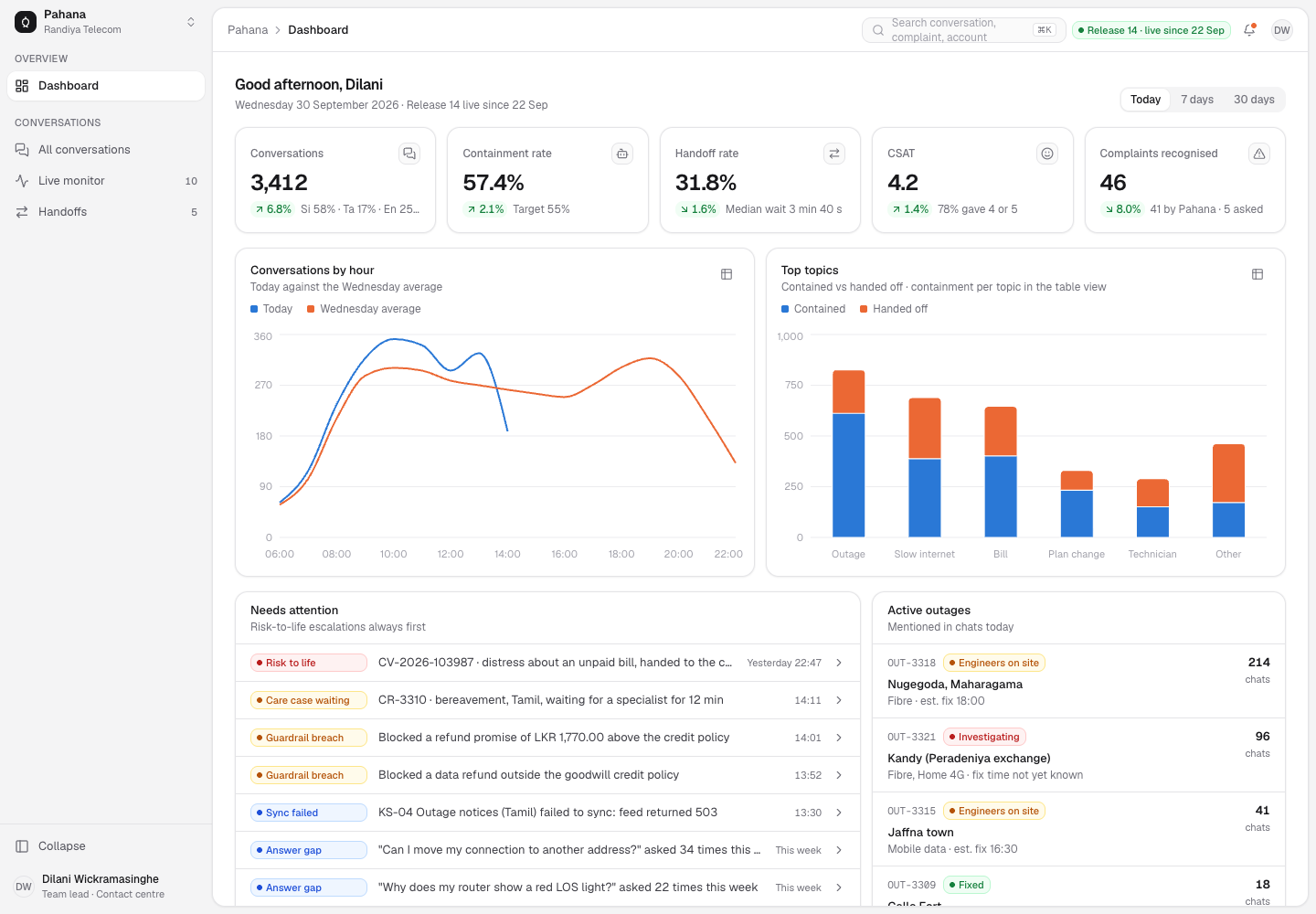
Pahana - Trilingual AI Support Agent with Safe Human Handoff
Designed and built the staff console for a trilingual AI support agent at a Colombo telecom operator: a dashboard of containment and satisfaction, every conversation with its tool calls and guardrail events, a live monitor where team leads take over a chat, and a handoff queue that makes sure no customer passed to a person is lost.
Palabre - Omnichannel Helpdesk for a West African Marketplace
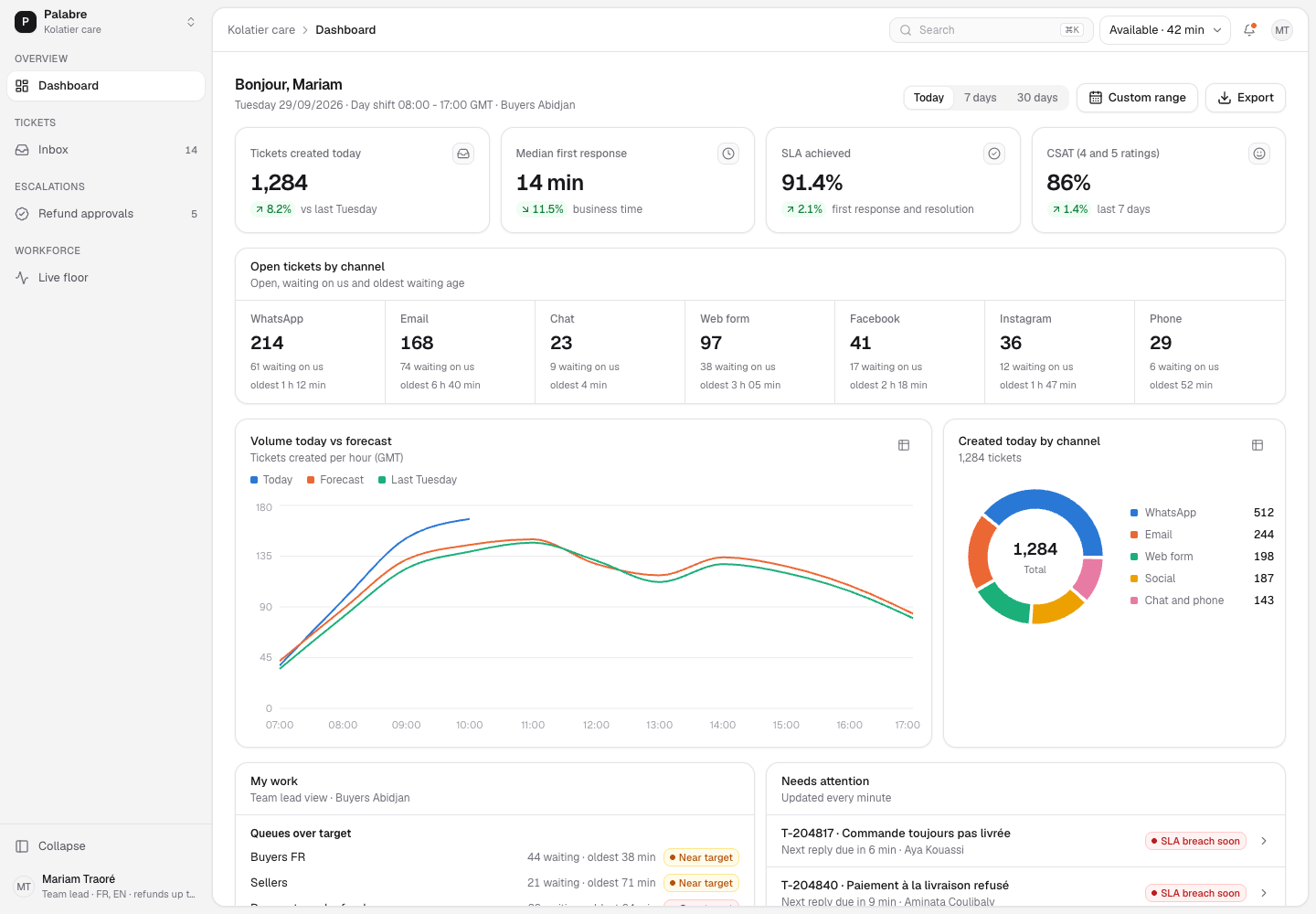
Designed and built a clickable omnichannel helpdesk for an Abidjan marketplace serving five francophone West African countries: email, web form, chat, WhatsApp, Facebook, Instagram and phone in one ticket timeline, a customer 360 with orders and mobile money refunds, refund approvals by limit and a live floor for team leads.
Enterprise Software Engineering - Human + AI
Contact Us
© 2026 - Copyright. All Rights reserved Oceanlab
Location
Global Headquarters
21 Merchant Road, 3rd Floor, Singapore 058267
Main corporate office and leadership operations
North America Office
548 Market Street, PMB 12345, San Francisco, CA 94104
Client operations and business development
India Office
402 Shivalik Shilp II, SG Highway, Ahmedabad 380015
Engineering and delivery center

Enterprise Software Engineering - Human + AI
Contact Us
Locations
Global Headquarters
21 Merchant Road, 3rd Floor, Singapore 058267
Main corporate office and leadership operations
North America Office
548 Market Street, PMB 12345, San Francisco, CA 94104
Client operations and business development
India Office
402 Shivalik Shilp II, SG Highway, Ahmedabad 380015
Engineering and delivery center
© 2026 - Copyright. All Rights reserved Oceanlab