Kivuko - Customs Documentation Workspace with Agent-Confirmed HS Classification
Customs Declaration Workspace for a Tanzanian Broker
Designed and built a clickable customs documentation workspace for a licensed broker in Dar es Salaam: every consignment on one board from first invoice to release, an HS classification workbench where a licensed agent confirms each suggested code, and a declaration builder that blocks lodgement until every check passes.
Most of our work is under NDA. Per agreement, we can share the work but not the company details - all names and identifying information shown here have been changed.
Impact
Dashboard, jobs board and table, job detail with 7 tabs, the classification workbench and the six-step declaration builder. Every job opens its own workbench, and every classified job its own declaration.
All lines confirmed by a licensed agent, required documents checked, permits present and valid, a valuation reason where needed, client approval received and the importer's agency authority valid.
Each with the heading path, the reasons, the General Interpretative Rule relied on, a confidence level and the configured duty rate, under a banner that says suggestions are not a ruling.
12 importers across machinery, textiles and food, 10 staff users, 16 declarations and 17 goods lines with tariff suggestions, spread across all 9 clearance stages plus on hold.
The Problem
Mchanga Bay's declarants worked from email attachments, WhatsApp photos of invoices and a spreadsheet per client. Invoice lines were retyped into the customs system, HS codes came from memory or last year's file, and nobody could see which consignments were waiting on a TBS certificate, a client approval or a duty payment. Port storage charges piled up while documents were chased, and two misclassification penalties in one year cost the firm a key textile client.
Our Solution
Kivuko takes a consignment from the first commercial invoice to the release order. Jobs move across a board of clearance stages with days in stage and missing items on every card, invoice lines are classified with reasoned suggestions that only a licensed agent can confirm, and the declaration builder works out the CIF value and a duty and tax estimate before checking that the declaration is ready to lodge.
The Challenge: Clearing Goods Without Guesswork
Mchanga Bay files import and export declarations for about 350 importers under the EAC Customs Management Act, 2004, as applied by the Tanzania Revenue Authority. Each declaration depends on a correct tariff line, a correct customs value, the right permits and the client's say-so, and a mistake in any one shows up as a query, a penalty or storage days at the port.
Classification From Memory
Goods are classified under the WCO Harmonized System and the EAC Common External Tariff, applying the General Interpretative Rules, down to the national tariff line. Declarants chose codes from memory with no record of why, and the tariff itself is revised from time to time.
Valuation and Estimates Done by Hand
Customs value is generally the transaction value plus freight and insurance to the port of entry, converted at the customs exchange rate in force. Freight and insurance had to be shared across lines by hand, and duty and VAT were worked out in spreadsheets.
Permits Nobody Could See
Some goods need a certificate or permit from another agency before release, such as TBS for standards and food safety or TMDA for medicines. Whether a job was waiting on one was buried in an email thread.
Authority and Accountability
A licensed agent lodges under the firm's customs agent licence and acts for each importer under written authority. The firm needed to know who confirmed every code and value, that the authority was valid, and that the client had approved before anything reached TANCIS.
Our Approach: From Customs Rules to a Clickable Workspace
Spec and Rules Research
Mapped 10 roles, from documentation clerk and licensed agent to the importer's approver, 35 screens across the broker console and a bilingual importer portal, and the data model for jobs, documents, invoice lines, classifications, versioned tariff tables, declarations, customs events, permits, disbursements and invoices. Wrote down the rules the design follows: the EAC Customs Management Act, the CET and HS, CIF valuation, preferential origin, agent licensing, other-agency permits, the Personal Data Protection Act, 2022 and fiscal receipts.
Clickable Demo on a Production UI Kit
Built 5 key screens on a production dashboard kit: the dashboard with KPIs, the pipeline by stage and My work for five roles, the jobs board with stage targets and a job quick view, job detail with checklists and a stage progress rail, the classification workbench with an HS code explorer, and the declaration builder with valuation build-up and a duty calculation breakdown. Suggestions and rates are seeded demo data, and all actions run on local state.
What a Production Build Adds
Lodgement and status through TANCIS, with a manual mode until TRA access for licensed agents is confirmed, TeSWS permits, GePG control numbers, OCR with Google Document AI or AWS Textract, the classification model, a TRA-approved VFD provider, Selcom or DPO Pay, and Africa's Talking and WhatsApp notices. Role-based auth that lets only licensed agents confirm and lodge, an append-only audit trail, and the remaining screens: document intake and check, queries, permits, billing, reports, settings and the importer portal.
Why It Works: The Agent Decides, the Screen Shows Why
Suggestions With Their Reasons
Each candidate code shows the path from section to tariff line, the matching words or item library history behind it, the rule relied on and a confidence level. Picking anything but the top suggestion needs a reason, and Confirm is reserved for a licensed agent, whose name and licence are shown beside it.
Lodge Stays Locked Until Ready
The builder's right rail lists six checks with pass or fail and keeps Lodge disabled while any one fails. Sending for client approval and recording the approval come first, so nothing is lodged on a version the importer has not seen.
Every Figure Opens Its Working
The valuation build-up shows invoice total, freight, insurance and CIF, with estimated figures marked. Each tax opens a breakdown with base, rate, tariff table version and formula, and the footer says the customs assessment is final and the estimate is not legal or tax advice.
Delays Visible Before They Cost Money
Days in stage turn amber past the stage target and red past twice the target, cards count missing documents, permits and approvals, and the dashboard lists consignments whose free port storage ends within 3 days with the reason they are not yet released.
Related case studies
View all: Logistics & supply chain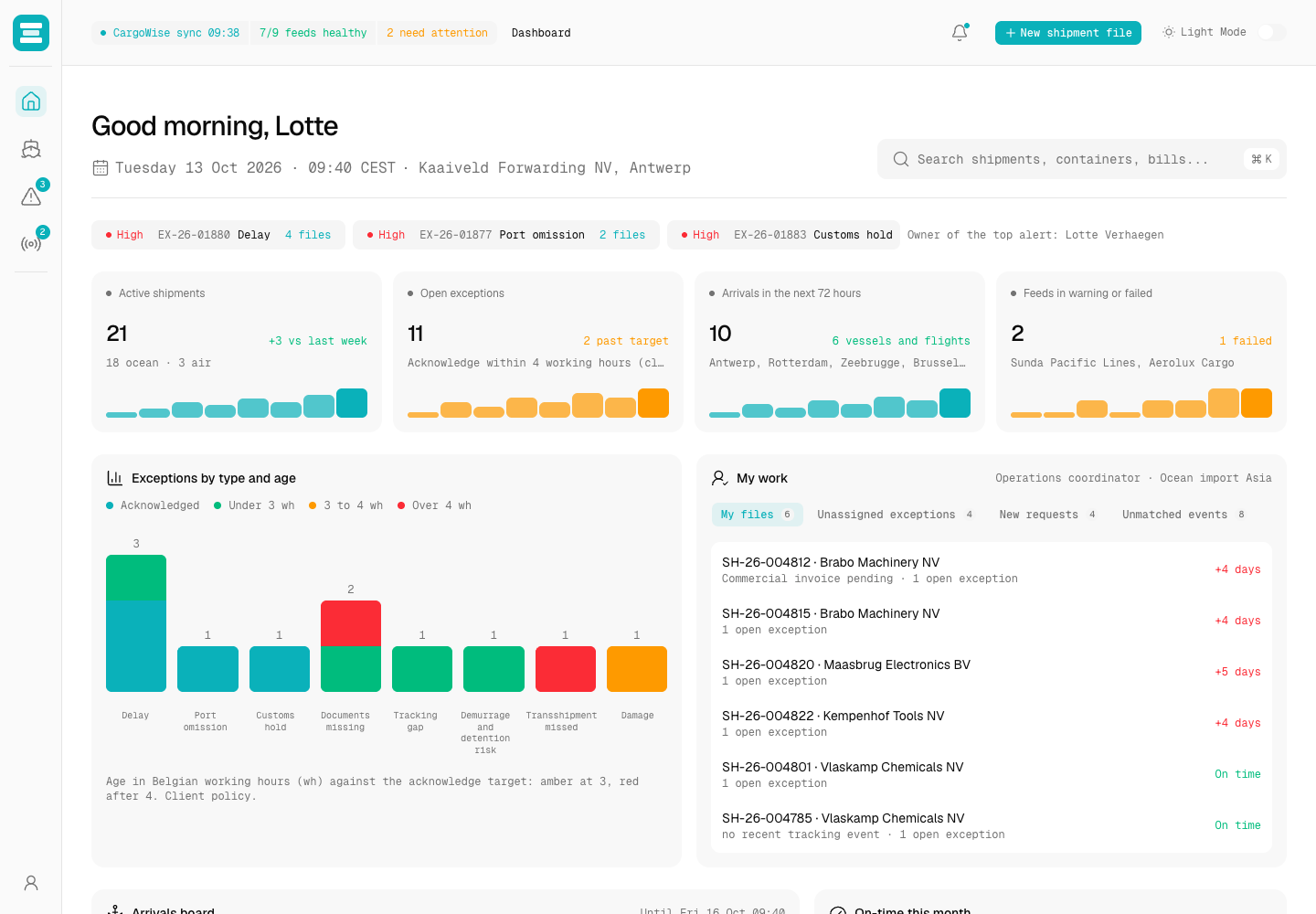
Dunnage - Shipment Tracking Portal and Ops Console for a Freight Forwarder
Designed a shipment tracking portal and operations console for an Antwerp freight forwarder moving ocean and air freight between Asia and Europe, and built the ops console as a clickable demo: shipment files with predicted and carrier ETAs, milestone timelines that show their sources, an exception queue against response targets and carrier data feed health.
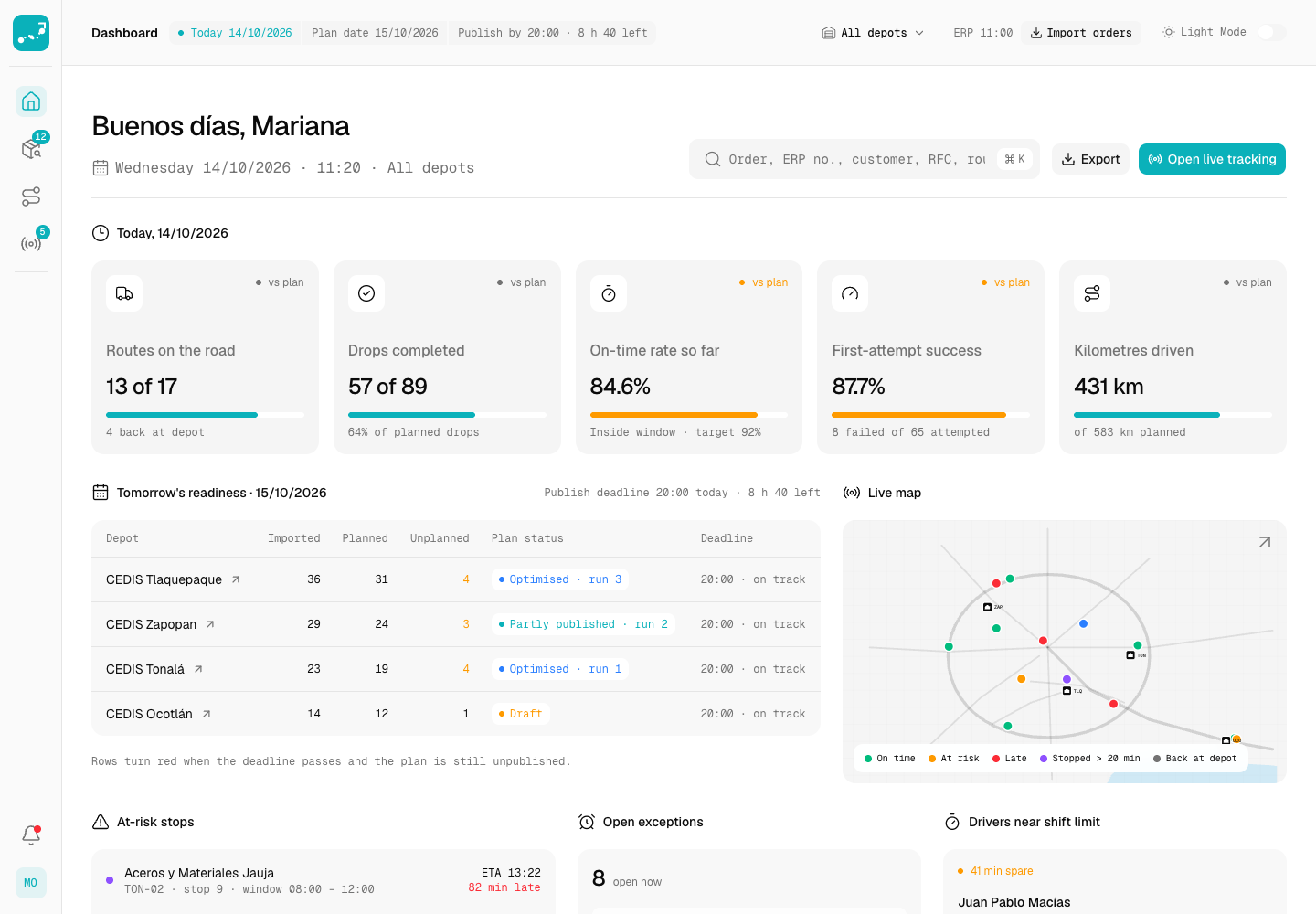
Recua - Dispatch and Route Optimisation Console for a Regional Distributor
Designed and built a clickable dispatch console for a Guadalajara distributor of building materials and beverages: import tomorrow's orders, plan routes for four depots on a map, route list and timeline, check every manual change against the fleet's limits, publish before the 20:00 deadline and watch the day live.
Enterprise Software Engineering - Human + AI
Contact Us
© 2026 - Copyright. All Rights reserved Oceanlab
Location
Global Headquarters
21 Merchant Road, 3rd Floor, Singapore 058267
Main corporate office and leadership operations
North America Office
548 Market Street, PMB 12345, San Francisco, CA 94104
Client operations and business development
India Office
402 Shivalik Shilp II, SG Highway, Ahmedabad 380015
Engineering and delivery center

Enterprise Software Engineering - Human + AI
Contact Us
Locations
Global Headquarters
21 Merchant Road, 3rd Floor, Singapore 058267
Main corporate office and leadership operations
North America Office
548 Market Street, PMB 12345, San Francisco, CA 94104
Client operations and business development
India Office
402 Shivalik Shilp II, SG Highway, Ahmedabad 380015
Engineering and delivery center
© 2026 - Copyright. All Rights reserved Oceanlab