Kinfold - Family Office Platform with Look-Through Net Worth Across Trusts and Companies
Family Office Dashboard for a Hong Kong Single Family Office
Designed and built a clickable family office platform for a Hong Kong single family office serving a three-generation family: one look-through net worth in HKD across trusts, holding companies and banks in six jurisdictions, an ownership map, an asset register with valuation ages, and a capital call calendar with four-eyes payment approval.
Most of our work is under NDA. Per agreement, we can share the work but not the company details - all names and identifying information shown here have been changed.
Impact
Net worth dashboard, structure map, entity detail, asset register and capital call calendar. Every one of the 20 demo entities opens its own detail page.
Each asset is multiplied by the family's effective ownership along every path, so a Singapore company held 60% and 40% through two branches is counted once. Totals convert to HKD at a locked month-end FX set.
A capital call needs a preparer and a different approver. Self-approval is blocked, and approval stays blocked while the wire details on a notice differ from those on file.
2 trusts, a private trust company, 14 companies, 2 partnerships and a foundation across 6 jurisdictions, with 12 people, 34 assets and liabilities in 5 currencies, 6 fund commitments and 17 scheduled cash flows.
The Problem
Jadeholm's team of seven ran the Wai family's wealth from a 40-tab master spreadsheet, eight custodian bank portals, a shared drive and WhatsApp. Month-end net worth took two analysts about nine working days of downloading statements, converting five currencies by hand and trying not to count a holding company twice. Capital calls lived in an email folder, and nobody could give a younger family member a login without showing them the whole balance sheet.
Our Solution
Kinfold maps the family's structure of trusts, holding companies and partnerships, rolls every holding up to one look-through net worth in HKD at a stated valuation date and FX set, and runs the office's daily work: valuations checked against policy, custodian feed freshness, and capital calls tracked from notice to approved payment with a wire check and two people on every instruction.
The Challenge: One Family, Thirty Vehicles
The Wai family's wealth sits in about 30 vehicles: two discretionary trusts with a private trust company as trustee, Hong Kong and BVI holding companies, a Singapore investment company, UK property companies and a family partnership. Each has its own owners, banks, currency and filings.
Counting Each Asset Once
A company can sit under a trust that also holds its shares, or be owned through two branches at once. Shares in family entities must not be valued again, loans between family entities cancel out, and every figure needs one currency, rate and date.
Trusts Are Not Personal Wealth
Trust assets are legally owned by the trustee, and beneficiaries of a discretionary trust have no fixed share. Showing trust assets in any one person's net worth would be wrong, and a letter of wishes has to stay restricted.
Rules in Every Jurisdiction
The Hong Kong family office tax concession for FIHVs has conditions on assets under management, family beneficial interest, local staff and local spending. CRS returns go through the IRD's AEOI Portal by 31 May, FATCA runs under a Model 2 agreement, and Hong Kong companies keep a significant controllers register.
Capital Calls by Email
Fund notices arrived in an email folder, and one was nearly missed in 2025 because it went to a retired director. Changed wire details on a notice are a common fraud route, so every payment needs checking against the details on file and a second pair of eyes.
Our Approach: From Family Structure to a Clickable Platform
Spec and Rules Research
Mapped 10 user roles, 34 screens (28 office screens and 6 mobile-first family portal screens) and the data model for entities, effective-dated ownership links, assets, valuations, FX rate sets, custodian feeds, commitments, cash flows, intercompany loans, documents, entitlements, memos and votes, FIHV conditions and CRS records. Wrote down the rules the design follows: the 2023 FIHV tax concession, the SFO licensing position of a single family office, CRS and FATCA, significant controllers under Cap. 622, discretionary trusts, the PDPO and look-through consolidation.
Clickable Demo on a Production UI Kit
Built 5 key screens on a production dashboard kit: the net worth dashboard with KPIs, net worth over time by asset class or structure, allocation against policy ranges, a 12-month liquidity strip and a needs-attention list; the structure map as a graph or table; entity detail with registration, trust, ownership, officers and compliance; the asset register with staleness chips; and the capital call calendar with its payment panel. The valuation date, currency switch and privacy blur work on every screen.
What a Production Build Adds
SWIFT MT535, MT536 and MT940 custodian feeds, Canoe for fund notices, LSEG or Bloomberg prices and HKMA reference rates, Xero or NetSuite, DocuSign, World-Check screening and Microsoft Entra ID for staff. A family portal with passkey login and entitlements enforced on the server, a hash-chained audit log, and the remaining screens: people, private investments, intercompany loans, liquidity forecast, performance, memos and votes, the document vault, the FIHV tracker, CRS and FATCA, reports and settings.
Why It Works: Every Figure Has an Owner, a Date and a Source
One Net Worth, Counted Once
The dashboard shows look-through net worth with the FX set and feed freshness in the header. Entities owned through more than one branch carry a 2 paths flag on the structure map, and the by-structure table splits the total into the two trusts, the partnership and the trust company.
Trusts Shown as Trusts
Settlor and trustee lines are drawn dotted, apart from ownership. Entities under a discretionary trust read "Discretionary: no fixed interest" instead of a percentage per person, and co-investors outside the family definition are flagged.
Payments Checked Before Money Moves
The calendar counts days left in business days, amber at 5 and red at 2, and totals the next 30 days per currency against cash in the paying entities. The capital call panel splits the amount, compares wire details with the verified ones on file and asks for a phone check when they differ.
Valuations Held to Policy
Each asset class has a maximum valuation age, from 3 days for listed securities and 120 for private funds to a yearly appraisal for property and 3 years for art. Assets turn amber past it and red at twice it, and analysts can request new valuations in bulk.
Related case studies
View all: Wealth & investing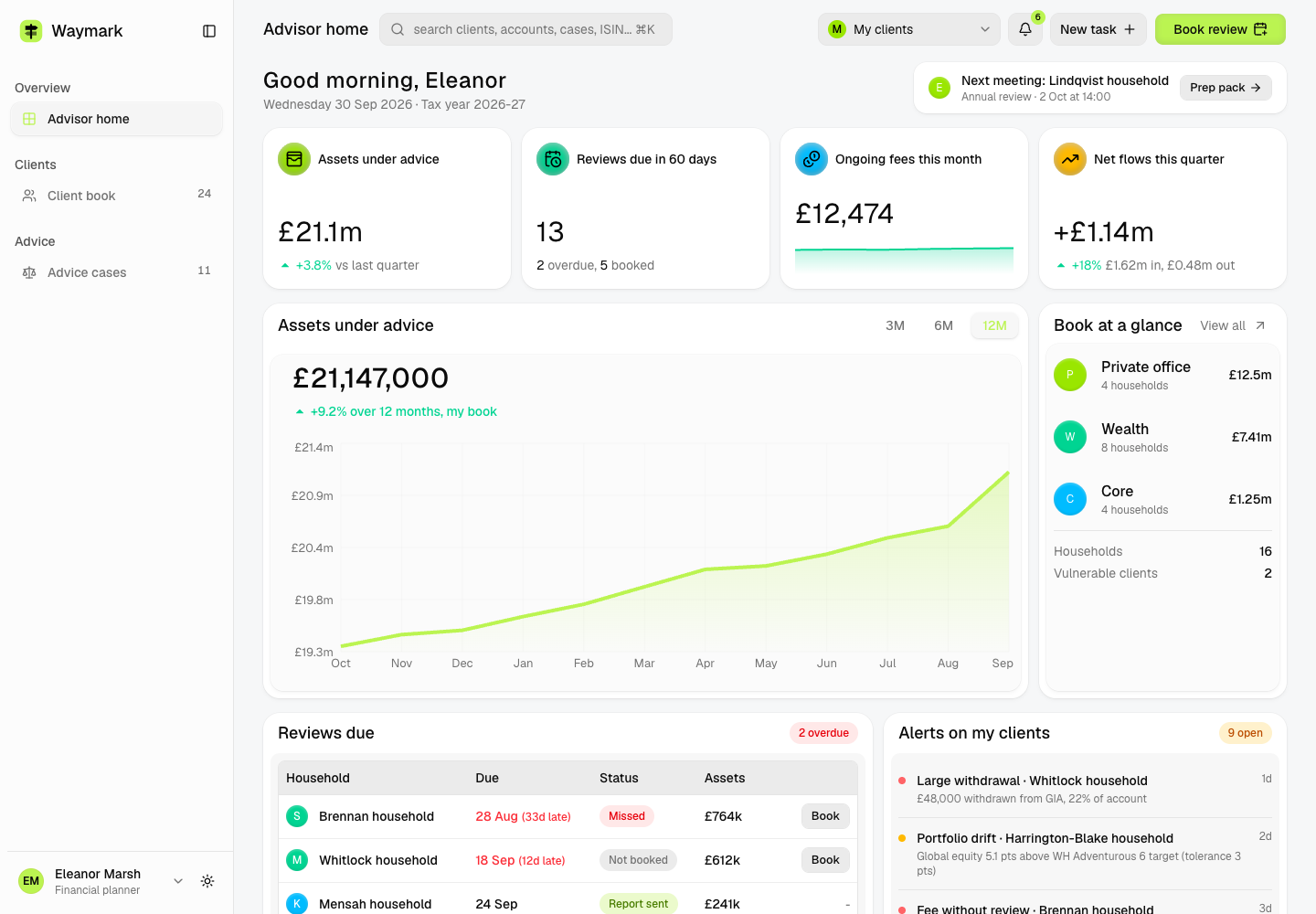
Waymark - Advisor Portal with Suitability Reports Built From the Case
Designed and built a clickable advisor portal for a UK wealth firm's financial planners: a daily home with reviews due and alerts, a segmented client book, a Client 360 for every household, an advice case board and a suitability report builder that will not issue a report until the checks and approvals are in place.
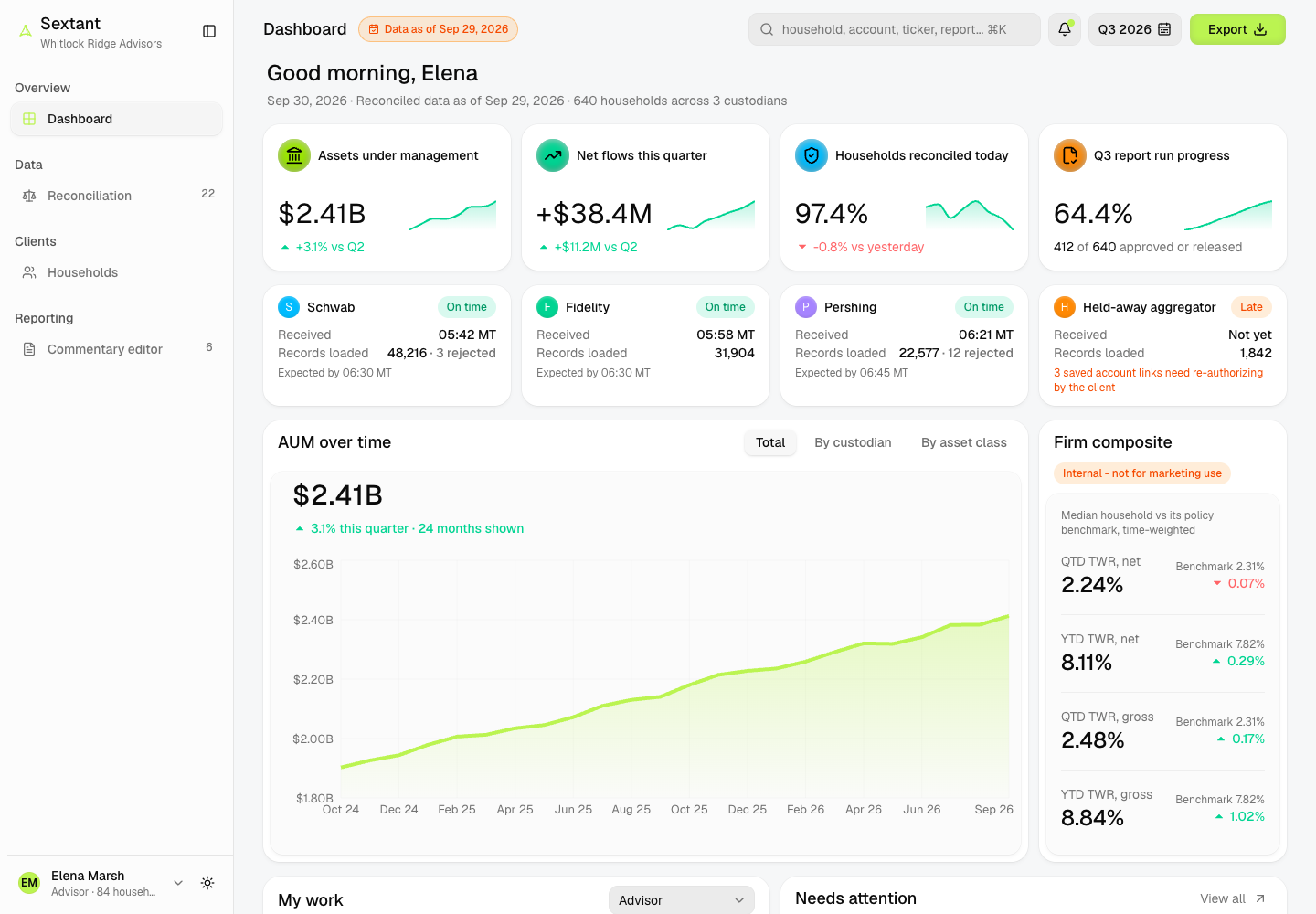
Sextant - Multi-Custodian Portfolio Reporting with Advisor-Reviewed AI Commentary
Designed and built a clickable portfolio reporting platform for a Denver investment adviser with client assets at three custodians: daily reconciliation against custodian files, household views with performance gross and net of fees, and quarterly AI commentary that may only cite engine numbers and needs advisor and compliance sign-off.
Enterprise Software Engineering - Human + AI
Contact Us
© 2026 - Copyright. All Rights reserved Oceanlab
Location
Global Headquarters
21 Merchant Road, 3rd Floor, Singapore 058267
Main corporate office and leadership operations
North America Office
548 Market Street, PMB 12345, San Francisco, CA 94104
Client operations and business development
India Office
402 Shivalik Shilp II, SG Highway, Ahmedabad 380015
Engineering and delivery center

Enterprise Software Engineering - Human + AI
Contact Us
Locations
Global Headquarters
21 Merchant Road, 3rd Floor, Singapore 058267
Main corporate office and leadership operations
North America Office
548 Market Street, PMB 12345, San Francisco, CA 94104
Client operations and business development
India Office
402 Shivalik Shilp II, SG Highway, Ahmedabad 380015
Engineering and delivery center
© 2026 - Copyright. All Rights reserved Oceanlab