Hatid - Remittance App and Ops Console for Sending Money Home to the Philippines
Remittance Operations for a Philippine Money Transfer Company
Designed and built a clickable ops console for a Manila remittance company paying out PHP to the families of overseas Filipino workers: a live view of today's flows across 4 corridors, a transfers monitor with SLA timers, a full transfer record, compliance holds with a tipping-off check, and FX margins priced per corridor, payout method and amount band.
Most of our work is under NDA. Per agreement, we can share the work but not the company details - all names and identifying information shown here have been changed.
Impact
Dashboard, transfers monitor, transfer detail with 6 tabs, compliance holds and FX rates and margins. Every one of the 30 demo transfers opens its own detail page.
4 corridors by 4 payout methods by 3 amount bands. Each edit must sit between a 0.40% floor and a 2.00% cap, applies to new quotes only and is written to the change log.
Screening hit, limit breach, velocity rule, incomplete travel rule data, KYC pending and manual, each shown with the values that tripped it and timed against a 4 business hour SLA.
Across the AED, SAR, SGD and USD corridors, with 12 compliance holds, 14 senders, 16 recipients, 4 licensed sending partners and 7 payout partners.
The Problem
Tanglaw grew through walk-in agents in Dubai, Riyadh and Singapore, and its first app was a thin form that emailed transfers to the operations team. Senders could not see the rate until after they paid, compliance worked holds from a shared inbox, treasury set rates in a spreadsheet each morning and phoned partners when prefunding ran low, returned bank credits sat unnoticed for days, and nobody could tell a sender in Riyadh whether their mother in Iloilo could collect the cash yet.
Our Solution
Hatid follows a transfer from quote and pay-in to payout in the Philippines. The ops console shows today's flows, partner health and prefunding cover on one dashboard, finds any transfer by reference, control number or name, keeps the quote, travel rule data, timeline and ledger on one record, puts every compliance hold next to the rules that fired, and lets treasury price each corridor with audited margins.
The Challenge: Money Home Across Many Hands
Every transfer passes through a licensed sending partner abroad, Tanglaw in Manila and a payout partner in the Philippines, under BSP rules, Philippine anti-money laundering law and the travel rule at once.
The Price Shown Too Late
BSP consumer protection rules and the Financial Products and Services Consumer Protection Act expect the sender to see the rate, the fee, the total and the exact PHP received before paying, with the rate locked for a set window. Tanglaw's senders saw the rate after paying and compared prices in Facebook groups instead.
Compliance Without Tipping Off
Under the Anti-Money Laundering Act, Tanglaw is a covered person: it screens senders and recipients against UN, AMLC and OFAC lists, holds transfers with incomplete travel rule data, and files CTRs above PHP 500,000 in one banking day and STRs at any amount. Staff must never tell a customer an STR is being filed.
Five Ways to Pay Out, Each With Limits
InstaPay is real time with a cap of generally PHP 50,000, PESONet is batch with no cap, e-wallets have their own account limits, and cash pickup needs a valid ID and the control number. Bank account names are not guaranteed to be checked, so credits can come back days later.
Licences and Cash Spread Across Partners
Collection in each country runs through a partner licensed by the CBUAE, SAMA, MAS or FinCEN and the states, while payout partners need PHP prefunded before they can pay. With rates in a spreadsheet and top-ups by phone, nobody saw a partner running dry until payouts failed.
Our Approach: From Remittance Rules to a Clickable Console
Spec and Rules Research
Mapped 8 roles from sender and recipient to compliance analyst, MLRO, treasury, support, payout operations and admin, 44 screens across the sender app, a public tracking page and the ops console, and the data model for corridors, partners, quotes, transfers, holds, RFIs, screening hits, reports, refunds and prefunding. Wrote down the rules the design follows: BSP registration and the National Payment Systems Act, AMLA, FATF Recommendation 16, sanctions under RA 10168 and the Anti-Terrorism Act, tiered KYC, InstaPay and PESONet rules, RA 11765 and the Data Privacy Act.
Clickable Demo on a Production UI Kit
Built the ops console's 5 key screens on a production dashboard kit: the dashboard with KPIs, hourly volume by corridor, pipeline, prefunding cover and partner status; the transfers monitor with SLA-coloured time in status and bulk re-route; transfer detail with quote, travel rule and ledger; compliance holds with the RFI composer; and the FX desk with the margin editor and rate freeze. Holds, re-routes, RFIs and margin changes all run on local state.
What a Production Build Adds
Integration with KYC and liveness (such as Onfido or Sumsub), sanctions screening (such as ComplyAdvantage or LSEG World-Check), a live FX feed, card pay-in with 3-D Secure, a Philippine partner bank for InstaPay and PESONet, GCash and Maya, pawnshop pickup networks, SMS, support desk and AMLC report uploads. Staff auth by role, an append-only audit log, the 19-screen sender app in English and Filipino, the recipient tracking page and the remaining 19 ops screens.
Why It Works: Every Transfer Accounted For
Every Hold Shows Why It Stopped
A hold opens beside the transfer, a customer 360 summary and the rules that fired with their values, such as 5 transfers to 4 new recipients in 24 hours against a rule of 3, plus screening hits with list and score and any open RFIs. Release, reject or escalate to the MLRO from the same view.
RFIs That Cannot Tip Off
The RFI composer blocks words such as suspicious, report, AMLC and STR before the message can be sent. In the spec, the sender only ever sees a plain line such as "We need a bit more information from you", never the reason for a review.
Stale Rates Are Caught Before Quoting
Feed age turns red past 60 seconds and each corridor has a rate freeze switch. Treasury sees open quotes, unhedged PHP owed and competitor rates beside the live mid-market rate, and every margin, lock window and freeze change is logged with who made it.
Partner Trouble Shows Up First
A red dot in the top bar marks a payout partner that is down, prefunding shows hours of cover left with warnings under 8 hours and 4 hours, and transfers stuck with the down partner can be re-routed in bulk with a reason. Personal data stays masked, and every Reveal is logged.
Related case studies
View all: Payments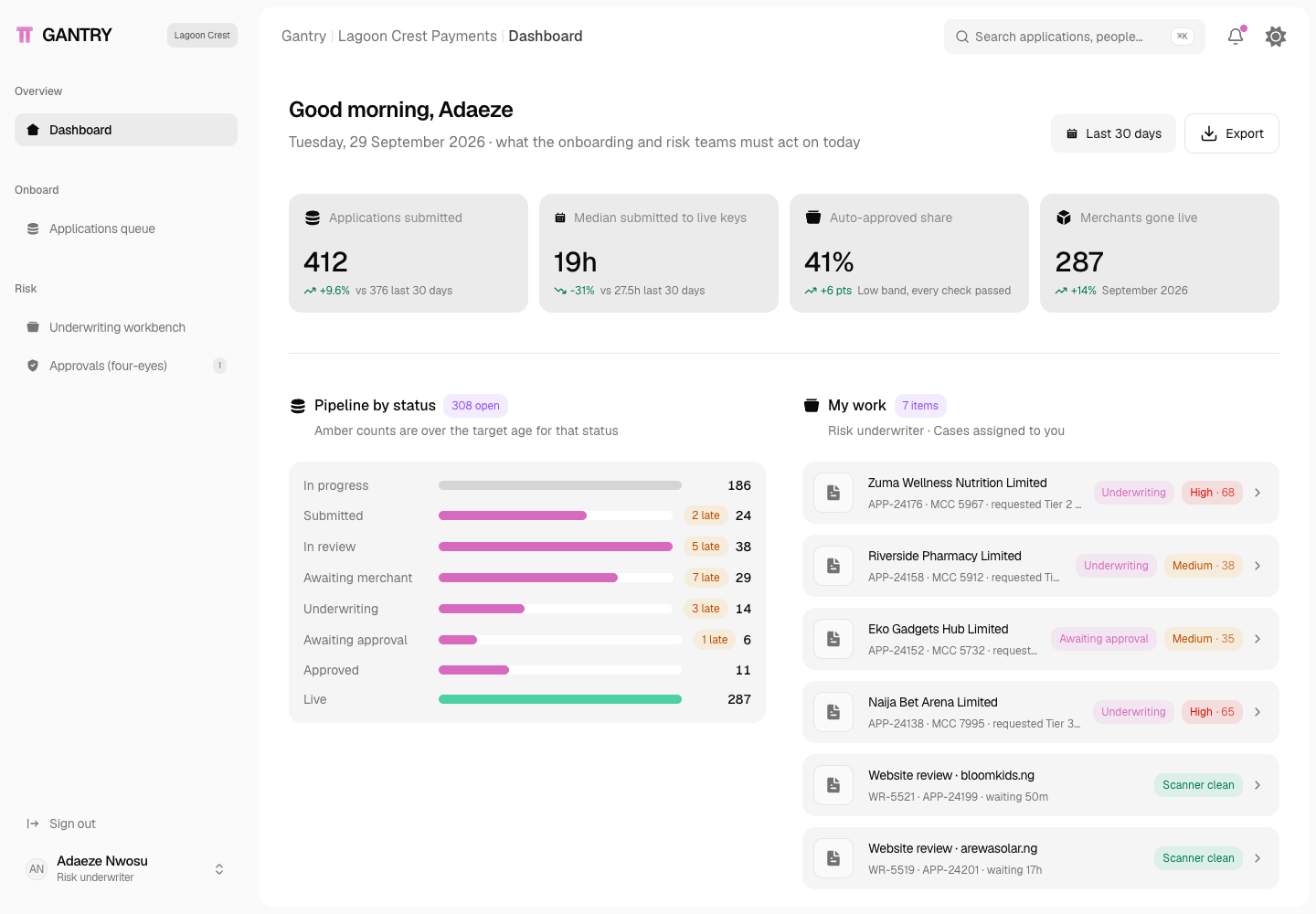
Gantry - Merchant Onboarding and KYB Platform with Four-Eyes Underwriting
Designed and built a clickable merchant onboarding and KYB console for a CBN-licensed payment gateway in Lagos: an applications queue, a case review that checks CAC, BVN, NIN, liveness and the settlement account name in one place, an underwriting workbench with an explainable risk score, limits and rolling reserves, and four-eyes approvals bound to each approver's mandate.
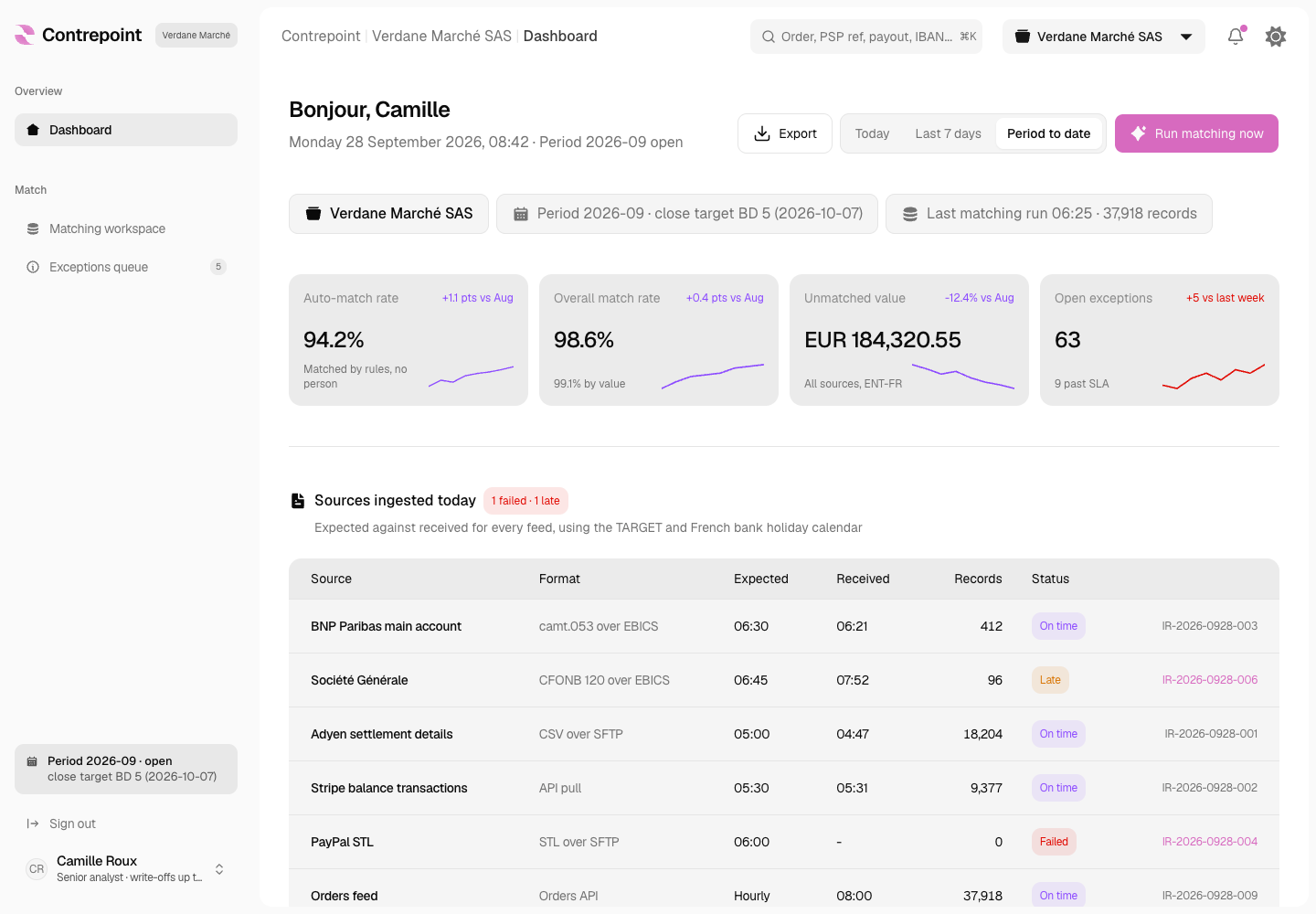
Contrepoint - Three-Way Reconciliation Engine for Orders, PSP Payouts and Bank Lines
Designed and built a clickable reconciliation engine for a Lyon-based marketplace group paid through Adyen, Stripe, PayPal and SEPA: it matches orders to PSP transactions, payouts and bank statement lines, explains every suggestion, turns what is left into a worked exceptions queue and traces each match to the journal entries it posts.
Enterprise Software Engineering - Human + AI
Contact Us
© 2026 - Copyright. All Rights reserved Oceanlab
Location
Global Headquarters
21 Merchant Road, 3rd Floor, Singapore 058267
Main corporate office and leadership operations
North America Office
548 Market Street, PMB 12345, San Francisco, CA 94104
Client operations and business development
India Office
402 Shivalik Shilp II, SG Highway, Ahmedabad 380015
Engineering and delivery center

Enterprise Software Engineering - Human + AI
Contact Us
Locations
Global Headquarters
21 Merchant Road, 3rd Floor, Singapore 058267
Main corporate office and leadership operations
North America Office
548 Market Street, PMB 12345, San Francisco, CA 94104
Client operations and business development
India Office
402 Shivalik Shilp II, SG Highway, Ahmedabad 380015
Engineering and delivery center
© 2026 - Copyright. All Rights reserved Oceanlab