Grantbook - Pre-Award Grant Platform from Call to Funding Line
Grant Applications Platform for a Czech Research Foundation
Designed and built a clickable pre-award grant platform for a Prague research foundation: a dashboard of every call's stages, proposals with ORCID-verified teams and word-limited sections, eligibility checks that a person always confirms, and a panel meeting screen with anonymised reviews, weighted scoring and a funding line.
Most of our work is under NDA. Per agreement, we can share the work but not the company details - all names and identifying information shown here have been changed.
Impact
Dashboard, applications, application detail with 7 tabs, eligibility checks and the panel meeting. Every one of the 28 demo proposals opens its own detail page.
Host institution, one proposal per PI, no more than two active grants, doctorate within 8 years plus declared career breaks, and a 3.5 minimum score to resubmit. Each shows its evidence, and an officer confirms every finding.
Excellence 40%, methods and feasibility 30%, team 15%, and impact and open science 15%, scored 1 to 5. The ranked list runs against the panel's CZK 58,000,000 budget.
Across 6 calls, 4 panels and 9 institutions, with 5 staff users and a live panel meeting of 7 members and 10 proposals on the agenda.
The Problem
Lipnice Research Foundation funds about 900 grants a year from about 4,000 applications, and ran its calls on a form builder, a shared mailbox and one spreadsheet per panel. Budgets were checked by hand against rules that changed per call, reviewers were matched from memory, conflicts were declared by email, and feedback letters copied from reviews twice sent a reviewer's name to an applicant. A standard call took 7 months from deadline to decision.
Our Solution
Grantbook runs the pre-award cycle in one place: calls with their own eligibility rules, proposals with authenticated ORCID iDs, ROR-identified institutions and word limits, eligibility suggestions a programme officer confirms, conflict-checked peer review, and panel meetings that rank proposals by weighted score and set a funding line against the panel's budget.
The Challenge: Fair Funding Decisions at Scale
A research funder has to judge thousands of proposals across six call types and every scientific field, keep reviewers anonymous and unconflicted, and be able to show afterwards who decided what and why.
Rules That Change With Every Call
Each call type sets its own eligibility rules, word limits, cost categories, overhead method and grant caps. Junior grants, for example, depend on when the doctorate was awarded, extended by declared career breaks. Officers checked all of it by hand.
People, Not Algorithms, Decide
Under GDPR Article 22, applicants should not be refused by a solely automated decision. Automatic checks can only suggest an outcome; an officer has to confirm every ineligible finding with a reason, and a manager has to approve it.
Peer Review Without Conflicts or Leaks
Reviewers and panel members must declare conflicts before seeing a proposal, reviewer names must never reach applicants, and assessment follows ALLEA and DORA principles: the work itself, not journal impact factors.
Panels Ranked in a Spreadsheet
Panel chairs ranked proposals in a spreadsheet that went through a dozen versions, with no record of why one moved above another or where the money ran out. The board had to approve a list nobody could trace.
Our Approach: From Funding Rules to a Clickable Platform
Spec and Rules Research
Mapped 12 roles, from programme officers and panel chairs to external reviewers, research offices and the board, and 51 screens across the staff console and the applicant, research office and reviewer portals. Defined the data model for calls, proposals, budgets, eligibility findings, conflicts, reviews, panel meetings and decisions, and the rules the design follows: GDPR and Czech Act No. 110/2019 Coll., Act No. 328/2025 Coll. on research funding, foundation governance under the Civil Code, ALLEA, DORA and Plan S.
Clickable Demo on a Production UI Kit
Built 5 key staff screens on a production dashboard kit: the dashboard with KPIs, a call timeline that turns late stages amber, work by role and reviews coverage; the applications list with filters and a quick view; application detail with team, flags and 7 tabs; eligibility checks with five queues and evidence per rule; and the panel meeting with quorum, anonymised reviews, per-criterion scoring, the ranked list and the funding line. All actions run on local state.
What a Production Build Adds
ORCID sign-in and works, ROR and ARES institution data, eduID.cz and mojeID sign-in, OpenAlex for reviewer expertise and co-authorship, Crossref Similarity Check, DocuSign or Signi for agreements and EU-region email. Plus role-based access, an append-only audit trail, and the remaining screens: call setup, reviewer matching, conflicts, decisions, letters, agreements, reports and the applicant, research office and reviewer portals.
Why It Works: Every Decision Has a Name and a Reason
Suggestions, Then a Person
Eligibility checks split proposals into suggested ineligible, needs officer check, suggested eligible, awaiting manager approval and done. Each rule shows its evidence, and confirming a proposal ineligible needs the rule breached and a plain-language reason for the applicant.
One View of Every Call
The dashboard shows each call's path from open to agreements with today marked and overdue stages in amber, next to reviews received against reviews needed and the work waiting for each role.
Anonymous, Conflict-Aware Panels
In the meeting, external reviews show as Reviewer 1, 2 and 3, members with a conflict are marked as out of the room for that item, and the header shows attendance against Lipnice's quorum rule, chair included.
A Funding Line You Can Trace
Panel scores are weighted by the call's criteria, the ranked list shows the cumulative budget against the panel's money, and the line sorts proposals into recommended, reserve and not recommended. Moving a proposal needs a reason, and closing the meeting locks the list.
Related case studies
View all: Science & research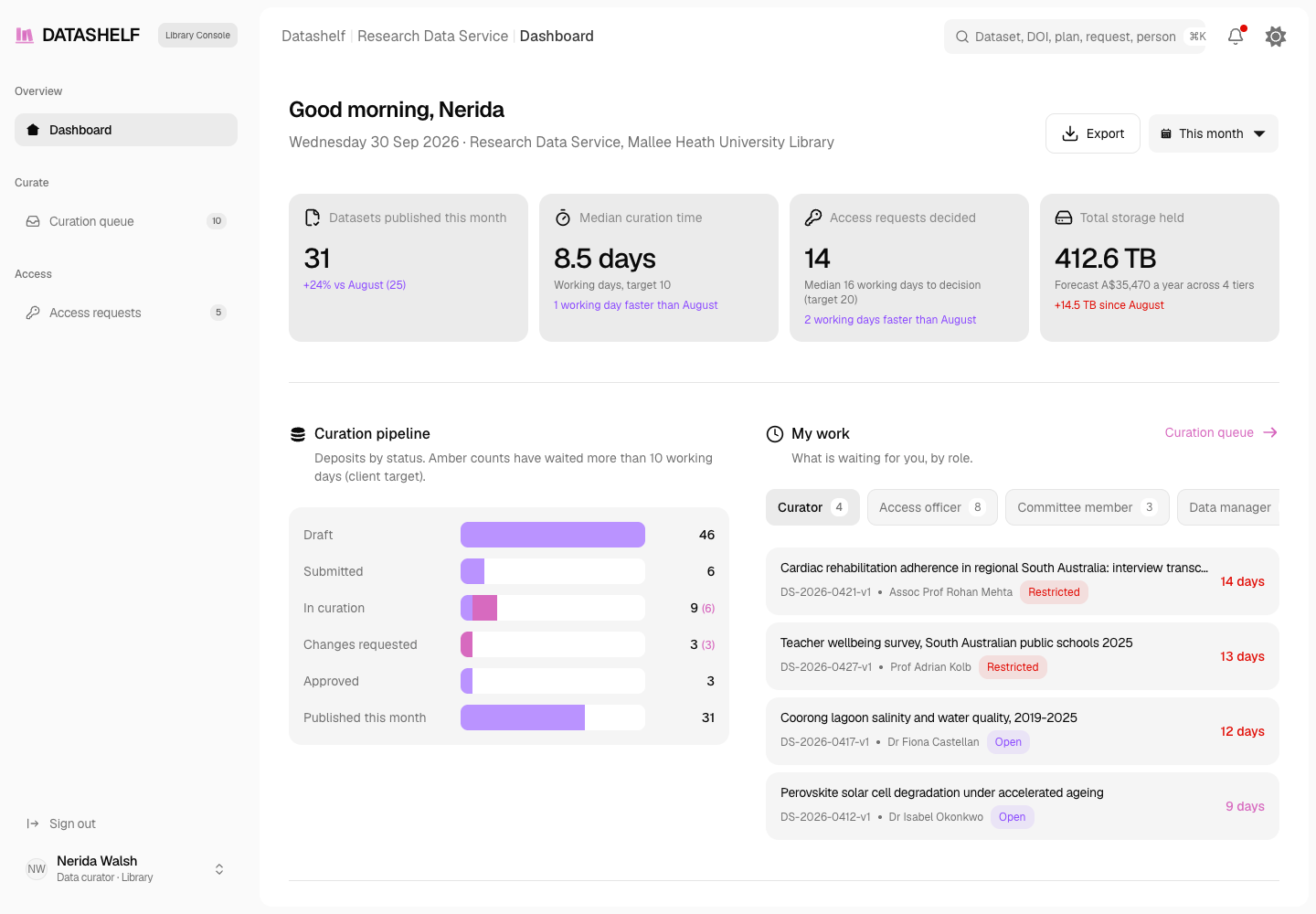
Datashelf - Research Data Repository with FAIR Curation and Controlled Access
Designed and built a clickable library console for an Adelaide university's research data repository: a curation queue on working-day clocks, a review workspace that checks every deposit against a FAIR checklist before a DOI is minted, and an access workflow that routes restricted and sensitive datasets to the custodian, the data access committee or the community data authority.
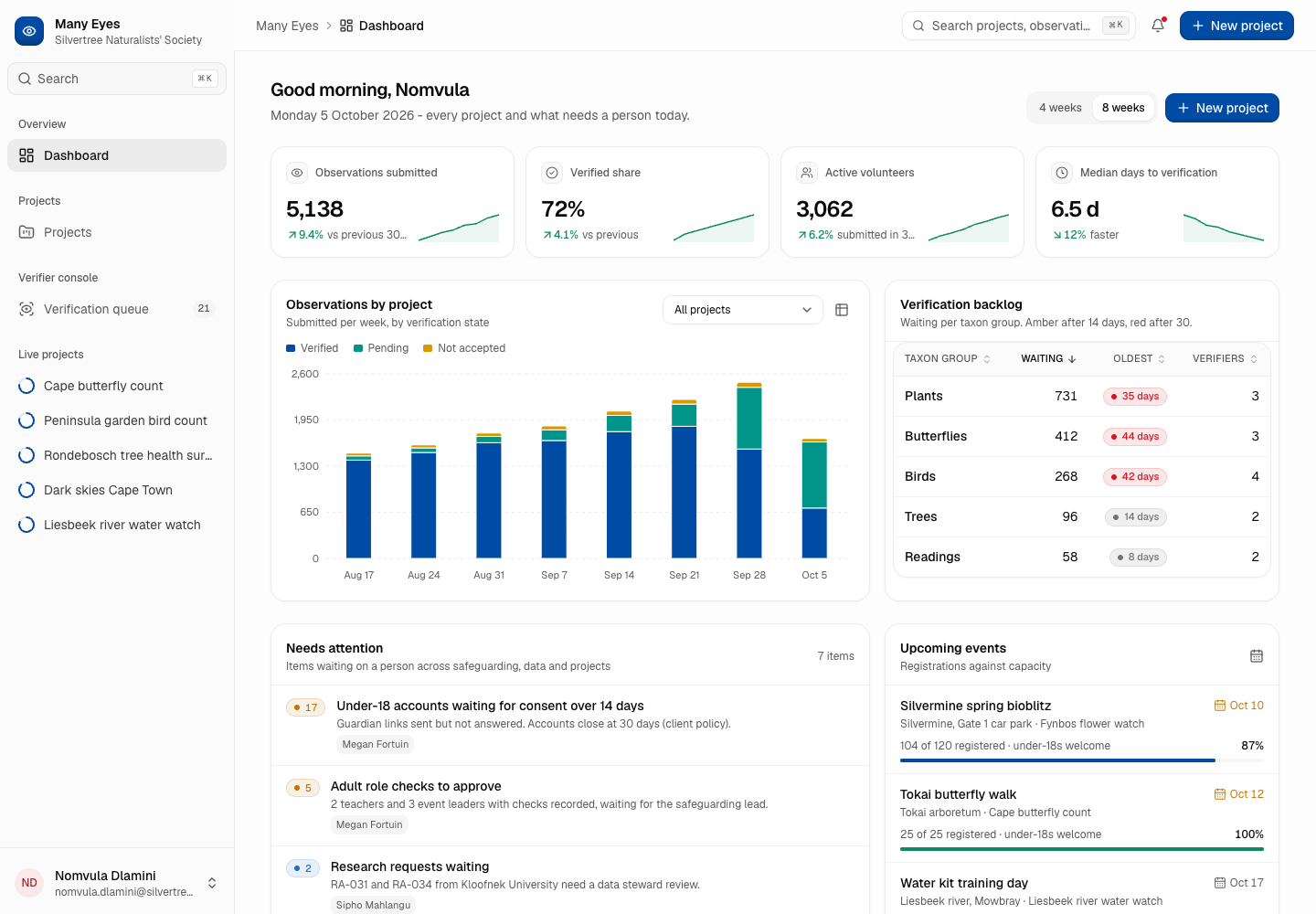
Many Eyes - Citizen Science Platform with Expert Verification and Research-Ready Data
Designed and built a clickable staff console for a Cape Town natural history society and its university partner: every project's numbers on one dashboard, a verification queue sorted by age, and a workspace where experts agree, correct or reject each observation against the project's consensus rule, with sensitive species locations kept generalised.
Enterprise Software Engineering - Human + AI
Contact Us
© 2026 - Copyright. All Rights reserved Oceanlab
Location
Global Headquarters
21 Merchant Road, 3rd Floor, Singapore 058267
Main corporate office and leadership operations
North America Office
548 Market Street, PMB 12345, San Francisco, CA 94104
Client operations and business development
India Office
402 Shivalik Shilp II, SG Highway, Ahmedabad 380015
Engineering and delivery center

Enterprise Software Engineering - Human + AI
Contact Us
Locations
Global Headquarters
21 Merchant Road, 3rd Floor, Singapore 058267
Main corporate office and leadership operations
North America Office
548 Market Street, PMB 12345, San Francisco, CA 94104
Client operations and business development
India Office
402 Shivalik Shilp II, SG Highway, Ahmedabad 380015
Engineering and delivery center
© 2026 - Copyright. All Rights reserved Oceanlab