Datashelf - Research Data Repository with FAIR Curation and Controlled Access
Research Data Repository for an Australian University
Designed and built a clickable library console for an Adelaide university's research data repository: a curation queue on working-day clocks, a review workspace that checks every deposit against a FAIR checklist before a DOI is minted, and an access workflow that routes restricted and sensitive datasets to the custodian, the data access committee or the community data authority.
Most of our work is under NDA. Per agreement, we can share the work but not the company details - all names and identifying information shown here have been changed.
Impact
Dashboard, curation queue, curation review, access requests and access request detail. Each of the 18 demo deposits opens its own review and each of the 16 access requests its own detail page.
16 Findable, Accessible, Interoperable and Reusable items plus 8 sensitive-data items that appear only when a flag is set. A live 0 to 100 quality score, and Approve and publish stays blocked until every mandatory item passes.
Human participants, Indigenous data, third-party rights, health information, threatened species location and commercial in confidence. Each flag adds its own checklist items and evidence, and decides who rules on access.
18 deposits from 5 faculties, 16 access requests on 9 restricted datasets, 26 staff and researcher accounts, 5 retention classes and 4 storage tiers holding 412.6 TB.
The Problem
Mallee Heath's research data lived on lab drives, personal cloud accounts and an ageing repository that only accepted files under 2 GB. Data management plans were Word documents attached to grant applications and never looked at again, curators minted DOIs by hand in the DataCite web form, access requests for sensitive datasets sat in one person's inbox with no record of who approved what, and nobody could tell the research office how much data the university held, what it cost or what was due for disposal review.
Our Solution
Datashelf gives the library's Research Data Service one console from deposit to DOI to access decision. Curators work a queue on working-day clocks and review each deposit against a FAIR checklist that blocks publishing until mandatory items pass, while access officers screen requests and route them to the custodian, the data access committee or the community data authority, with every response recorded.
The Challenge: Sharing Research Data Inside the Rules
A university repository has to make data findable and citable while protecting the people, communities and partners behind it. The rules that apply change with every dataset: what participants consented to, whose data it is, who holds the rights and how long it must be kept.
Data Scattered Across Drives
Datasets sat on lab drives, personal cloud accounts and an old repository with a 2 GB file limit. Data management plans were filed with grant applications and never linked to what was later deposited, so funders' questions about data had no easy answer.
Consent Sets the Limits
Research with human participants follows the National Statement and an HREC approval, and reuse must stay within the consent participants gave. Every deposit flagged for human participants has to carry its HREC number and consent scope, and every access request has to be checked against it.
Communities Control Their Data
Data about Aboriginal and Torres Strait Islander peoples is governed by the CARE Principles, the Maiam nayri Wingara principles and the AIATSIS Code of Ethics. In practice a named community data authority must approve each request, on top of the custodian and the committee.
Retention, Cost and Privacy Unclear
The Australian Code for the Responsible Conduct of Research expects data to be kept for an appropriate period and disposed of properly, with minimums from state disposal schedules and funder conditions. Whether the Privacy Act 1988 or South Australia's Information Privacy Principles apply depends on the university's status, so identifiable data is restricted by default.
Our Approach: From Research Data Rules to a Clickable Console
Spec and Rules Research
Mapped 10 user roles, 38 screens across the library console, researcher portal and public catalogue, 4 slide-over panels and about 17 modals, and the data model for plans, datasets and versions, DataCite metadata, files with checksums, sensitive flags, checklist items, curation reviews, DOIs, access requests, committee meetings, retention classes and storage tiers. Wrote down the rules the design follows: privacy law, the National Statement, the CARE and Maiam nayri Wingara principles, the AIATSIS Code, the Australian Code, state records schedules, the FAIR principles and the DataCite Metadata Schema 4.x.
Clickable Demo on a Production UI Kit
Built 5 key library console screens on a production dashboard kit: the dashboard with KPIs, curation pipeline, My work by role, deposits by faculty and a downloads and citations chart, the curation queue with tabs, filters and a quick view panel, the curation review with editable DataCite fields, file checksums and virus scans, the FAIR checklist and the Approve and publish modal, the access request list, and the request detail with screening, routing, a consultation log and the decision and issue access modals. Everything runs on mock data in the browser.
What a Production Build Adds
Sign-in through the Australian Access Federation, DOI minting through the DataCite REST API via ARDC, ORCID, ROR and Crossref lookups, Research Data Australia harvesting over OAI-PMH, Globus for large transfers, S3 storage in the Sydney region with an archive tier, OpenSearch, the research management system and COUNTER usage metrics. Role-based access, an audit log of every access decision, licence, embargo, DOI event and disposal, and the remaining screens: the researcher portal, the public catalogue, committee meetings, retention and disposal, storage and costs, reports and settings.
Why It Works: Rules Built Into Every Step
The Checklist Gates Publishing
Most FAIR items are auto-checked, the rest are ticked by the curator, and each can carry a comment for the depositor. The quality score updates as items pass, curator edits to metadata are kept as suggested changes the depositor sees, and Approve and publish only opens once every mandatory item passes.
Sensitive Data Shows Its Evidence
The Sensitive data tab lists each flag with its HREC number, consent scope, community data authority or third-party licence, and warns when they disagree, such as identifiable data set to open, sensitive data off the Restricted storage tier, a missing community agreement or a human participants deposit with no HREC number.
The Data Decides the Route
Restricted data without sensitive flags goes to its custodian. Human participants, health or Indigenous data goes to the data access committee, with a quorum of 3 including the chair, and Indigenous data also needs the community data authority's approval. Whether a purpose fits the consent is shown as a prompt for the access officer, not an automatic decision.
Clocks in Working Days
Deposits turn amber after 7 working days and red after 10, the client's curation target, and access requests turn amber after 15 and red after 20. The dashboard's Needs attention list and My work panel, switchable between curator, access officer, committee member and data manager, show what is late first.
Related case studies
View all: Science & research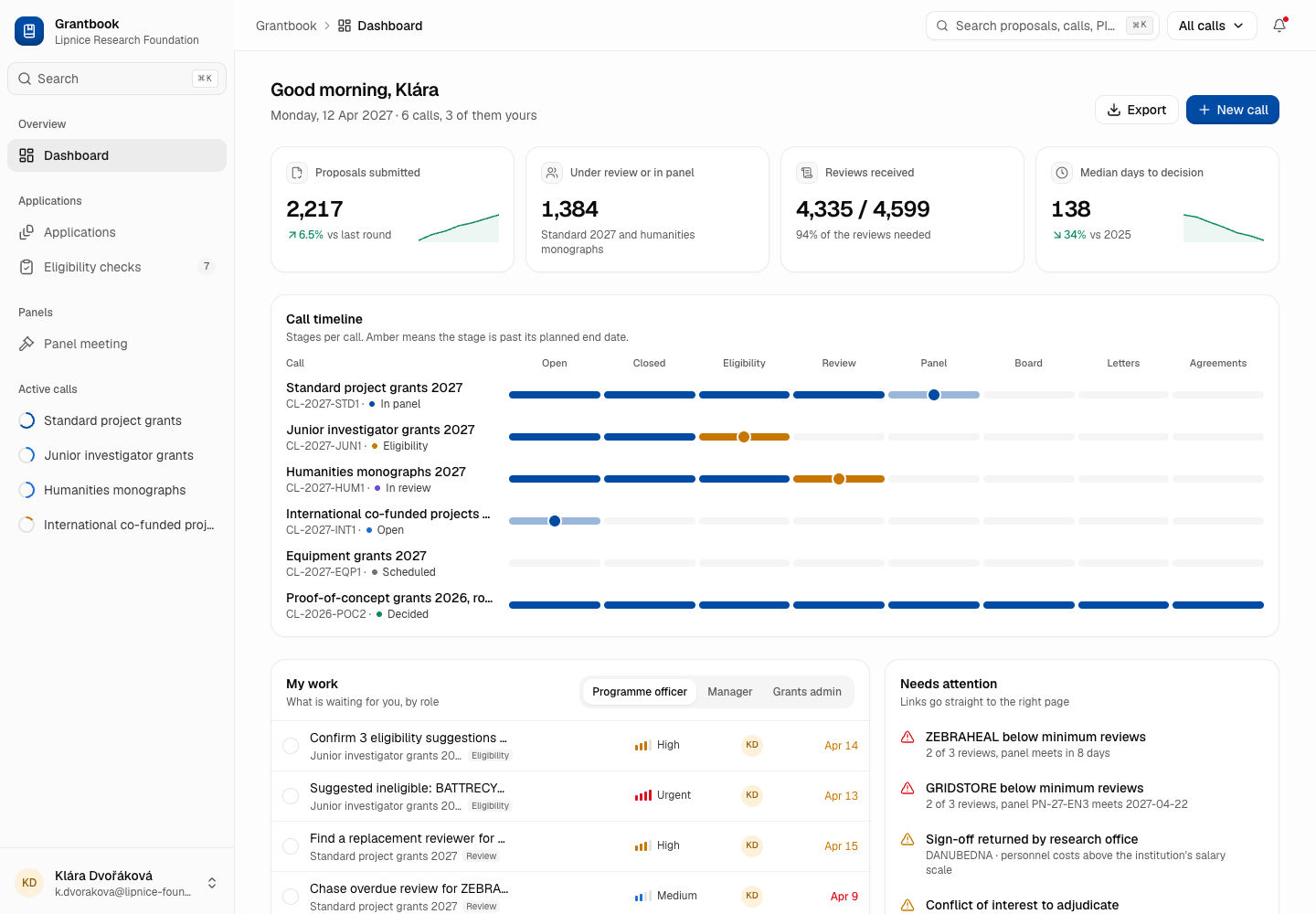
Grantbook - Pre-Award Grant Platform from Call to Funding Line
Designed and built a clickable pre-award grant platform for a Prague research foundation: a dashboard of every call's stages, proposals with ORCID-verified teams and word-limited sections, eligibility checks that a person always confirms, and a panel meeting screen with anonymised reviews, weighted scoring and a funding line.
Many Eyes - Citizen Science Platform with Expert Verification and Research-Ready Data
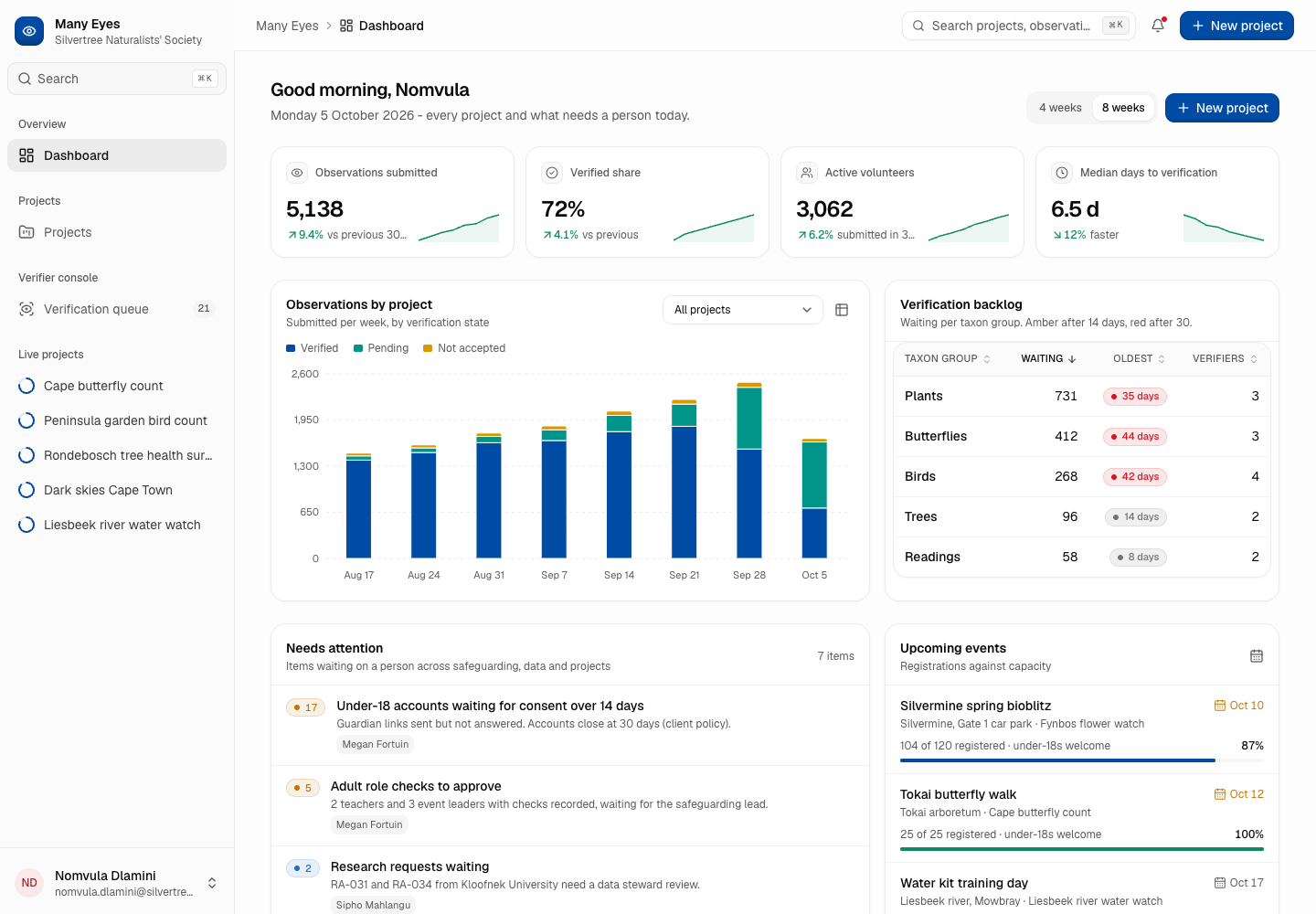
Designed and built a clickable staff console for a Cape Town natural history society and its university partner: every project's numbers on one dashboard, a verification queue sorted by age, and a workspace where experts agree, correct or reject each observation against the project's consensus rule, with sensitive species locations kept generalised.
Enterprise Software Engineering - Human + AI
Contact Us
© 2026 - Copyright. All Rights reserved Oceanlab
Location
Global Headquarters
21 Merchant Road, 3rd Floor, Singapore 058267
Main corporate office and leadership operations
North America Office
548 Market Street, PMB 12345, San Francisco, CA 94104
Client operations and business development
India Office
402 Shivalik Shilp II, SG Highway, Ahmedabad 380015
Engineering and delivery center

Enterprise Software Engineering - Human + AI
Contact Us
Locations
Global Headquarters
21 Merchant Road, 3rd Floor, Singapore 058267
Main corporate office and leadership operations
North America Office
548 Market Street, PMB 12345, San Francisco, CA 94104
Client operations and business development
India Office
402 Shivalik Shilp II, SG Highway, Ahmedabad 380015
Engineering and delivery center
© 2026 - Copyright. All Rights reserved Oceanlab