Dropzone - Operations Console for a Medical Drone Delivery Network
Drone Delivery Operations for Rural Clinics in Malawi
Designed and built a clickable operations console for a medical drone operator flying blood, samples, vaccines and medicines from one hub near Lilongwe to 40 rural clinics: an order queue fed by app, SMS and phone, a mission board with weather, airspace and battery checks, and a live flight monitor that mirrors telemetry without ever sending a command to an aircraft.
Most of our work is under NDA. Per agreement, we can share the work but not the company details - all names and identifying information shown here have been changed.
Impact
Operations board, order queue, order detail, mission board and live flight monitor, plus a New order panel. Each of the 27 demo orders opens its own detail page with stage times, packing, cold chain and activity.
Wind and gust at the hub and each drop zone are marked pass, marginal or fail against the client's limits: 10 and 13 m/s for multirotors, 12 and 15 m/s for fixed-wing, marginal within 1.5 m/s of either.
Emergency orders pin to the top of the queue and pulse until accepted, and a red banner follows staff to every page while one is unassigned. Order ages turn amber past their priority's target and red past twice the target.
40 clinics in 5 districts, 27 orders, 19 missions, 14 aircraft (8 fixed-wing, 6 multirotor), 8 remote pilots, 15 payload catalogue items and 4 aircraft airborne with live alerts.
The Problem
Linthipe Air Medical grew from a pilot corridor of 6 clinics to 40 in two years, but its back office did not grow with it. Orders arrived as SMS messages, WhatsApp voice notes and calls and were copied onto a whiteboard, mission plans and pre-flight checklists lived on paper, and battery cycle counts sat in one technician's spreadsheet. When a unit of blood took 3 hours instead of 40 minutes, nobody could say why, and the aviation authority's requests for flight records had to be rebuilt by hand.
Our Solution
Dropzone takes an order from a clinic by app, SMS or phone, tracks it through packing, mission planning, pilot sign-off, flight and delivery, and records who did what at each step. The operations board shows what is flying, what is waiting and what is blocking, and the live flight monitor mirrors autopilot telemetry while flight control stays with the remote pilot and the ground control station.
The Challenge: Medical Deliveries by Air, on Paper
A medical drone network has to move blood and vaccines fast, inside aviation approvals, weather limits and cold-chain ranges, for clinics that often have only a basic phone and a patchy signal.
Orders From Every Channel
Clinics ordered by SMS, WhatsApp voice note and phone call, and the order desk copied each one onto a whiteboard. There was no single record of when an order arrived, who accepted it or whether a delay came from intake, packing, weather or a grounded aircraft.
Flying Inside Approvals and Limits
Beyond visual line of sight operations generally need approval from the Malawi Civil Aviation Authority, with registered aircraft, licensed remote pilots and approved routes. Each mission also has to sit inside the operator's wind, gust and battery reserve limits for its aircraft type, and clear of no-fly zones and NOTAMs.
A Cold Chain That Leaves the Fridge
Red cells must stay inside the range the blood service specifies and vaccines generally at 2 to 8 °C. A payload can go out of range while packed, in flight or waiting at the drop zone, and someone has to notice and decide whether it is still usable.
Software Next to a Flying Aircraft
Flight control, geofencing and lost-link behaviour run in the certified autopilot and ground control station. The operations system has to show every alert and lost-link step without ever being able to command an aircraft, and an outage must never affect a flight in progress.
Our Approach: From Flight Rules to a Clickable Console
Spec and Rules Research
Mapped 11 user roles, from the head of flight operations and remote pilots to clinic staff ordering by SMS, and 42 screens across the staff console and a mobile clinic app. Defined the data model for clinics, drop zones, routes, orders, payloads, missions, aircraft, batteries, pilots, telemetry, excursions and occurrences, and wrote down the rules the design follows: MCAA approvals for RPAS and BVLOS, NOTAMs, occurrence reporting, PMRA and blood service requirements, WHO cold-chain guidance and the Data Protection Act, 2024.
Clickable Demo on a Production UI Kit
Built 5 key screens on a production dashboard kit: the operations board with network status, KPIs, network map, weather now and a pipeline by stage, the order queue with filters and bulk actions, order detail with a cold-chain trace, the mission board with a timeline view and wind, airspace and reserve checks before PIC sign-off, and the live flight monitor with an alert feed and a time-stamped lost-link checklist. All actions run on local state.
What a Production Build Adds
Read-only MAVLink telemetry through a ground control station bridge with an Iridium backup link, DCCMS and forecast weather, OpenStreetMap tiles with terrain data, an SMS short code through Africa's Talking or Twilio, Bluetooth or cellular temperature loggers and DHIS2 for the facility list. Staff sign-in by role with PIN re-confirmation for sign-offs, an append-only audit log, and the remaining screens: mission planner, pre-flight checklist, flight replay, fleet, crew, safety, reports, settings and the clinic app.
Why It Works: Plans, Monitors and Records, Never Flies
One Board for the Whole Day
The operations board opens on the network status with who set it and why, deliveries against plan, emergency orders and available aircraft, then a pipeline from New to Delivered with the oldest item in each stage and a Needs attention list that links to the order or mission to fix.
Blockers Shown Before a Pilot Sees Them
Every mission card carries its blocker: no pilot, a battery set below the 25% landing reserve, a gust over the limit at the drop zone, or a NOTAM conflict. Weather is graded per aircraft type, so a LIMITED status can hold multirotors on escarpment routes while fixed-wing aircraft keep flying.
Telemetry In, Never Commands Out
The live monitor shows altitude, speed, battery against the planned curve, primary and backup link and payload temperature for each aircraft. Alerts show the aircraft's lost-link procedure and the next checklist step, and events such as a drop or an abort are logged as the pilot reports them from the ground control station.
Cold Chain and Delivery on Every Order
Each order keeps its stage times, the original SMS text, packing with the logger id, and a temperature trace against the payload's range from the catalogue. An excursion is flagged with its peak and time outside range, and a delivery stays open until the clinic confirms receipt.
Related case studies
View all: Space & frontier tech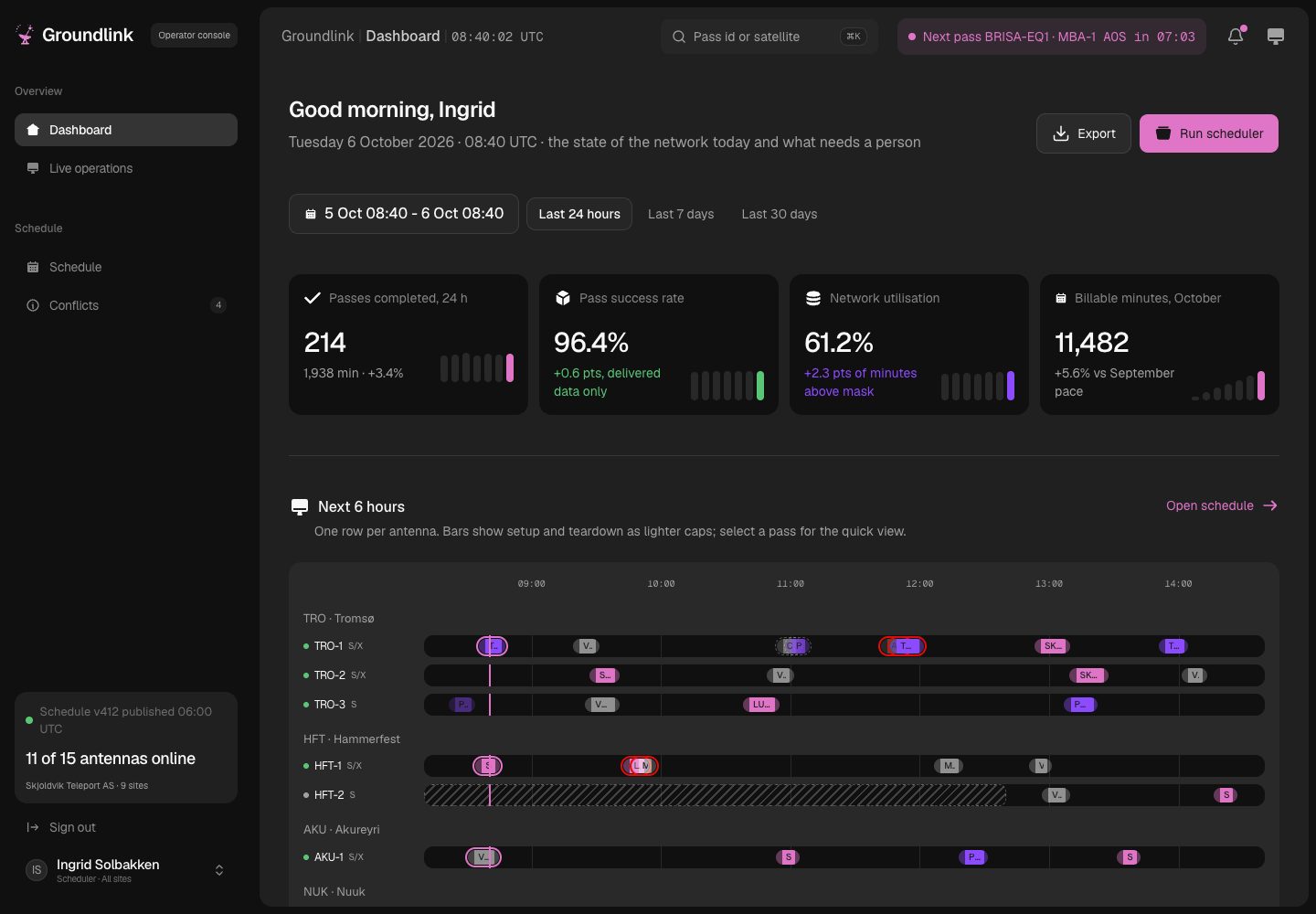
Groundlink - Ground Station Scheduling Platform from Orbit Data to Invoice
Designed and built a clickable scheduling and operations platform for a Tromsø ground-station-as-a-service operator: predict and book satellite passes across nine antenna sites, resolve conflicts by priority tier and contract, block any pass a site licence does not cover, follow every pass live through antenna telemetry and trace it through to delivered data and billable minutes.
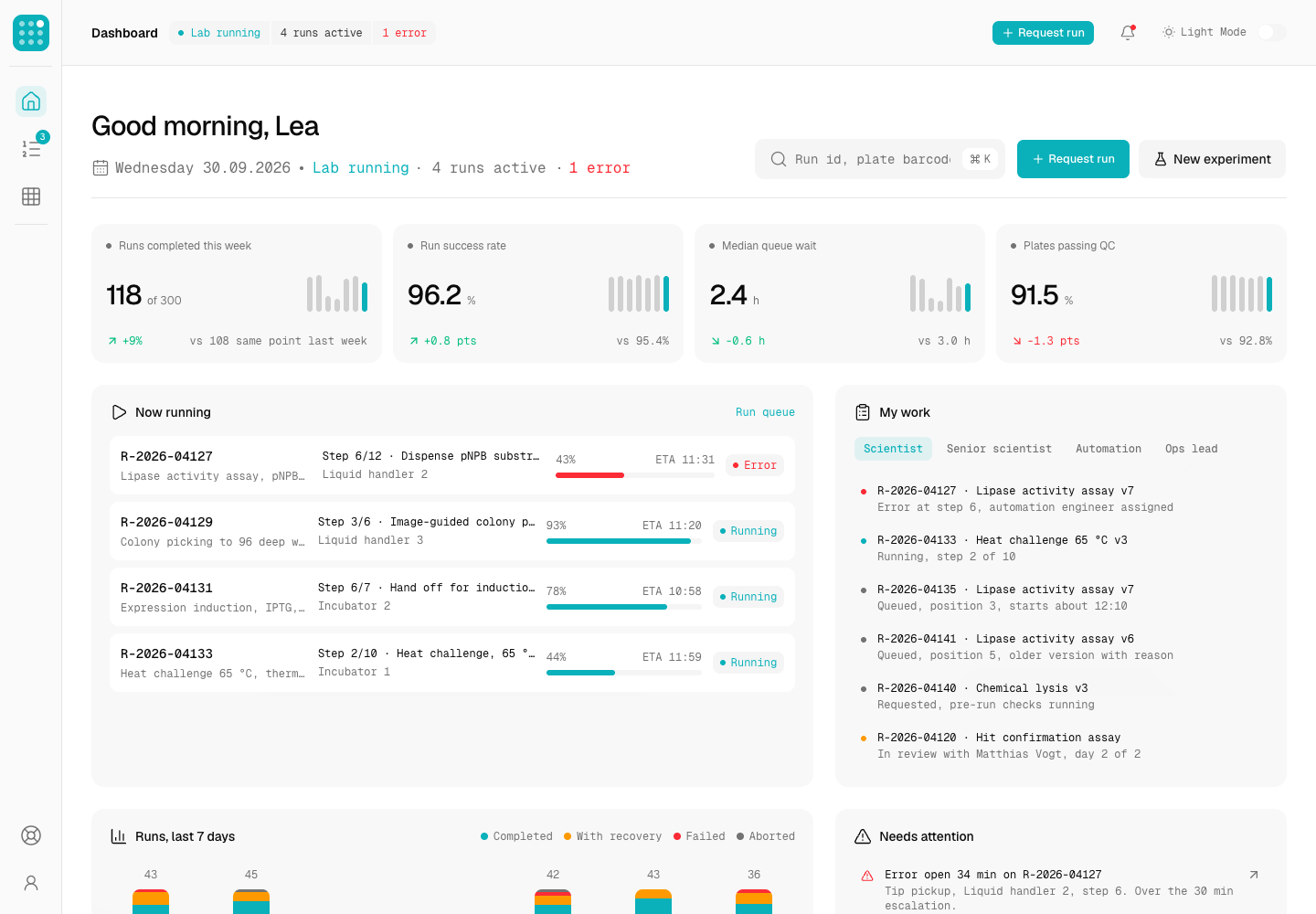
Benchbot - Lab Robotics Tracker for Protocols, Robot Runs and Sample Lineage
Designed and built a clickable lab robotics tracker for a Basel enzyme engineering start-up running about 300 automated runs a week: what is running now, the robot queue against a 24-hour instrument timeline, live run status with errors and recoveries, and every plate traced well by well back to its glycerol stock.
Enterprise Software Engineering - Human + AI
Contact Us
© 2026 - Copyright. All Rights reserved Oceanlab
Location
Global Headquarters
21 Merchant Road, 3rd Floor, Singapore 058267
Main corporate office and leadership operations
North America Office
548 Market Street, PMB 12345, San Francisco, CA 94104
Client operations and business development
India Office
402 Shivalik Shilp II, SG Highway, Ahmedabad 380015
Engineering and delivery center

Enterprise Software Engineering - Human + AI
Contact Us
Locations
Global Headquarters
21 Merchant Road, 3rd Floor, Singapore 058267
Main corporate office and leadership operations
North America Office
548 Market Street, PMB 12345, San Francisco, CA 94104
Client operations and business development
India Office
402 Shivalik Shilp II, SG Highway, Ahmedabad 380015
Engineering and delivery center
© 2026 - Copyright. All Rights reserved Oceanlab