Dark Sky - Observatory Booking and Night Operations Platform with a Red-Light Console
Booking and Night Operations for an Atacama Observatory
Designed and built a clickable staff console for a public observatory and dark-sky tourism centre in the Chilean Atacama: tonight's tours, telescopes and imaging on one timeline, a weather go/no-go call that shows who it affects before it is recorded, bookings with rebooking and refunds under the weather policy, and a remote imaging queue scheduled in UTC - all in a theme that keeps night vision intact.
Most of our work is under NDA. Per agreement, we can share the work but not the company details - all names and identifying information shown here have been changed.
Impact
Tonight, the go/no-go decision, bookings, booking detail and the imaging queue. Every one of the 29 demo bookings opens its own detail page, with rebook and refund panels.
Cloud above 70% at session start, gusts above 45 km/h (the 1 m telescope's limit is 40 km/h) and humidity above 90%, shown against the hourly forecast. It is advice only: the duty astronomer makes the call, by 17:00.
One switch turns every colour to deep red on black and stops animations. Status chips carry a shape and a word (Go, Go with warning, No-go, Pending), so they still read without green or red.
4 sessions tonight, 7 telescopes, 19 imaging requests across every queue stage, 9 staff users, 6 pickup points and an 11-hour forecast by cloud layer.
The Problem
Chaxiru sold tours through a WhatsApp number, two OTA listings and a spreadsheet. On cloudy nights the duty astronomer made the call at 18:00, then staff phoned or messaged up to 140 guests one by one in Spanish and English while the transport company still sent minibuses to hotels. Guides got their telescopes from a whiteboard, check-in was a paper list read by torchlight, imaging requests arrived by email and were queued in a text file, and management could not say how many nights were lost to weather.
Our Solution
Dark Sky gives the duty astronomer, guides and reservations staff one console for the night: a sunset-to-sunrise timeline of twilight, moon, sessions, imaging and transport, a go/no-go call with an advisory and an impact preview, bookings that carry their policy, payment and weather history, and an imaging queue that schedules each telescope around tour and research time.
The Challenge: Selling the Night Sky Before the Weather Decides
An astrotourism night depends on cloud nobody controls, telescopes shared between visitors, research and paying imaging customers, and Chilean consumer, tax and personal data law. And everyone using the system is standing in the dark.
One Weather Call, Every Guest Affected
When the call is no-go, every guest booked that night has to hear it in their own language, minibus pickups have to be cancelled with the contractor, and each booking gets a free rebooking or a full refund under the weather policy. Done by phone, that took hours.
Screens That Ruin Night Vision
A phone at full brightness undoes the dark adaptation guides and guests need at the telescope. The console cannot use white or blue after dark, and status that relies on green or red stops reading under red light.
Many Channels, Fixed Telescopes
Bookings come from the website, GetYourGuide and Viator, resellers, phone and the desk, while capacity is set per telescope: 10 guests at each visitor telescope and 8 at the 1 m. A telescope out of service cuts a session's capacity on the day.
Imaging on Shared Time
Remote imaging competes with tours and the research programme for the same telescopes, and each request has its own altitude, moon separation and date window. Credits are charged by the minute and results are FITS files, scheduled and recorded in UTC while tours run on local time.
Our Approach: From Night Operations to a Clickable Console
Spec and Rules Research
Mapped 10 user roles and 47 screens across the staff console, the public visitor site, the school visit request and the imaging portal, and the data model for telescopes and their status, sessions, nights, forecasts, weather decisions, bookings, pickups, payments, vouchers, imaging requests, the credit ledger, FITS files, school visits and sky brightness readings. Wrote down the rules the design follows: Law 19.628 and the stricter Law 21.719 on personal data, consumer law 19.496, SERNATUR registration under Law 20.423, SII electronic receipts, DS 1 of 2022 on light pollution and FITS header keywords.
Clickable Demo on a Production UI Kit
Built 5 key staff screens on a production dashboard kit: Tonight with the timeline, KPI cards, sessions and read-only telescope tiles; the go/no-go decision with the hourly forecast, advisory, per-session outcome and decision history; bookings with filters and a quick view; booking detail with payment, messages, history, rebook and refund; and the imaging queue with tonight's schedule per telescope. A red-light mode covers every screen, and all actions run on local state.
What a Production Build Adds
Integration with Transbank Webpay Plus, Mercado Pago and Flow for payments, Bsale or OpenFactura for SII documents, a Meteoblue seeing forecast, ASCOM Alpaca or ACP for read-only telescope status, Sky Quality Meters, SIMBAD and JPL Horizons, WhatsApp and email messaging and the GetYourGuide and Viator supplier APIs. Staff auth by role, an append-only audit log, consent records and data subject requests, red-light mode switched on by twilight, and the remaining screens: night plan, check-in, the public site and the imaging portal.
Why It Works: Built for Staff Working in the Dark
Red Light Without Losing Meaning
The console has no white theme at all. Red-light mode swaps every token to deep red on black, and each status keeps its shape and its word, so a guide holding a tablet at the telescope can still tell go from no-go.
The Call Shows Its Impact First
The decision page sets the hourly forecast by cloud layer against each policy threshold at each session start. Before a call is recorded, it previews the guests affected per session, the pickups to cancel and the messages that go out in each guest's language.
Imaging Fits Around the Tours
Tonight's schedule runs per telescope in UTC, ordered by priority class, then deadline, then visibility, and keeps visitor tour time and the research programme free. Each request shows its exposure plan, constraints and the credits it reserves: 1 per minute on T5 and T6, 4 on the 1 m.
Every Booking Carries Its Policy
A booking records the policy version and consents it was made under, its SII receipt and a history that includes every weather call that touched it. Rebooking shows each night's moon and forecast, and a refund states the policy outcome before it is confirmed.
Related case studies
View all: Space & frontier tech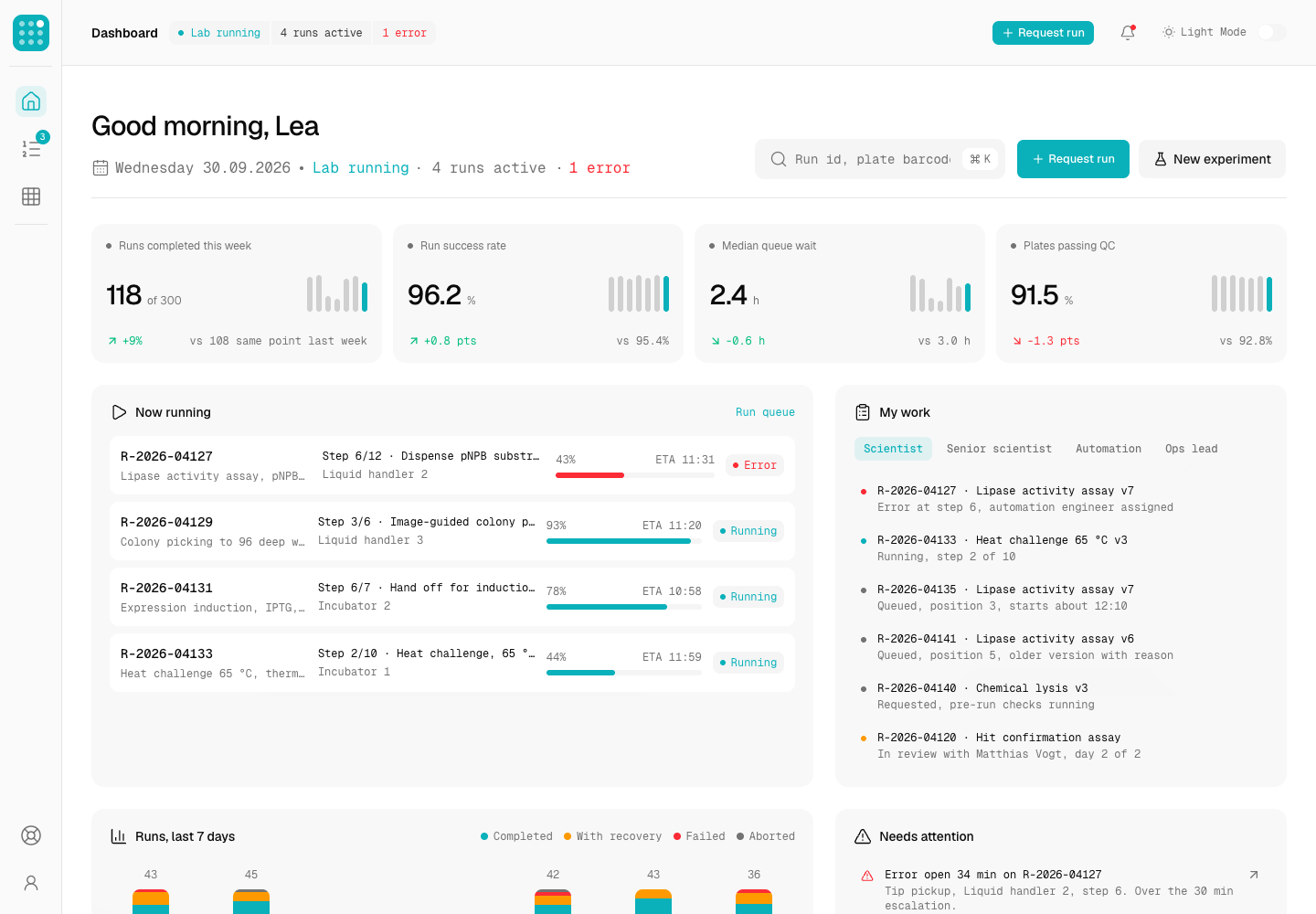
Benchbot - Lab Robotics Tracker for Protocols, Robot Runs and Sample Lineage
Designed and built a clickable lab robotics tracker for a Basel enzyme engineering start-up running about 300 automated runs a week: what is running now, the robot queue against a 24-hour instrument timeline, live run status with errors and recoveries, and every plate traced well by well back to its glycerol stock.
Groundlink - Ground Station Scheduling Platform from Orbit Data to Invoice
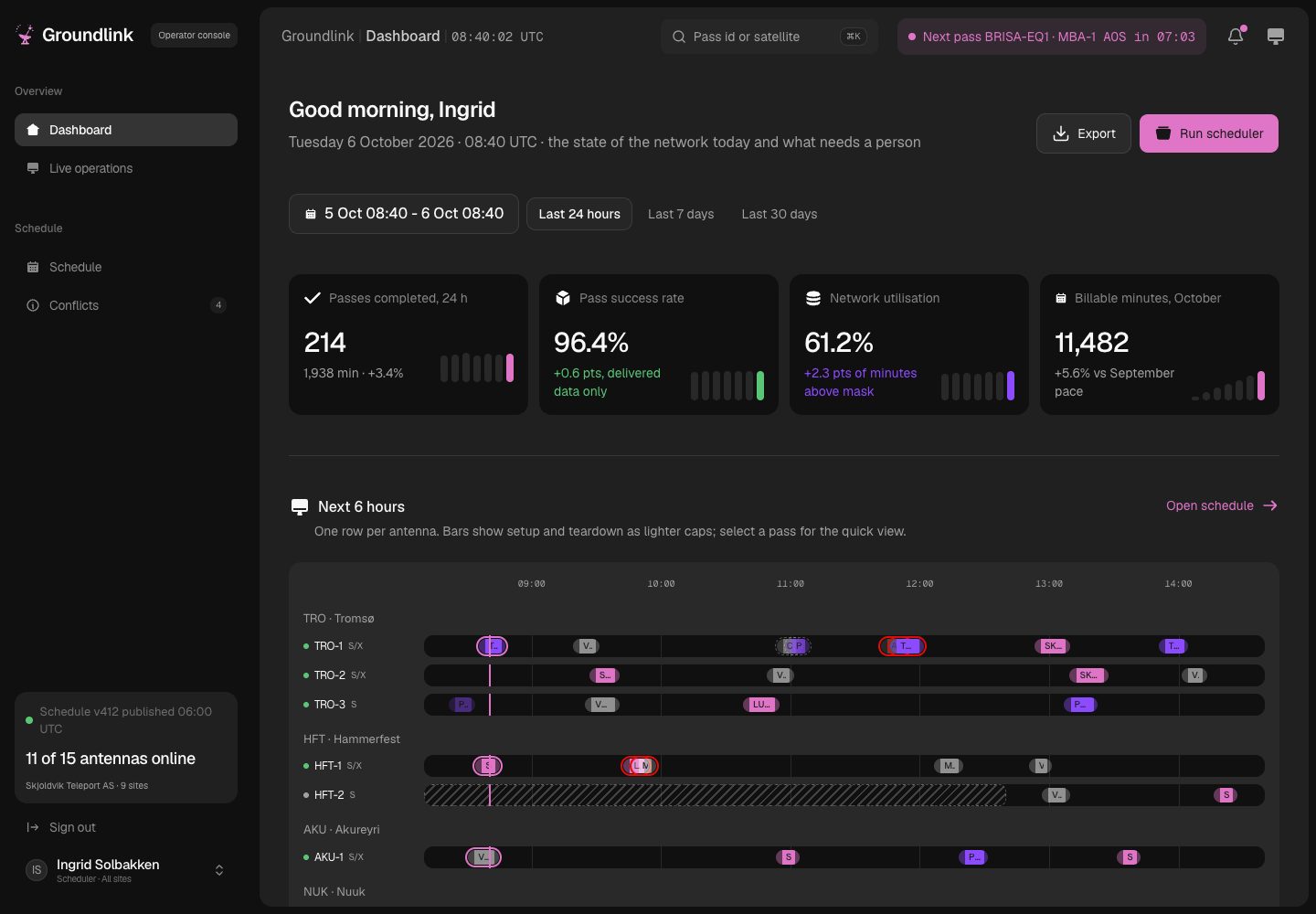
Designed and built a clickable scheduling and operations platform for a Tromsø ground-station-as-a-service operator: predict and book satellite passes across nine antenna sites, resolve conflicts by priority tier and contract, block any pass a site licence does not cover, follow every pass live through antenna telemetry and trace it through to delivered data and billable minutes.
Enterprise Software Engineering - Human + AI
Contact Us
© 2026 - Copyright. All Rights reserved Oceanlab
Location
Global Headquarters
21 Merchant Road, 3rd Floor, Singapore 058267
Main corporate office and leadership operations
North America Office
548 Market Street, PMB 12345, San Francisco, CA 94104
Client operations and business development
India Office
402 Shivalik Shilp II, SG Highway, Ahmedabad 380015
Engineering and delivery center

Enterprise Software Engineering - Human + AI
Contact Us
Locations
Global Headquarters
21 Merchant Road, 3rd Floor, Singapore 058267
Main corporate office and leadership operations
North America Office
548 Market Street, PMB 12345, San Francisco, CA 94104
Client operations and business development
India Office
402 Shivalik Shilp II, SG Highway, Ahmedabad 380015
Engineering and delivery center
© 2026 - Copyright. All Rights reserved Oceanlab