Cuadrilla - Street Incident Reporting and Crew Dispatch for a Chilean Municipality
Non-Emergency Reporting and Dispatch for a Chilean Comuna
Designed and built a clickable operations console for a hillside comuna in the Valparaíso Region: residents' reports of potholes, fallen trees, flooding and broken streetlights are triaged once, merged when they repeat, routed to the right department or responsible body and dispatched to crews against published service targets - with emergencies handed to 131, 132 and 133 by phone, never by the system.
Most of our work is under NDA. Per agreement, we can share the work but not the company details - all names and identifying information shown here have been changed.
Impact
Operations dashboard, triage queue, incident list, incident detail and dispatch board. Every one of the 25 demo incidents opens its own detail page with status rail, photos, work orders and activity.
P1 hazards made safe within 4 hours, P2 resolved within 2 working days and P3 within 15. Each incident counts down to its target and turns at risk with 20% of the time left, or breached.
Reports with words such as "cable cortado" or "atrapado" go to a possible-emergency tab and the top of the dashboard. The dispatcher is told to call and record the handover; Cuadrilla sends no data to emergency services.
18 reports from web, phone, counter, email and crews, 9 crews including a contractor lighting crew, 10 categories across 6 departments, 8 sectors and an active winter storm event with its weather warning.
The Problem
Quebrada Canelo received street problems through five channels: the phone line, a contact form, emails to councillors, neighbourhood WhatsApp groups and walk-ins. Each department kept its own spreadsheet. One fallen tree was reported eleven times and sent two crews, while a flooded underpass waited a day unseen. Supervisors phoned drivers to find them, residents never heard back, and genuinely dangerous reports sat in the same inbox as a broken bench.
Our Solution
Cuadrilla gives the municipal operations centre one console for every non-emergency street report: a triage queue where each report is turned into an incident, merged, referred or rejected exactly once, an incident record with its service level clock, and a dispatch board that assigns work to internal and contractor crews by skills, load and distance.
The Challenge: One Inbox, Many Owners, Real Hazards
A comuna of about 140,000 residents on steep hillsides takes its heaviest load during winter frontal systems, when potholes, fallen trees, blocked drains and small landslides arrive all at once, and some of them are not street problems at all but emergencies.
Not an Emergency Service
In Chile emergencies go by phone to 131 (SAMU), 132 (Bomberos) and 133 (Carabineros). A municipal reporting tool has no link to them, yet a downed live cable or a person trapped by a fallen wall can still arrive as a web report and must not wait in the queue.
The Same Problem, Reported Again and Again
During a storm a single blocked road can bring a dozen reports from different channels. Without merging, crews are sent twice, residents subscribe to different tickets and the true workload is invisible.
Not Every Street Is the Municipality's
Depending on the road, a defect belongs to the municipality, SERVIU, the Dirección de Vialidad or a highway concessionaire, and downed power lines and burst mains belong to the utilities. These have to be referred and followed up, not closed.
Public Records, Private Reporters
Incident statistics are public information under Ley 20.285 and municipal decisions can be reviewed by the Contraloría, while reporters' identities, faces and vehicle plates in photos are personal data under Ley 19.628 and its reform, Ley 21.719.
Our Approach: From Municipal Rules to a Clickable Console
Spec and Rules Research
Mapped 12 user roles from residents and call centre agents to dispatchers, crew leaders, contractor crews and the risk manager, 42 screens across the operations console, an offline-capable crew app and mobile-first public pages, and the data model for reports, incidents, work orders, crews, handovers, referrals, major events and SLA policy. Wrote down the rules the design follows: the emergency boundary, Ley 21.364 and SENAPRED, road and utility ownership, Ley 19.628 and Ley 21.719, Ley 20.285, Ley 18.695 and the council's own service targets.
Clickable Demo on a Production UI Kit
Built 5 key console screens on a production dashboard kit: the operations dashboard with the life-risk strip, KPIs, open incidents by priority and status and a needs-attention list, the triage queue with routing suggestions and keyboard shortcuts, the incident list with SLA states and bulk actions, the incident detail with status rail, photos, work orders costed in CLP, referral and public update tabs, and the dispatch board with crew lanes and drag and drop. Maps are schematic and all actions run on local state.
What a Production Build Adds
ClaveÚnica sign-in for residents and municipal SSO for staff, real maps and geocoding, vehicle trackers, SMS and WhatsApp status updates, crew push notifications, photo storage with automatic face and plate blurring, weather warnings, utility referral channels and the open data feed. A full audit log, privacy request handling, and the remaining screens: live map, handovers, major events, SLA monitor, reports, settings, the offline crew app and the public reporting pages in Spanish, Haitian Creole and English.
Why It Works: Every Report Seen Once, by the Right People
Emergencies Come First and Leave by Phone
Possible emergencies sit above everything on the dashboard with their age in minutes, in their own triage tab, with a banner telling the dispatcher to call 131, 132 or 133 and record the handover. The screen states plainly that Cuadrilla does not transmit data to emergency services.
Duplicates Merge Into One Incident
Each report shows a possible-duplicate chip with a count and the open incidents within 100 metres. Merging moves the reporter onto the existing incident's updates, so the fallen tree on Av. Los Peumos is one incident with 11 reports and one crew.
Suggestions Show Their Reasons
Triage suggests the category, priority, department and target with the rule that produced them, such as a fallen tree plus the words "bloquea calle" raising it to P1, and names the responsible body when it is SERVIU or a utility. The dispatch board suggests a crew with its travel time, skills and current load.
Reporters Stay Private by Default
Reporter names are hidden until a dispatcher opens them, and opening them is logged. Every photo shows whether it is public or private and its blur status, location metadata is removed on upload, and the public status text never names reporters or crew members.
Related case studies
View all: GovTech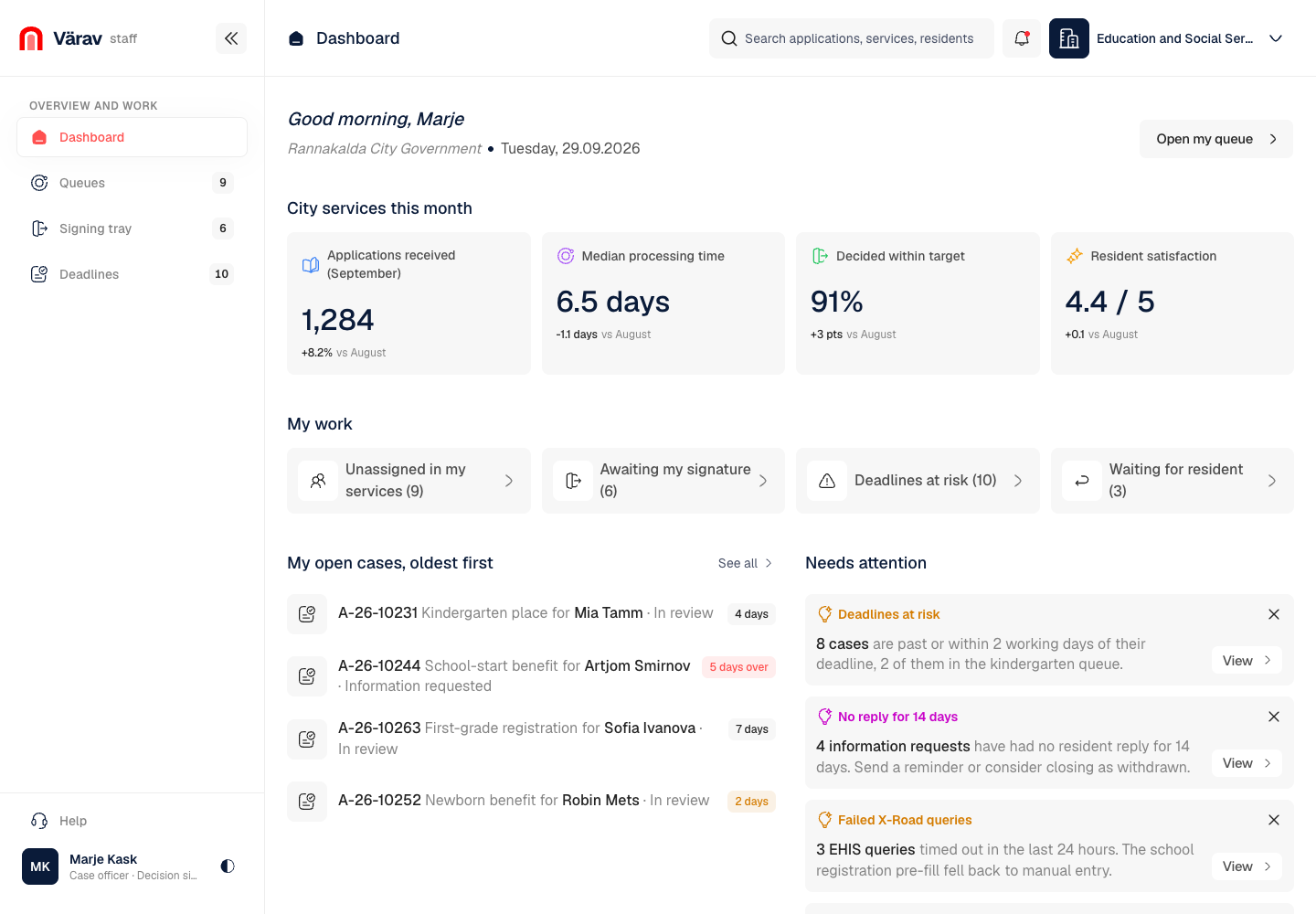
Värav - Citizen Services Portal Built on Estonia's eID and X-Road
Designed and built a clickable staff console for an Estonian city's resident services portal: service queues with eligibility results, case detail with register data pulled over X-Road, decision drafting with lawful reasons and appeal information, batch signing with eID and deadline tracking - so residents are never asked for data the state already holds.
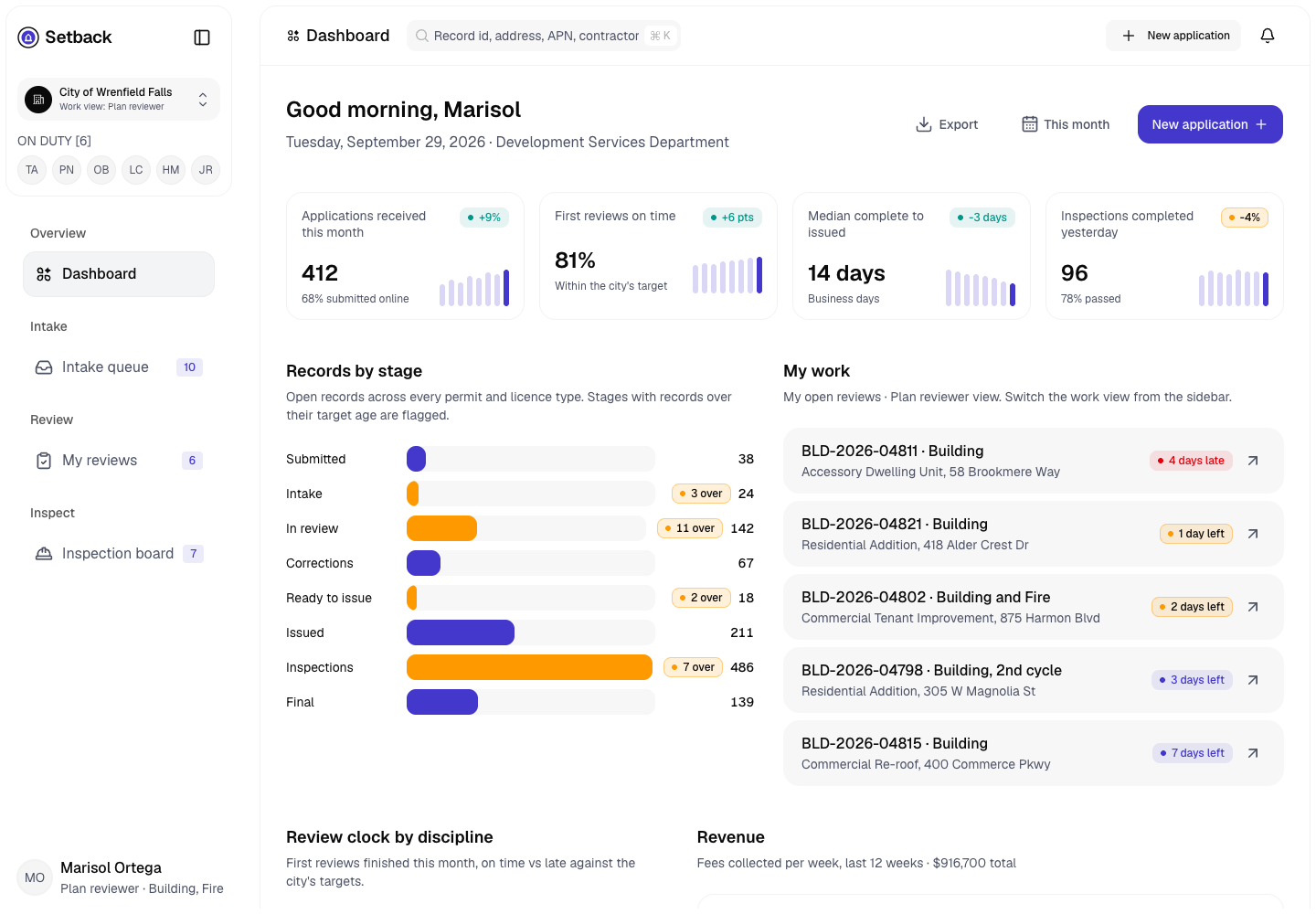
Setback - Permitting and Licensing Platform with Parallel Plan Review
Designed and built a clickable permitting and licensing platform for a US city's development services department: completeness checks before the review clock starts, building, zoning, fire and public works reviews running in parallel against city targets, an inspection board that checks certifications, and one record for every permit with its parcel, parties, holds, fees and inspections.
Enterprise Software Engineering - Human + AI
Contact Us
© 2026 - Copyright. All Rights reserved Oceanlab
Location
Global Headquarters
21 Merchant Road, 3rd Floor, Singapore 058267
Main corporate office and leadership operations
North America Office
548 Market Street, PMB 12345, San Francisco, CA 94104
Client operations and business development
India Office
402 Shivalik Shilp II, SG Highway, Ahmedabad 380015
Engineering and delivery center

Enterprise Software Engineering - Human + AI
Contact Us
Locations
Global Headquarters
21 Merchant Road, 3rd Floor, Singapore 058267
Main corporate office and leadership operations
North America Office
548 Market Street, PMB 12345, San Francisco, CA 94104
Client operations and business development
India Office
402 Shivalik Shilp II, SG Highway, Ahmedabad 380015
Engineering and delivery center
© 2026 - Copyright. All Rights reserved Oceanlab