Brolga - Case Management for a Fair Trading Regulator
Complaint to Enforcement Case Management for a Victorian Regulator
Designed and built a clickable case management system for a Victorian consumer affairs and fair trading regulator: one intake queue for web, phone, email and agency complaints, rule-based triage, a case workspace with every party, deadline and document, and a conciliation board that keeps dispute help separate from enforcement.
Most of our work is under NDA. Per agreement, we can share the work but not the company details - all names and identifying information shown here have been changed.
Impact
Dashboard, intake queue with a triage panel, cases list with quick view, case workspace with 6 tabs and the conciliation board. Every one of the 22 demo cases opens its own workspace.
Conciliation, information only, refer out, intelligence only or investigation review. Each intake shows the rule that suggested its route, such as motor vehicles over $5,000 with a Very high risk trader going to investigation review.
OFFICIAL, OFFICIAL: Sensitive and PROTECTED, following the VPDSS. Confidential complainants and witnesses are masked outside the investigation team, and an open by someone not on the case team is flagged in the access log.
18 intakes across 4 channels, 22 cases of which 16 are on the conciliation board, 12 traders with risk scores and bands, and 10 staff across 4 teams.
The Problem
Fair Markets Victoria receives around 38,000 consumer complaints a year. It ran complaints in a contact-centre CRM, investigations in a separate legacy matter system, evidence on network drives and enforcement decisions in Word documents. A conciliator could not see that the trader in front of them had 40 other complaints and an open investigation, investigators tracked limitation periods in personal spreadsheets, and complainants calling to ask where their complaint was up to took about a fifth of contact-centre calls.
Our Solution
Brolga takes a complaint from first contact to closure in one system: intake and triage from every channel, one case record with every party, a shared workspace with tasks, deadlines, notes, documents and correspondence, and conciliation that runs on a board with entry checks. Investigation, enforcement and records retention are designed in the spec and connect to the same case.
The Challenge: One Regulator, Many Rulebooks
A state fair trading regulator helps consumers settle disputes, investigates traders who may be breaking the Australian Consumer Law and takes enforcement action, all under Victorian rules on human rights, privacy, data security, evidence and public records.
Dispute Help Is Not Enforcement
Conciliation is voluntary: the regulator cannot force a trader to settle, and a failed conciliation points the consumer to VCAT. A trader who does not engage should be flagged to intelligence, not penalised in the dispute, so the two paths must stay separate while sharing one view of the trader.
Deadlines With Legal Consequences
Notice compliance dates, procedural fairness response periods, infringement internal reviews and limitation dates for commencing proceedings all run on different clocks. In two matters the regulator came close to missing a deadline to commence proceedings.
Sensitive Records, Need to Know
Under the VPDSS every case, document and exhibit carries a protective marking, and the Privacy and Data Protection Act 2014 governs disclosure. Confidential witnesses must be masked, complainant details go to a trader only with consent or a recorded basis, and views of sensitive files are logged.
Records Nobody Could Dispose Of
Case records are public records under the Public Records Act 1973. Without knowing which were due for disposal, or which sat under a legal hold, an FOI request or current proceedings, nothing was ever destroyed. Exhibits also had no reliable chain of custody for court.
Our Approach: From Regulatory Rules to a Clickable System
Spec and Rules Research
Mapped 14 roles from intake officer to legal, records and privacy officers, plus complainants, traders and the public, across 44 screens. Defined the data model for intakes, cases, parties, deadlines, investigations, exhibits with custody, notices, enforcement actions, register entries and disposal batches. Wrote down the rules the design follows: the Australian Consumer Law, the Infringements Act 2006, procedural fairness, the Charter of Human Rights, privacy, the VPDSS, public records, the Evidence Act 2008 and FOI.
Clickable Demo on a Production UI Kit
Built 5 key screens on a production dashboard kit: the dashboard with KPIs, case flow, top traders by new complaints and statutory deadlines for the next 30 days, the intake queue with pick up, bulk assign and a triage panel, the cases list with masked complainants and marking badges, the case workspace with parties, progress rail, notes, offers and agreements, and the conciliation board. All actions run on local state.
What a Production Build Adds
Integration with ABN Lookup, ASIC extracts, G-NAF, the contact centre, Microsoft 365, SMS, TIS National, OpenText Content Manager, Fines Victoria, and PayWay and BPAY payments. Staff sign-in through Microsoft Entra ID, a hash-chained audit log, deadline rules and offences held as versioned configuration confirmed by legal, and the remaining screens: investigations, the evidence register, notices, enforcement, records disposal, the complaint form and tracker, the trader response page and the public register.
Why It Works: The Whole Picture Before Every Decision
Triage Shows Its Reasoning
The triage panel puts the complaint next to the matched trader, the match confidence and the trader's risk band, then suggests a route with the rule that matched. The officer still chooses the route, and information-only items close with advice instead of opening a case.
Statutory and Policy Deadlines Kept Apart
Every deadline is labelled as statutory or a client service standard, the dashboard shows the next 30 days with anything within 7 days in red, and the cases list filters to statutory deadlines due within 30 days.
Stage Changes Have Entry Checks
A case cannot move to the compliance check stage until an agreement is recorded, on the board or in the workspace. Conciliation cards turn amber after 10 working days in a column and red after 20, and a trader who does not respond can be flagged to intelligence from the card.
Confidentiality Built Into Every View
The top bar shows the protective marking for the page, a case page shows the case's own marking, and confidential parties appear only as masked names outside the investigation team. The access log records who opened the case and flags anyone not on the case team.
Related case studies
View all: GovTech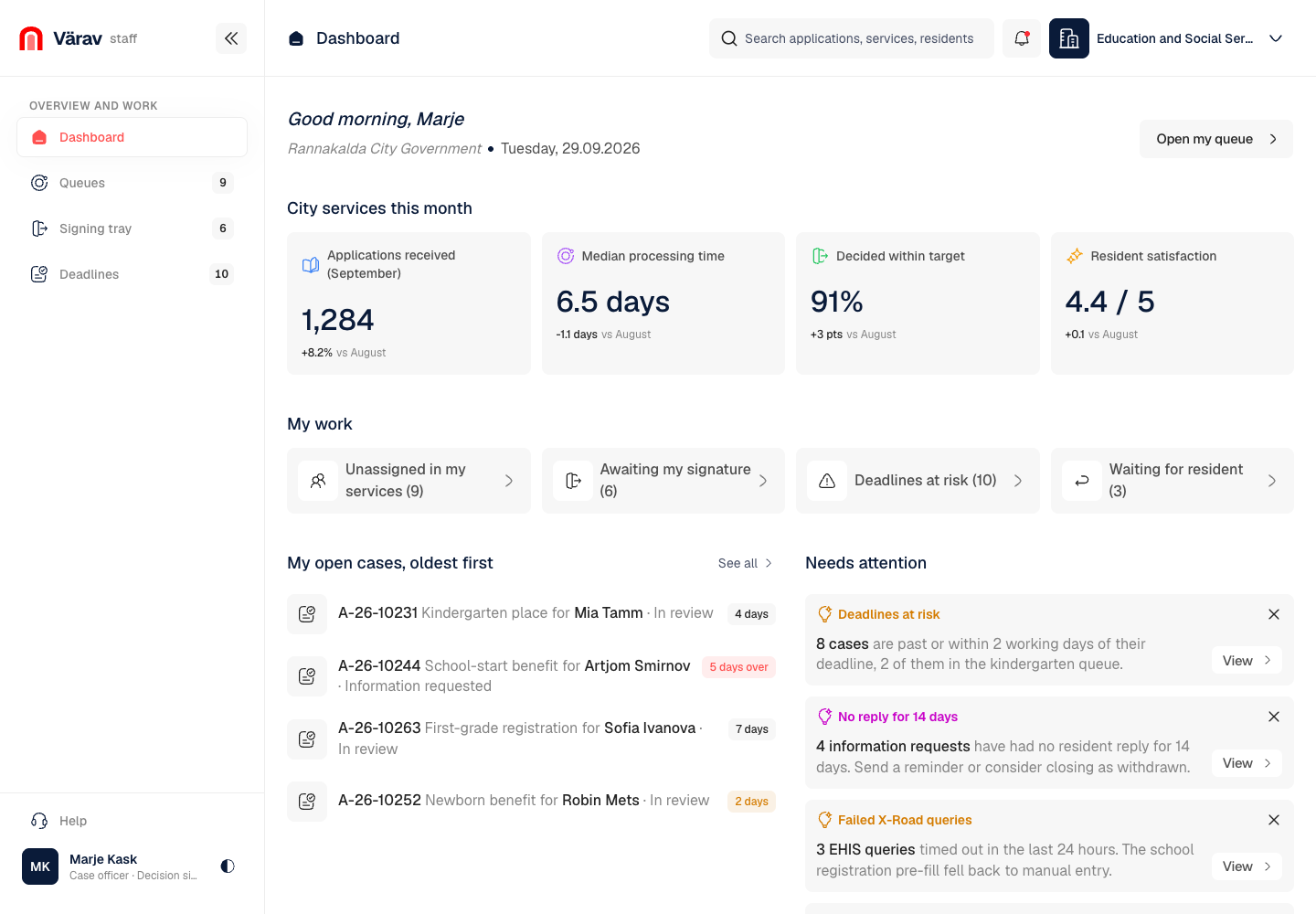
Värav - Citizen Services Portal Built on Estonia's eID and X-Road
Designed and built a clickable staff console for an Estonian city's resident services portal: service queues with eligibility results, case detail with register data pulled over X-Road, decision drafting with lawful reasons and appeal information, batch signing with eID and deadline tracking - so residents are never asked for data the state already holds.
Setback - Permitting and Licensing Platform with Parallel Plan Review
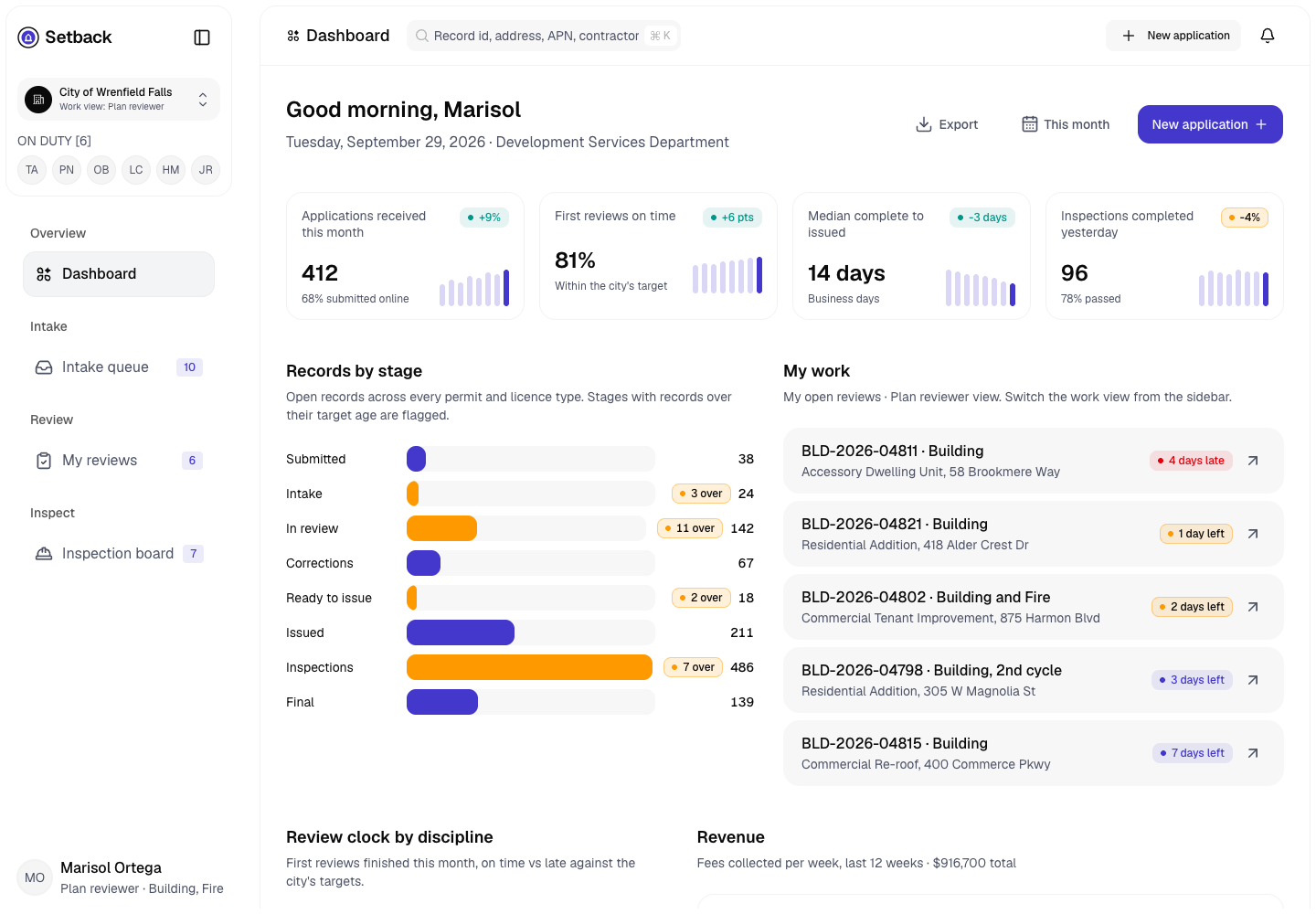
Designed and built a clickable permitting and licensing platform for a US city's development services department: completeness checks before the review clock starts, building, zoning, fire and public works reviews running in parallel against city targets, an inspection board that checks certifications, and one record for every permit with its parcel, parties, holds, fees and inspections.
Enterprise Software Engineering - Human + AI
Contact Us
© 2026 - Copyright. All Rights reserved Oceanlab
Location
Global Headquarters
21 Merchant Road, 3rd Floor, Singapore 058267
Main corporate office and leadership operations
North America Office
548 Market Street, PMB 12345, San Francisco, CA 94104
Client operations and business development
India Office
402 Shivalik Shilp II, SG Highway, Ahmedabad 380015
Engineering and delivery center

Enterprise Software Engineering - Human + AI
Contact Us
Locations
Global Headquarters
21 Merchant Road, 3rd Floor, Singapore 058267
Main corporate office and leadership operations
North America Office
548 Market Street, PMB 12345, San Francisco, CA 94104
Client operations and business development
India Office
402 Shivalik Shilp II, SG Highway, Ahmedabad 380015
Engineering and delivery center
© 2026 - Copyright. All Rights reserved Oceanlab