Almojarife - Property Tax and ICA Collection Console for a Colombian City
Local Tax Collection Platform for a Colombian Finance Secretariat
Designed and built a clickable staff console for a Colombian city's finance secretariat: look up any property and its property tax bill with the early payment discount, see debt with interest and prescription dates, approve payment agreements within mandate, and run coercive collection cases stage by stage.
Most of our work is under NDA. Per agreement, we can share the work but not the company details - all names and identifying information shown here have been changed.
Impact
Dashboard, property search, property detail with bill breakdown and debt, the payment agreements board and coercive collection, plus the agreement and coercive case slide-overs.
Arrears officer up to $20.000.000 and 24 months, Head of Revenue up to $250.000.000, Secretary of Finance above that. Every request is checked against a 36-month term, 20% down payment and a guarantee above $50.000.000.
Verified title, payment order, notification, exceptions period, order to continue, liens, auction referral and closure, with each case's prescription date and whether a notified payment order interrupted it.
22 taxpayers, 5 years of bills per property, 16 payment agreements across all four board columns, 12 coercive cases and 6 staff users, on a 2026 calendar with 10% and 5% discount deadlines.
The Problem
Tamarindo Alto's Hacienda ran property tax on a 2000s client-server system that printed bills once a year, and ICA on paper forms typed into a spreadsheet by a contractor. Residents queued in March to get a bill printed before the discount deadline, bank collection files arrived by email in four layouts and took treasury two weeks a month to match, arrears older than three years sat untouched because nobody knew which were close to prescription, and coercive cases lived in Word documents. Collection ran about 12% under budget and the Secretary could not say where the gap was.
Our Solution
Almojarife gives Hacienda staff one console for property tax and its arrears: a dashboard of collection against budget and the discount season, a property register searchable by cadastral number, address or owner, a property file with every bill, payment, debt and prescription date, a payment agreements board that checks policy and the officer's mandate, and coercive cases that move through the legal stages one signed document at a time.
The Challenge: Collecting Local Taxes by the Book
Colombian municipalities administer and collect their own taxes within national law. Rates, discounts, deadlines and collection rules come from each city's acuerdo municipal and tax statute, while filing, interest and coercive collection follow the national Estatuto Tributario as adopted locally.
A Bill Built From Many Rules
Property tax is charged per mil of the cadastral value set by the cadastral authority, at rates that differ by use, estrato 1 to 6 and built or unbuilt land. Increase caps, exemptions under an acuerdo and early payment discounts of 10% and 5% before set dates all change the amount a resident owes.
Debts That Quietly Prescribe
The action to collect generally prescribes five years after a debt becomes enforceable, unless a step such as a notified payment order or a payment agreement interrupts it. With no prescription date per debt, old arrears were lost without anyone deciding to let them go.
Agreements With Policy and Mandates
Hacienda may grant instalment plans under Estatuto Tributario article 814 and the internal collection rules required by Law 1066 of 2006. Terms, down payments, guarantees and who may approve what are the city's own policy, and they were applied case by case.
A Legal Procedure Tracked in Word
Coercive collection under Estatuto Tributario articles 823 onwards runs from payment order and notification through exceptions, liens and auction, with deadlines in working days. Officers tracked each case in documents, so nobody could see which deadline came next.
Our Approach: From Municipal Tax Rules to a Clickable Console
Spec and Rules Research
Mapped 11 roles from resident taxpayer to Secretary of Finance and 51 screens: 37 staff screens and 14 taxpayer portal screens. Modelled taxpayers, properties, cadastral values, versioned rates and tax calendars, bills, the RIT register, ICA declarations, a charges ledger, payments, reconciliation batches, agreements, coercive cases, official documents and an append-only audit log. Wrote down the rules the design follows: Law 44 of 1990, Law 14 of 1983, Law 788 of 2002, the Estatuto Tributario, Law 1066 of 2006, Law 1581 of 2012, Law 1712 of 2014 and MinTIC Resolution 1519 of 2020.
Clickable Demo on a Production UI Kit
Built 5 key staff screens on a production dashboard kit, in Spanish with peso amounts and a clock set inside the 5% discount season: the dashboard with collection against budget, discount tracker, channel mix and work by role, the property register, the property file with bill options per deadline, bill breakdown, debt statement and paz y salvo, the agreements board with policy and mandate checks, and coercive collection with the stage rail and liens. Approving, referring, rejecting, declaring default and advancing a case all run on local state.
What a Production Build Adds
Cadastral imports from IGAC or the city's gestor catastral, PSE and card payments through a gateway, Asobancaria bank collection files with reconciliation, DIAN RUT and RUES validation, GOV.CO digital authentication, electronic signature from an ONAC-accredited provider and the budget ERP feed. Then the ICA, treasury and audit screens, the mobile-first taxpayer portal, staff auth by role and mandate, the official moratory rate table, and an audit log that records every view of a declaration.
Why It Works: Every Peso Traced to a Rule
Bills That Explain Themselves
The property file shows the rate applied and why, any increase cap or exemption with its acuerdo, and the environmental surcharge the discount does not reduce. The current bill shows one payable amount per deadline, with past deadlines marked expired.
Approval Within Mandate Only
Each agreement card shows whether it meets policy and who must approve it. Approve is enabled only when the request is within policy and the signed-in officer's mandate. Otherwise the officer refers it up or rejects it with a reason.
Prescription in Plain Sight
Every unpaid year shows its prescription date, coercive cases show whether a notified payment order interrupted it, and the dashboard flags debts within 90 days of prescription with no action taken, so old arrears are worked before they are lost.
One Console, Work by Role
The dashboard compares collection with budget and the same date last year, and projects payments to the next discount deadline. My work switches between arrears, coercive, treasury, tax roll and service, and the navigation counts agreements awaiting approval and coercive deadlines due soon.
Related case studies
View all: GovTech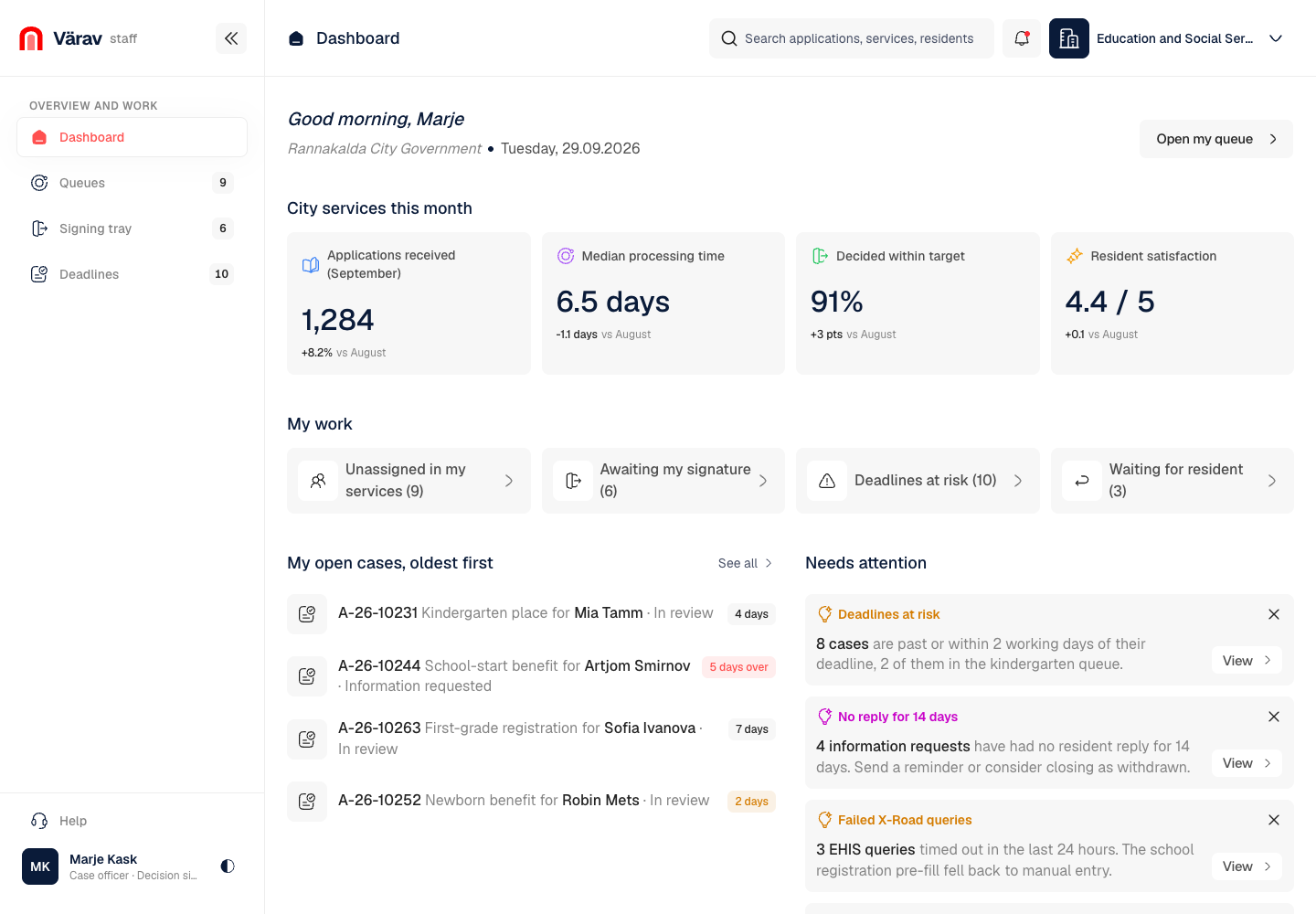
Värav - Citizen Services Portal Built on Estonia's eID and X-Road
Designed and built a clickable staff console for an Estonian city's resident services portal: service queues with eligibility results, case detail with register data pulled over X-Road, decision drafting with lawful reasons and appeal information, batch signing with eID and deadline tracking - so residents are never asked for data the state already holds.
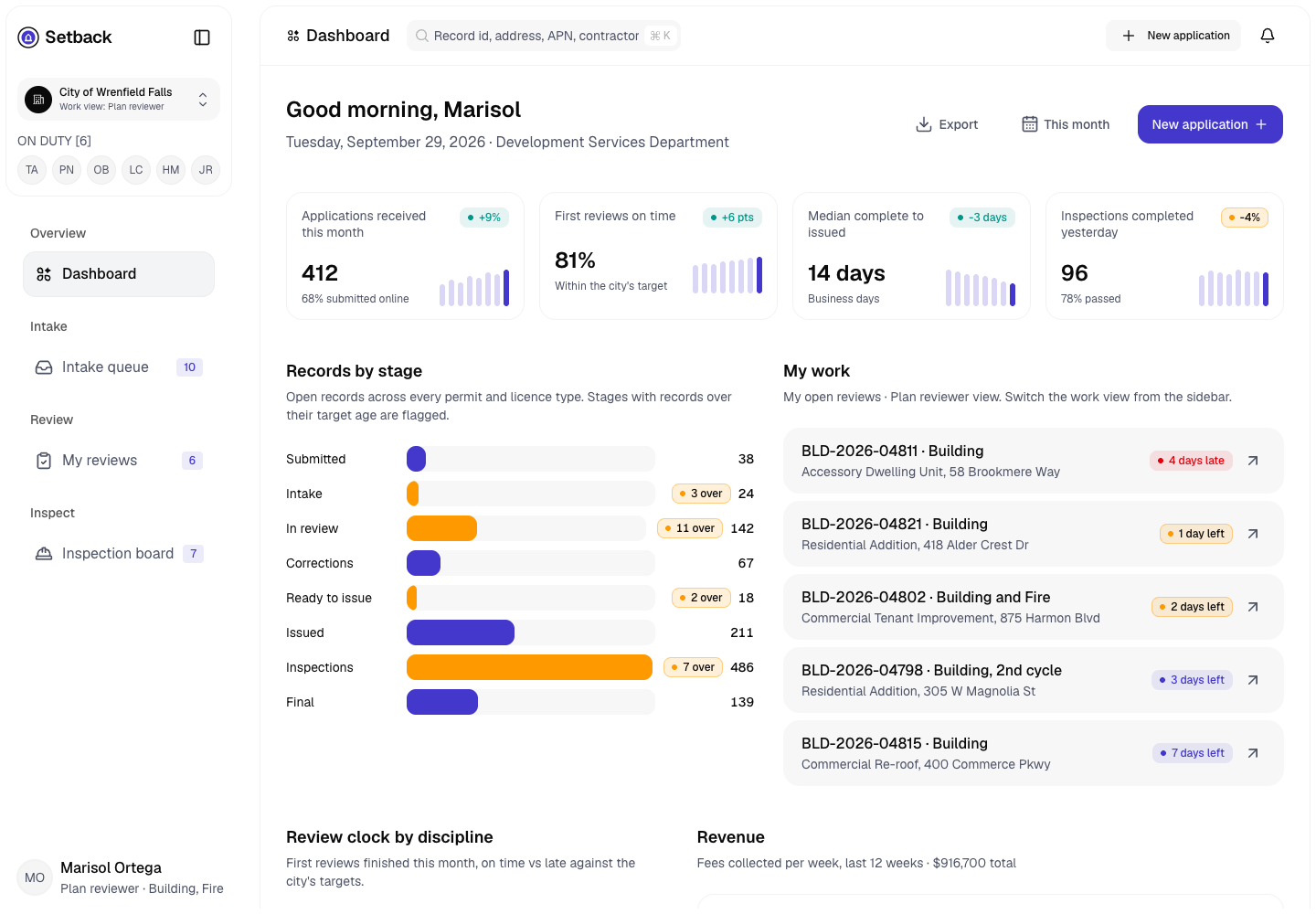
Setback - Permitting and Licensing Platform with Parallel Plan Review
Designed and built a clickable permitting and licensing platform for a US city's development services department: completeness checks before the review clock starts, building, zoning, fire and public works reviews running in parallel against city targets, an inspection board that checks certifications, and one record for every permit with its parcel, parties, holds, fees and inspections.
Enterprise Software Engineering - Human + AI
Contact Us
© 2026 - Copyright. All Rights reserved Oceanlab
Location
Global Headquarters
21 Merchant Road, 3rd Floor, Singapore 058267
Main corporate office and leadership operations
North America Office
548 Market Street, PMB 12345, San Francisco, CA 94104
Client operations and business development
India Office
402 Shivalik Shilp II, SG Highway, Ahmedabad 380015
Engineering and delivery center

Enterprise Software Engineering - Human + AI
Contact Us
Locations
Global Headquarters
21 Merchant Road, 3rd Floor, Singapore 058267
Main corporate office and leadership operations
North America Office
548 Market Street, PMB 12345, San Francisco, CA 94104
Client operations and business development
India Office
402 Shivalik Shilp II, SG Highway, Ahmedabad 380015
Engineering and delivery center
© 2026 - Copyright. All Rights reserved Oceanlab