Allmend - Tokenisation Platform for Funds, Property and Private Credit
Tokenised Asset Platform for a Liechtenstein TVTG Service Provider
Designed and built a clickable tokenisation platform for a Vaduz token issuer registered under the TVTG: permissioned tokens for fund units, real estate SPV shares and private credit notes, with every on-chain operation approved under a signing policy, every investor transfer checked before it settles, and the token ledger kept in step with the legal register.
Most of our work is under NDA. Per agreement, we can share the work but not the company details - all names and identifying information shown here have been changed.
Impact
Dashboard, assets list, asset detail with 7 tabs, on-chain operations and transfer requests, with the asset quick view, document viewer, operation and transfer detail panels.
Receiver onboarded and eligible, receiver wallet approved, country allowed, holder limit, lock-up ended, minimum holding kept on both sides, screening clear and no freeze. Approve stays blocked while any rule fails.
Each operation type has its own rule, from 1 approver to register an identity to 3 approvers including a key custodian for mints above 10,000 tokens. The proposer can never approve their own operation.
4 issuers, fund units, property SPV shares and credit notes on Ethereum and Polygon, from draft to closed, with 24 investors, 16 on-chain operations, 14 transfer requests and 8 staff users.
The Problem
Falkenau launched its first three tokenised assets with a spreadsheet cap table, a smart contract deployed by a contractor and investor onboarding by email. Every transfer between investors needed a developer to add a wallet to the allowlist by hand, distributions were calculated in Excel, token balances drifted from the share register, and when an investor lost a hardware wallet nobody could say who was allowed to move the tokens or on what legal basis. A fourth asset took 14 weeks to set up, and two issuers walked away.
Our Solution
Allmend covers the whole life of a tokenised asset in one platform: legal classification and token parameters, investor whitelisting, issuance and minting, secondary transfers checked against each token's compliance rules, distributions and NAV updates, and reconciliation of the chain against the legal register. Every write to the chain is proposed, approved and signed under a policy, with its legal basis and register entries recorded.
The Challenge: A Token That Is Also a Legal Right
Under Liechtenstein's TVTG a token is a container for a right, such as a share, a fund unit or a claim, so moving the token generally moves the right. The chain and the legal register have to agree at all times, and every action on them has to follow financial, anti-money laundering and data protection law.
Two Ledgers That Must Agree
The token balances on chain and the register kept for the SPV or fund are two views of the same ownership. Falkenau's balances drifted from the lawyers' register, and nobody could prove which was right for a given investor on a given day.
Securities Rules, Not Crypto Rules
Tokenised fund units, SPV shares and credit notes are generally financial instruments, so MiCA gives way to MiFID II, the Prospectus Regulation and, for funds, the AIFM rules. Each offering relies on an exemption, such as qualified investors only or a minimum of EUR 100,000 per investor, that the platform must enforce.
Permissioned Transfers at Scale
Under the ERC-3643 pattern a transfer only succeeds if both wallets belong to verified identities and the token's rules pass: allowed countries, maximum holders, minimum holding and lock-ups. Wallets are screened under the Due Diligence Act before whitelisting and on every transfer.
Moving Tokens Without the Holder
Lost wallets, inheritance and insolvency mean the issuer's agent sometimes has to freeze or force-transfer tokens. That power needs a recorded legal basis, such as a court order or a signed instruction with verified identity, a second approver and an audit entry every time.
Our Approach: From Tokenisation Law to a Clickable Platform
Spec and Rules Research
Mapped 11 roles, from issuance manager, registrar, key custodian and physical validator to issuer users, fund administrators, auditors and investors, and 45 screens across the staff console and the investor portal. Defined the data model for assets, tokens, investors, wallets, offerings, subscriptions, on-chain operations, the append-only register and transfer requests, and wrote down the rules the design follows: the TVTG roles, MiCA, MiFID II, the Prospectus Regulation, FinSA, the Due Diligence Act, GDPR and ERC-3643.
Clickable Demo on a Production UI Kit
Built 5 key staff screens on a production web3 dashboard kit: the dashboard with KPIs, live asset strip, capital raised by month, work by role and items needing attention, the assets list with quick view, asset detail with token settings, documents, attestations and legal classification, on-chain operations with approve and sign, reject and retry, and transfer requests with the full check list. The issuer switcher filters every screen, in light and dark mode.
What a Production Build Adds
Integrations for KYC (such as IDnow or Sumsub), sanctions and wallet risk screening, the ERC-3643 identity registry, MPC signing through Fireblocks, node access, CHF and EUR accounts, USDC and EURC payments, qualified e-signatures and travel rule messaging, plus an event indexer per chain. Staff auth by role, a full audit log, and the remaining screens: asset setup wizard, cap table, investor onboarding, offerings and payments, corporate actions, NAV, votes, reconciliation, recovery cases and the investor portal.
Why It Works: Every Token Movement Accounted For
Chain and Register Side by Side
Every live asset carries a matched or break chip, and the dashboard lists open breaks with the register and chain balances that disagree. Each mint, burn and forced transfer names the register entries it will create, so the two ledgers move together.
Chain Writes in Plain Words
An operation reads as a sentence, such as Mint 1,250 FKRE1 to a named wallet for a subscription, with the simulation result, the approval policy, the approval trail and the transaction hash once sent. Nobody signs calldata they cannot read.
Transfers Explain Their Status
Each transfer request shows both parties, their wallets and every compliance check with its result and reason, such as a lock-up still in force or a seller who would fall below the minimum holding. When the receiver is not yet an investor, staff can ask them to onboard instead of adding a wallet by hand.
Legal Basis Before Power
Forced transfers, freezes and pauses each record the document they rely on, from a recovery case to a confirmed screening alert or a board resolution. Staff with a TVTG registration act under that role, such as TT key depositary or physical validator, and every asset shows its classification, legal opinion and prospectus exemption.
Related case studies
View all: Crypto & DeFi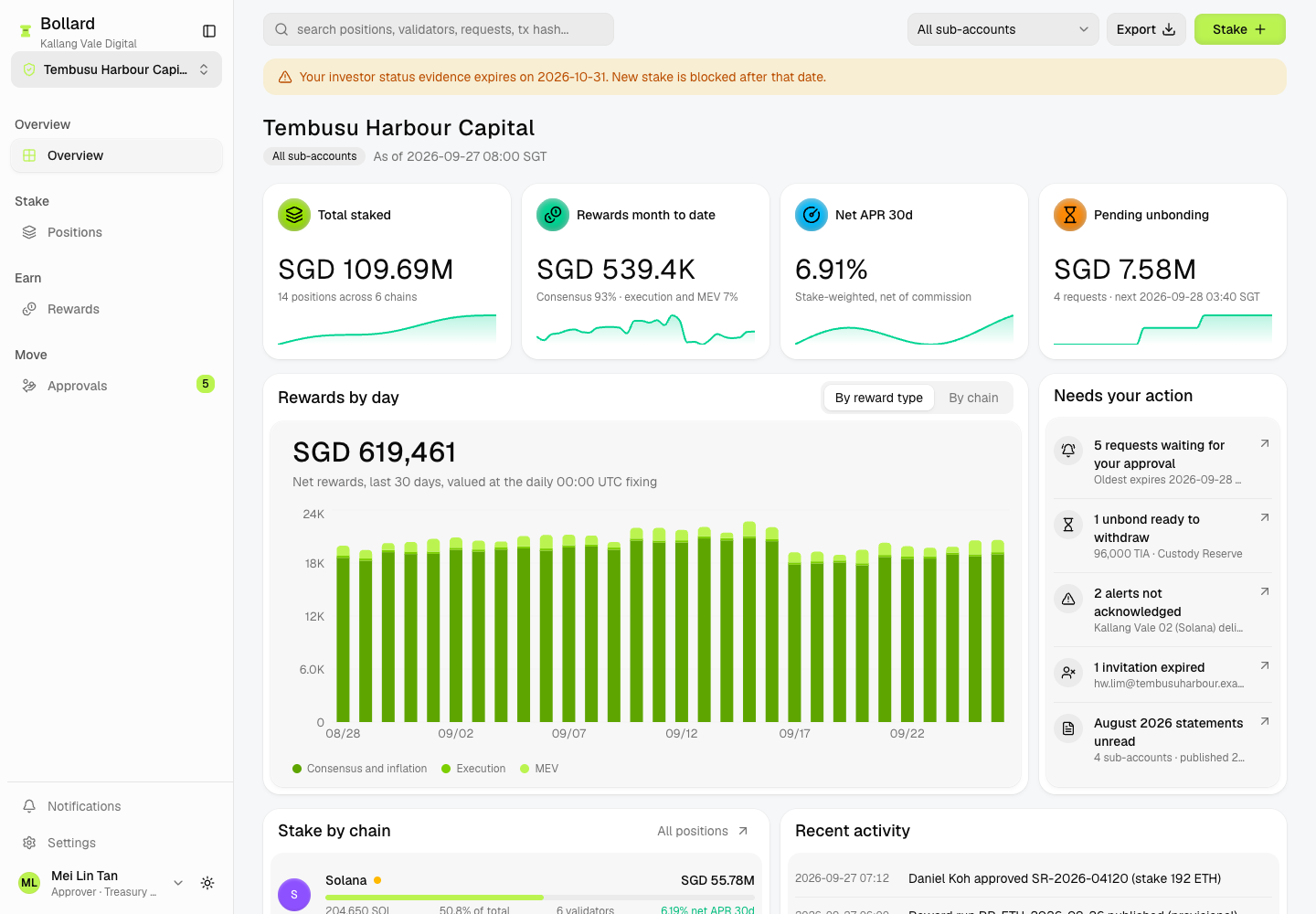
Bollard - Institutional Staking Dashboard for Validators, Rewards and Approvals
Designed and built a clickable client dashboard for a Singapore staking provider serving funds, family offices and corporate treasuries: positions across six chains, daily rewards split by type with SGD and USD values at receipt, unbonding dates per chain, and an approvals inbox that applies each institution's policy before stake moves.

ChainFlow - On-Chain Lending, Borrowing and Swap Console from Prototype to Production
Unified supply, borrow, swap, vault staking and portfolio analytics into a single multi-chain console - shipped from clickable AI prototype to production in 8 weeks.
Enterprise Software Engineering - Human + AI
Contact Us
© 2026 - Copyright. All Rights reserved Oceanlab
Location
Global Headquarters
21 Merchant Road, 3rd Floor, Singapore 058267
Main corporate office and leadership operations
North America Office
548 Market Street, PMB 12345, San Francisco, CA 94104
Client operations and business development
India Office
402 Shivalik Shilp II, SG Highway, Ahmedabad 380015
Engineering and delivery center

Enterprise Software Engineering - Human + AI
Contact Us
Locations
Global Headquarters
21 Merchant Road, 3rd Floor, Singapore 058267
Main corporate office and leadership operations
North America Office
548 Market Street, PMB 12345, San Francisco, CA 94104
Client operations and business development
India Office
402 Shivalik Shilp II, SG Highway, Ahmedabad 380015
Engineering and delivery center
© 2026 - Copyright. All Rights reserved Oceanlab