AI for e-commerce and D2C, grounded in your catalogue
OceanLab builds AI into online retail: assistants that answer from the product catalogue and moderation that puts safety first. The AI answers and sorts; shoppers and staff decide. Every example below is a product we built.
OceanLab product builds
AI products we designed and built in this industry. Each one is a full case study with screens, scope and the rules it was built for.
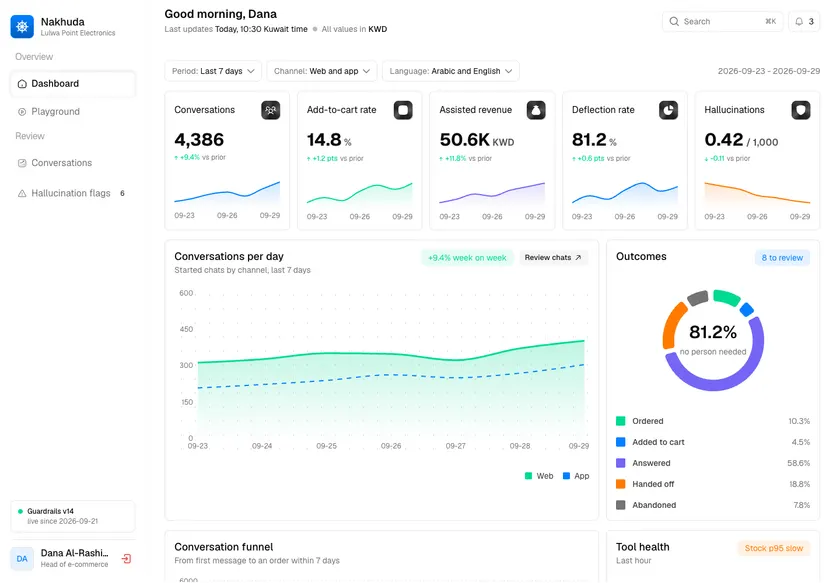
Nakhuda - Bilingual AI Shopping Assistant Grounded in the Product Catalogue
Designed and built a clickable console for an Arabic and English AI shopping assistant at a Kuwait City electronics retailer: every product claim cited to a catalogue field, compatibility decided by fixed rules, nothing added to a cart without the shopper's tap, and a review queue for every suspected invented fact.
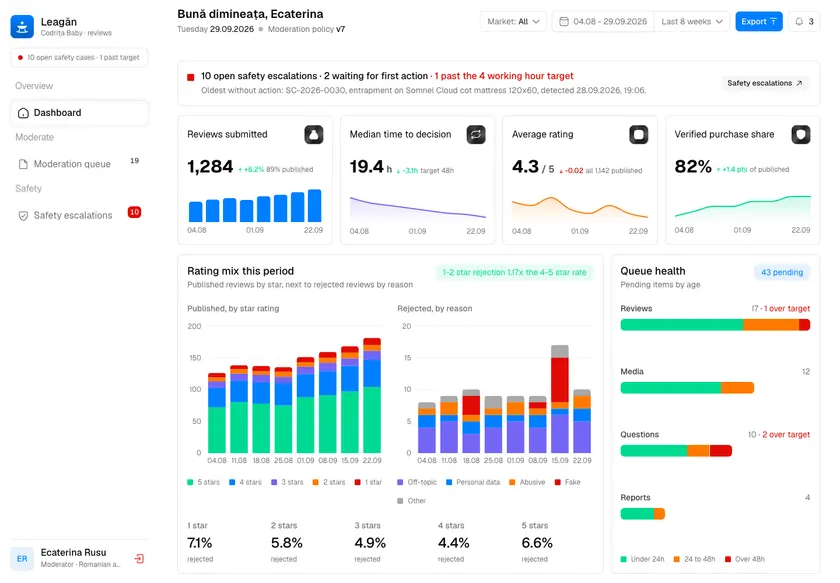
Leagăn - Reviews and UGC Platform with Built-In Safety Escalation
Designed and built a clickable reviews and user-generated content platform for a Chișinău baby and nursery retailer selling in Moldova and Romania: a moderation queue that works to a written policy, review detail with personal data masking, and a safety escalation desk that picks up any review describing a hazard to a child.
Where AI earns its place
Each use case names the builds that did it.
Shopping assistant
An Arabic and English assistant where every product claim is cited to a catalogue field, compatibility is decided by fixed rules and nothing goes in the cart without the shopper's tap.
Catching invented facts
A review queue for every answer the assistant may have made up, so staff can fix the catalogue or the prompt.
Review moderation
A moderation queue that works to a written policy, with personal data masked in each review.
Safety escalation
Any review that describes a hazard to a child goes to a safety desk, not the normal queue.
What to plan for
The rules that shape AI in this industry. General information, not legal advice: check with your own counsel.
Say it is an AI
Under the EU AI Act, providers must make sure people are told they are dealing with an AI system, unless that is obvious from the context.
EU AI Act, Article 50 (AI Act Service Desk), checked 2026-10-25
Cite the catalogue
The shopper decides
Safety first in reviews
Frameworks our AI builds here cite
From one workflow to production
- 01
Pick the workflow
We start from one workflow your team wants off its plate and agree what a working result looks like.
- 02
Clickable AI prototype
Your team tries the flow on a clickable prototype before any production code is written.
- 03
Production build
We build the production version, with the approval steps and records your industry needs.
- 04
Launch and improve
It goes live in your team's hands, and we tune it as real work runs through it.
Priced either way, whichever suits the work: outcome-based, paid per milestone, or hourly at $30-50 depending on role and seniority. More on AI automation →
Questions teams ask
What can AI do for an online store?
Answer shoppers from the product catalogue with every claim cited, flag answers that may be wrong, moderate reviews to a written policy and send safety reports to a person fast. Each of these is a product OceanLab built.
Does a shopping assistant need to say it is AI?
In the EU, yes: the AI Act requires that people are told they are dealing with an AI system unless it is obvious. Telling people is good practice everywhere.
How is it priced?
Either way, whichever suits the work: outcome-based, where you pay per milestone, or hourly at $30-50 depending on role and seniority.
Keep exploring
Are you an AI lab looking for human training or evaluation data? That is a separate offer, OceanLab Labs.
