LLM token counter
Paste any text to estimate how many tokens it is, and what it would cost to send to each model.
Free, runs in your browser, no sign-up. Updated 2026-10-25.
An estimate. Real token counts depend on each model's tokenizer; this tool estimates them from characters and words.
Result
Estimated 52 tokens (range 41–63) for 205 characters and 39 words. This is an estimate, not an exact tokenizer count.
- Characters
- 205
- Words
- 39
- By characters
- 51
- By words
- 52
| Model | Cost | Price checked |
|---|---|---|
| Claude Haiku 5.5 | $0.0000052 | 2026-10-23 |
| gpt-6-luna | $0.0000052 | 2026-10-23 |
| MiniMax M3.1-Flash | $0.0000078 | 2026-10-23 |
| gpt-5.6-luna | $0.00001 | 2026-10-23 |
| Gemini 2.5 Flash | $0.000016 | 2026-10-23 |
| deepseek-flash | $0.000016 | 2026-10-23 |
| MiniMax M3 | $0.000016 | 2026-10-23 |
| gpt-5.4-mini | $0.000039 | 2026-10-23 |
| Gemini 3.8 Flash | $0.000039 | 2026-10-23 |
| Claude Haiku 4.5 | $0.000052 | 2026-10-23 |
| Gemini 2.5 Pro | $0.000065 | 2026-10-23 |
| deepseek-v4-pro | $0.000069 | 2026-10-23 |
| Claude Sonnet 5.5 | $0.0001 | 2026-10-23 |
| Claude Sonnet 5 | $0.0001 | 2026-10-23 |
| gpt-6.1-sol | $0.0001 | 2026-10-23 |
| gpt-5.6-terra | $0.0001 | 2026-10-23 |
| Gemini 4 Argon | $0.0001 | 2026-10-23 |
| Gemini 3.1 Pro Preview | $0.0001 | 2026-10-23 |
| Claude Opus 5.5 | $0.00021 | 2026-10-23 |
| gpt-5.6-sol | $0.00021 | 2026-10-23 |
| Claude Opus 5 | $0.00026 | 2026-10-23 |
| Claude Fable 5.1 | $0.00052 | 2026-10-23 |
| gpt-6-astra | $0.00052 | 2026-10-23 |
Assumptions
Every number the result depends on, and where it comes from. Change any value and the result updates.
| Assumption | Value | Source |
|---|---|---|
| Characters per token (non-CJK text) | chars | OceanLab planning assumption: a common rule of thumb for English prose. Not measured by OceanLab; edit it if you have counts from the provider's tokenizer.Reviewed 2026-10-25 |
| Tokens per word | tokens | OceanLab planning assumption: a common rule of thumb for English prose. Not measured by OceanLab; edit it if you have counts from the provider's tokenizer.Reviewed 2026-10-25 |
| Tokens per CJK character | tokens | OceanLab planning assumption: CJK scripts usually tokenize at around one token per character or more. Edit it for your model.Reviewed 2026-10-25 |
| Range around the estimate | % | OceanLab planning assumption: ±20% covers typical differences between tokenizers on ordinary text. Code, numbers and rare words can fall outside it.Reviewed 2026-10-25 |
Ask OceanLab about your AI build
Opens an email to OceanLab with this result and a link to your inputs. Nothing is sent until you press send, and there is no sign-up.
How this is calculated
This is an estimate, not a tokenizer. Tokens ≈ the average of (characters ÷ characters per token) and (words × tokens per word), with Chinese, Japanese and Korean characters counted at about one token each.
The range shown is ±20% around the estimate. Code, numbers and rare words can fall outside it.
Each model family has its own tokenizer. For exact counts, use the provider's token-counting endpoint.
The cost table prices the estimated tokens as input on each model, at the prices shown with their checked dates.
Sources
- Anthropic API pricing · checked 2026-10-23
- OpenAI API pricing · checked 2026-10-23
- Google API pricing · checked 2026-10-23
- DeepSeek API pricing · checked 2026-10-23
- MiniMax API pricing · checked 2026-10-23
Questions about this tool
Is this an exact token count?
No. It is an estimate from characters and words, shown as a range. Each model family has its own tokenizer; use the provider's token-counting endpoint for exact numbers.
Why do code and other languages count differently?
Tokenizers are trained mostly on English text, so code, numbers and other scripts often split into more tokens per character.
Is my text sent anywhere?
No. Counting happens in your browser and the text is not stored or put in the page link.
Other free tools
OceanLab product builds like this
Products OceanLab designed and built. Each case study covers the screens, the scope and the rules it was built for.
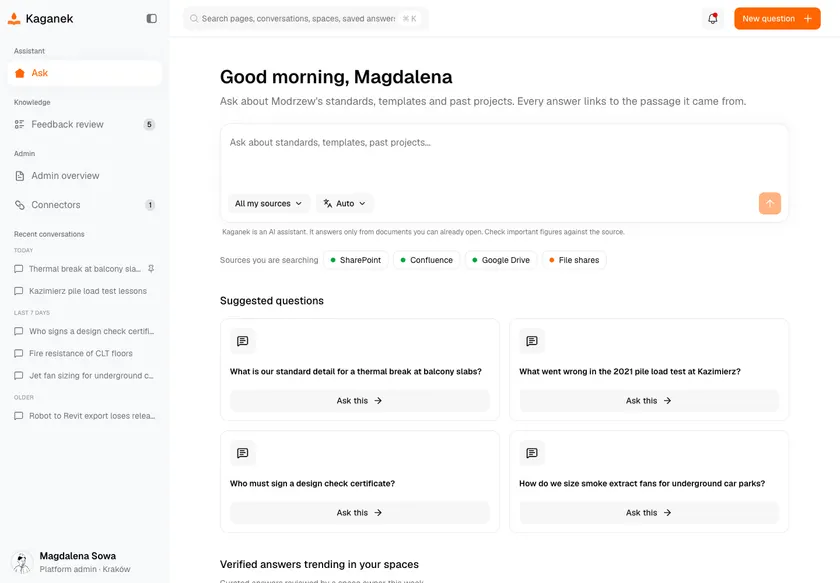
Kaganek - RAG Knowledge Assistant with Citations and Permissions Intact
Designed and built a clickable internal knowledge assistant for a Kraków consulting engineering firm: staff ask in Polish or English and get answers built only from the firm's own SharePoint, Confluence, Google Drive and file share documents, with every claim linked to its source passage and an honest "I don't know" when the sources are weak.
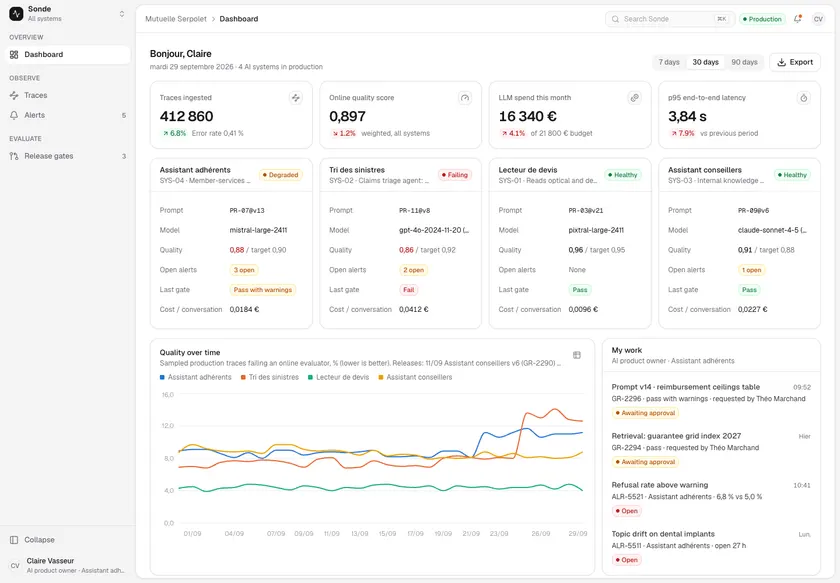
Sonde - LLM Evaluation and Observability Platform with Release Gates
Designed and built a clickable LLM evaluation and observability platform for the AI team of a French health mutual: redacted production traces span by span, release gates that block a prompt or model change when quality regresses, alerts with owners and ageing, and the monitoring record its risk and compliance teams can show a supervisor.
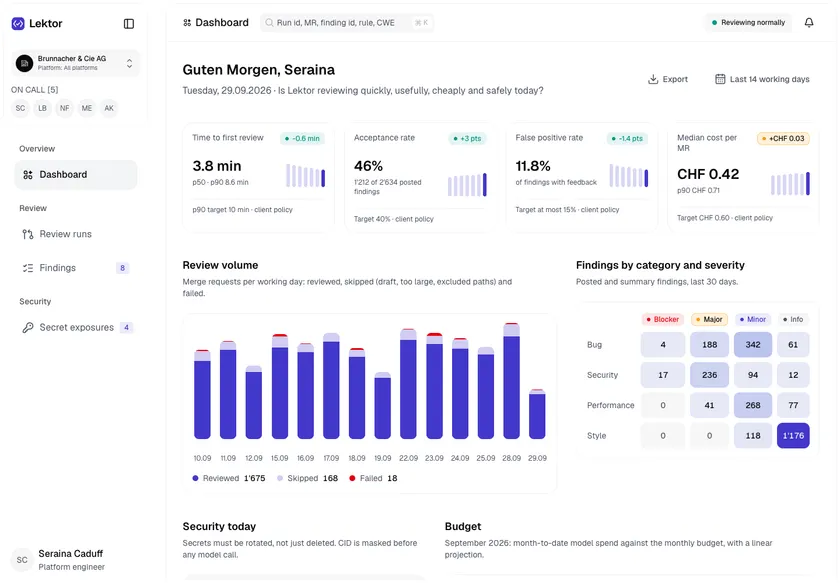
Lektor - AI Code Review Agent That Comments but Never Merges, Hosted Inside a Private Bank
Designed and built a clickable AI code review agent for the engineering team of a Zurich private bank: it reviews every merge request on GitLab and GitHub Enterprise with models hosted in the bank's own tenancy, masks client data and secrets before any model sees the diff, posts inline findings with rule, CWE and suggested patch, and never approves or merges.
