Yaxalıq - On-Site Check-In, Badge Printing and Access Control for a Trade Fair
Check-In and Badge System for a Baku Exhibition Organiser
Designed and built a clickable check-in and badge console for a Baku exhibition organiser's four-day trade fair of about 40,000 visitors: a live control room dashboard, room counts against approved fire safety limits, registrations with a lost-badge reprint that cancels the old badge, and an access alert board for the security lead.
Most of our work is under NDA. Per agreement, we can share the work but not the company details - all names and identifying information shown here have been changed.
Impact
Live dashboard, room capacity board, registrations, registration detail with the report lost and reprint flow, and access alerts. Every seeded registration opens its own record.
6 halls and 12 seminar rooms, each against the limit from the venue's fire safety approval. Rooms turn amber at 90% and entry scans stop at 100% (client policy), as in Seminar Room B2 at 350 of 350.
A reprint revokes the current badge and prints the next version, and scanners reject anything older. The lost BG-240118-1 is denied at the Hall 3 door and raised as an alert.
Across 5 badge types and 7 countries, with names in Azerbaijani Latin and Cyrillic, plus 12 access alerts, 14 devices, 12 staff users and event-wide totals of 41,286 registrations.
The Problem
At its last edition, Sahilkənd Expo printed 31,000 badges in advance and sorted them into alphabetical boxes at eight desks. Opening morning queues reached 70 minutes, a third of the badges were never collected and walk-ins filled in paper forms that were typed up overnight. Lost badges were reprinted without cancelling the originals, hall doors had no scanning, and a Wi-Fi outage on day two stopped registration for 40 minutes.
Our Solution
Yaxalıq imports pre-registrations, prints badges on demand at self-service kiosks and staffed desks, scans badges at hall and room doors, and keeps live counts against each room's approved limit. A reprint raises the badge version so the old badge stops working, and the control room sees check-in, occupancy, devices and misuse attempts on one live dashboard.
The Challenge: 40,000 Arrivals, One Badge Each
Sahilkənd Industry Week runs for four days across six halls and twelve seminar rooms, with visitors, exhibitors, press, VIPs and contractors who each have different rules for where they may go, when, and what they must show at the desk.
Queues and Uncollected Badges
Printing every badge in advance meant long alphabetical queues on opening morning and thousands of badges that were never picked up. Walk-ins had no digital path at all, so their records reached the system a day late.
Lost Badges Kept Working
A reprint created a second valid badge on the same registration, so two people could enter on one ticket. Nothing at the door could tell an original from its replacement, and nobody was told when it happened.
Rooms Without a Count
Each hall and room has a maximum occupancy from the venue's fire safety approval, generally overseen in Azerbaijan by the Ministry of Emergency Situations. With no door scanning, the only way to know a seminar room was full was a steward counting heads.
Personal Data and ID Checks
Azerbaijan's Law on Personal Data generally requires consent and purpose limits, and GDPR may apply to visitors from the EU. Press, VIP, contractor badges and any reprint need a photo ID check, but keeping copies of identity documents would create a risk the organiser does not need.
Our Approach: From Accreditation Rules to a Clickable Console
Spec and Rules Research
Mapped 11 user roles, from registration manager and desk agent to access steward, security lead and data protection officer, and 38 screens across the organiser console, desk, kiosk, handheld scanner, exhibitor portal and visitor pages. Defined the data model for registrations, versioned badges, signed QR payloads, ID checks, zones and access rules, rooms, scans, devices, edge servers and data requests, and wrote down the rules the design follows: Azerbaijani personal data law, GDPR for EU visitors, fire safety occupancy, Azerbaijani and Cyrillic names on badges and Asia/Baku time.
Clickable Demo on a Production UI Kit
Built 5 key screens on a production dashboard kit: the live dashboard with 5 KPIs against the same hour on day 1, arrivals per 15 minutes by badge type with the 2025 edition line, check-in point tiles and a needs-attention list; the room capacity board with correct count, close and reopen; registrations with filters, bulk actions and a quick view; the registration detail with consent, ID check, badge history and the reprint flow; and access alerts with assign, close and block. All actions run on local state.
What a Production Build Adds
Sync with the ticketing platform and the venue and exhibitor system, Zebra or Epson badge printers, Zebra or Honeywell handhelds, dormakaba or Gunnebo turnstiles, email, SMS through a local aggregator and Apple and Google Wallet passes. Hosting in Baku with an edge server per hall block so devices keep working offline, event signing key management, the desk, kiosk, scanner, exhibitor and visitor apps, staff auth by role, a tamper-evident audit log, and counsel review of consent wording and data localisation.
Why It Works: Every Badge Accounted For
A Reprint Cancels the Old Badge
Report lost and reprint asks for the reason and an ID check, revokes the current version and prints the next, and needs a supervisor PIN once the reprint limit is reached. Badge history shows every version with where it was printed and by whom.
Room Counts Stewards Can Trust
Each room card shows the count against its approved limit, entries and exits in the last 15 minutes, the current session and the steward on the door. When a door scanner goes offline the card says the count may be behind, and every manual correction keeps its reason and who made it.
ID Checks Without ID Copies
The ID check records that a check happened, the document type seen and who checked it. There is no field for a document number or image, contact details are masked unless the user reveals them, and each reveal is logged.
Misuse Surfaces as Alerts
Old-version, revoked and forged codes, the same badge at two entrances within 2 minutes and repeated denials at one door become alerts on an open, investigating and closed board. Closing one needs an outcome and a note, and the security lead can block the registration from the alert.
Related case studies
View all: Events & ticketing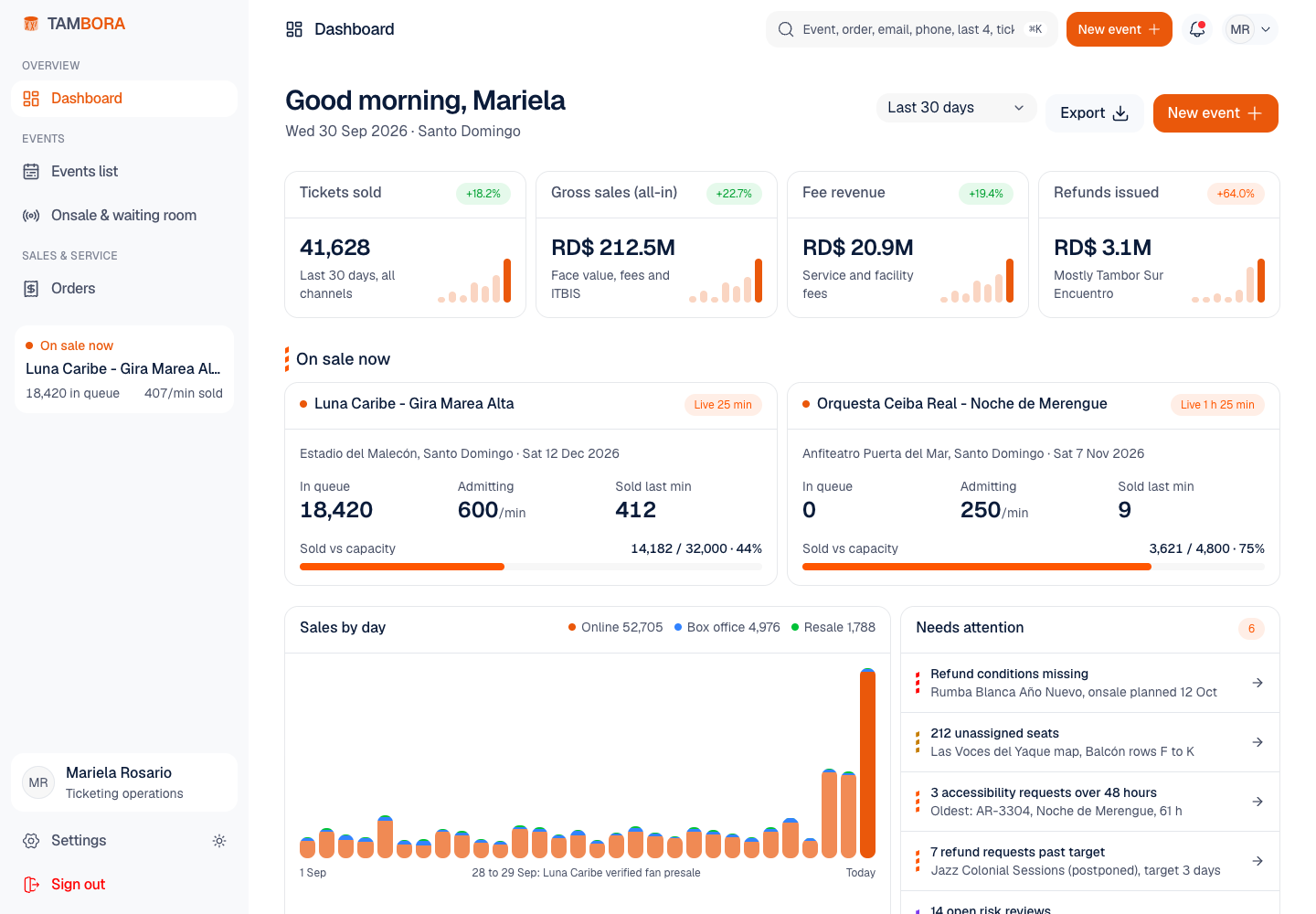
Tambora - Ticketing Platform for Caribbean Concerts and Festivals
Designed and built a clickable ticketing platform for a Santo Domingo ticket company selling concerts and festivals across the Caribbean: all-in prices from the first view, a live waiting room and bot controls for big onsales, event inventory with holds and a readiness checklist, and an orders view with payment, 3-D Secure and fiscal receipt details.
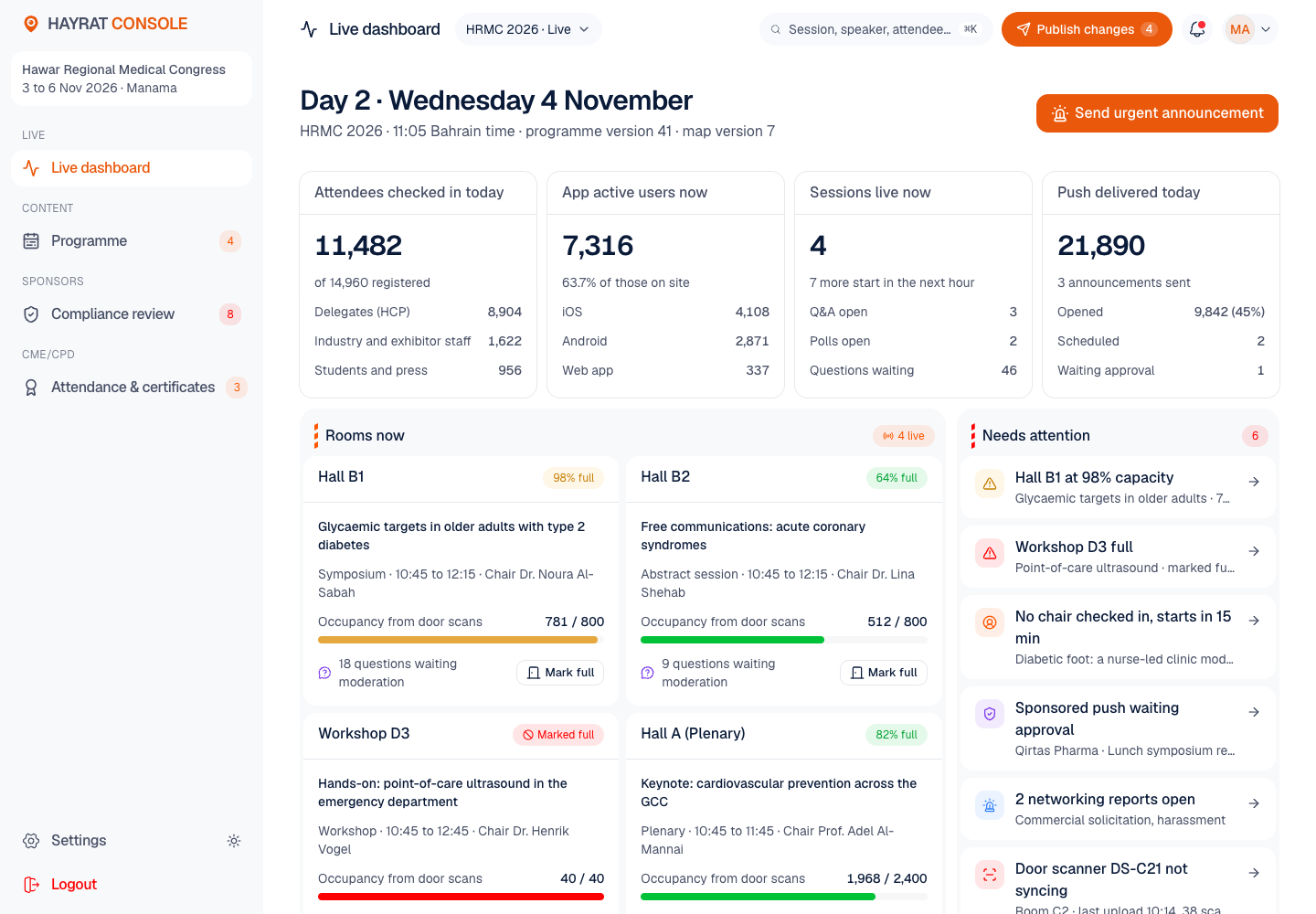
Hayrat - Congress App and Organiser Console for a Medical Congress
Designed and built a clickable organiser console for a Manama congress organiser running a four-day medical congress of about 15,000 attendees: a live dashboard fed by door scans, a programme grid that catches clashes before publishing, one compliance queue for everything industry-funded, and CME/CPD credits calculated from verified attendance.
Enterprise Software Engineering - Human + AI
Contact Us
© 2026 - Copyright. All Rights reserved Oceanlab
Location
Global Headquarters
21 Merchant Road, 3rd Floor, Singapore 058267
Main corporate office and leadership operations
North America Office
548 Market Street, PMB 12345, San Francisco, CA 94104
Client operations and business development
India Office
402 Shivalik Shilp II, SG Highway, Ahmedabad 380015
Engineering and delivery center

Enterprise Software Engineering - Human + AI
Contact Us
Locations
Global Headquarters
21 Merchant Road, 3rd Floor, Singapore 058267
Main corporate office and leadership operations
North America Office
548 Market Street, PMB 12345, San Francisco, CA 94104
Client operations and business development
India Office
402 Shivalik Shilp II, SG Highway, Ahmedabad 380015
Engineering and delivery center
© 2026 - Copyright. All Rights reserved Oceanlab