Tamis - Sanctions and PEP Screening Platform with Four-Eyes Decisions
Name Screening for a Luxembourg Private Bank and Fund Administrator
Designed and built a clickable sanctions and PEP screening platform for a Luxembourg private bank and fund administrator: rescreening as soon as a list changes, a payment hold queue against currency cut-offs, side-by-side alert review with four-eyes approval, and true hit cases that track the freeze and every report to the authorities.
Most of our work is under NDA. Per agreement, we can share the work but not the company details - all names and identifying information shown here have been changed.
Impact
Dashboard with the live screening pipeline, alert queue, three-column alert review, payment screening with a held-payment panel, and the true hit case. A role switcher shows the same product as an L1 analyst, L2 senior analyst, compliance officer or payments operations.
An analyst proposes with a reason code and a rationale of at least 30 characters; a senior analyst who is not the proposer approves or rejects. Every whitelist needs L2 and expires after 12 months by default, 24 at most.
A company owned more than 50% by a designated person alerts even though it is not listed. In the demo case, a 55% owner's listing freezes EUR 18.55M across 6 accounts, fund holdings and payments.
22 screened parties, 20 list entries from 7 list sources, 19 payments on SWIFT, SEPA and SEPA Instant, and 3 true hit cases in different stages.
The Problem
Banque Sauerthal screened with three tools that did not talk to each other: a vendor list search for onboarding, a payment filter bolted onto the SWIFT gateway and a PEP spreadsheet kept by the compliance officer. Its 38,000 private clients and around 210,000 fund investors were rescreened once a month, about 97% of alerts were false positives, payment hits sat in the gateway with no queue, and nobody could show the CSSF why the matching thresholds were right.
Our Solution
Tamis screens every client, beneficial owner and fund investor at onboarding and again as soon as a list changes, and holds SWIFT and SEPA payments until each hit is cleared. Analysts review alerts side by side with the listed record, a second person confirms each decision, and confirmed matches become true hit cases with the freeze, the reports and the no-tipping-off instruction tracked in one place.
The Challenge: Screening at the Speed of the Lists
A Luxembourg bank screens against EU, UN and national sanctions by law, and against the OFAC and UK lists by its own policy. EU freezes generally apply from the moment a listing is published, so a name added this morning has to reach every customer and every payment the same day.
Lists That Change Faster Than Screening
With a monthly rescreen, a new EU designation could go unnoticed for weeks. Under EU guidance, an entity owned more than 50% by a designated person is generally frozen too, so beneficial owners have to be screened as well as the customer.
Names in Many Spellings
Listed names come from Cyrillic, Arabic and Chinese scripts, in different word orders and with initials. Fuzzy matching tuned years ago and never tested produced about 97% false positives, and the same good guys alerted again after every list update.
Payments Waiting on Nobody
Payment hits sat in the SWIFT gateway with no queue or SLA, so urgent private-client payments missed their currency cut-off. SEPA Instant needs a different approach again, because the Instant Payments Regulation replaces per-payment EU name screening with at least daily customer screening.
Freeze Fast, Report, Say Nothing
A confirmed match must be frozen without delay, reported to the Ministry of Finance with the CSSF informed, and sent to the CRF through goAML where there is a suspicion. The client must not be tipped off, and access to true hits is limited and logged under the GDPR.
Our Approach: From Screening Rules to a Clickable Platform
Spec and Rules Research
Mapped 10 staff roles, 37 screens with 4 slide-over panels and about 16 modals, and the data model for list sources and versions, list entries, parties, payments, alerts with candidates, four-eyes decisions, whitelist entries, true hit cases and PEP records. Wrote down the rules the design follows: the 2004 AML/CFT law and CSSF Regulation 12-02, EU, UN and Luxembourg sanctions, the 50% ownership rule, freezing and reporting, PEP rules including the 12 months after office, the Transfer of Funds and Instant Payments Regulations, and the GDPR.
Clickable Demo on a Production UI Kit
Built 5 key screens on a production dashboard kit: the dashboard with list status and the latest EU delta run from list load to alerts raised, the alert queue with payment alerts first, alert review with candidate cards, field-by-field comparison, name match breakdown and ownership chain, payment screening with the raw ISO 20022 or MT message, and the true hit case. Proposals, approvals, escalations, payment decisions and case records update local state and the sidebar badges.
What a Production Build Adds
Feeds from the EU, UN, Luxembourg, OFAC and UK lists and a commercial PEP provider such as LSEG World-Check or Dow Jones, core banking (Avaloq or Temenos Transact), the Temenos Multifonds transfer agency, SWIFT Alliance Access, the SEPA gateway, goAML and Microsoft Entra ID single sign-on. A tamper-evident audit log, and the remaining screens: PEP register and reviews, list sources with a delta viewer, the whitelist, threshold tests with below-the-line samples, QA, reports with a CSSF evidence pack, and settings.
Why It Works: Evidence Before Every Decision
Both Records Side by Side
Alert review puts our subject, the candidate list entries and the decision in three columns. Each field shows our value, the listed value and a chip from exact to conflict, and the name breakdown shows which tokens matched by transliteration, phonetics or reordering.
Good Guys Stay Quiet, Safely
A whitelisted pair rests on named identifiers such as date of birth and nationality, and stops working early if either record changes. The pipeline on the dashboard shows the latest EU delta run: 1,904 candidates, 1,611 suppressed by the whitelist, 284 already in an open alert, 9 new alerts.
Payments Ranked by Cut-Off
Payment alerts sort to the top of the queue and held payments turn amber 30 minutes before the currency cut-off. Release is possible only when every alert is closed as not a match, a freeze only from a confirmed true hit, and SEPA Instant hits are rejected by the gateway and reviewed after the fact.
True Hits Handled Discreetly
A true hit case is visible only to roles with access, and every view is logged. It lists the frozen assets of the party and of entities it owns more than 50%, and a reporting checklist for the Ministry of Finance, the CSSF, the CRF via goAML and the no-tipping-off instruction.
Related case studies
View all: RegTech & compliance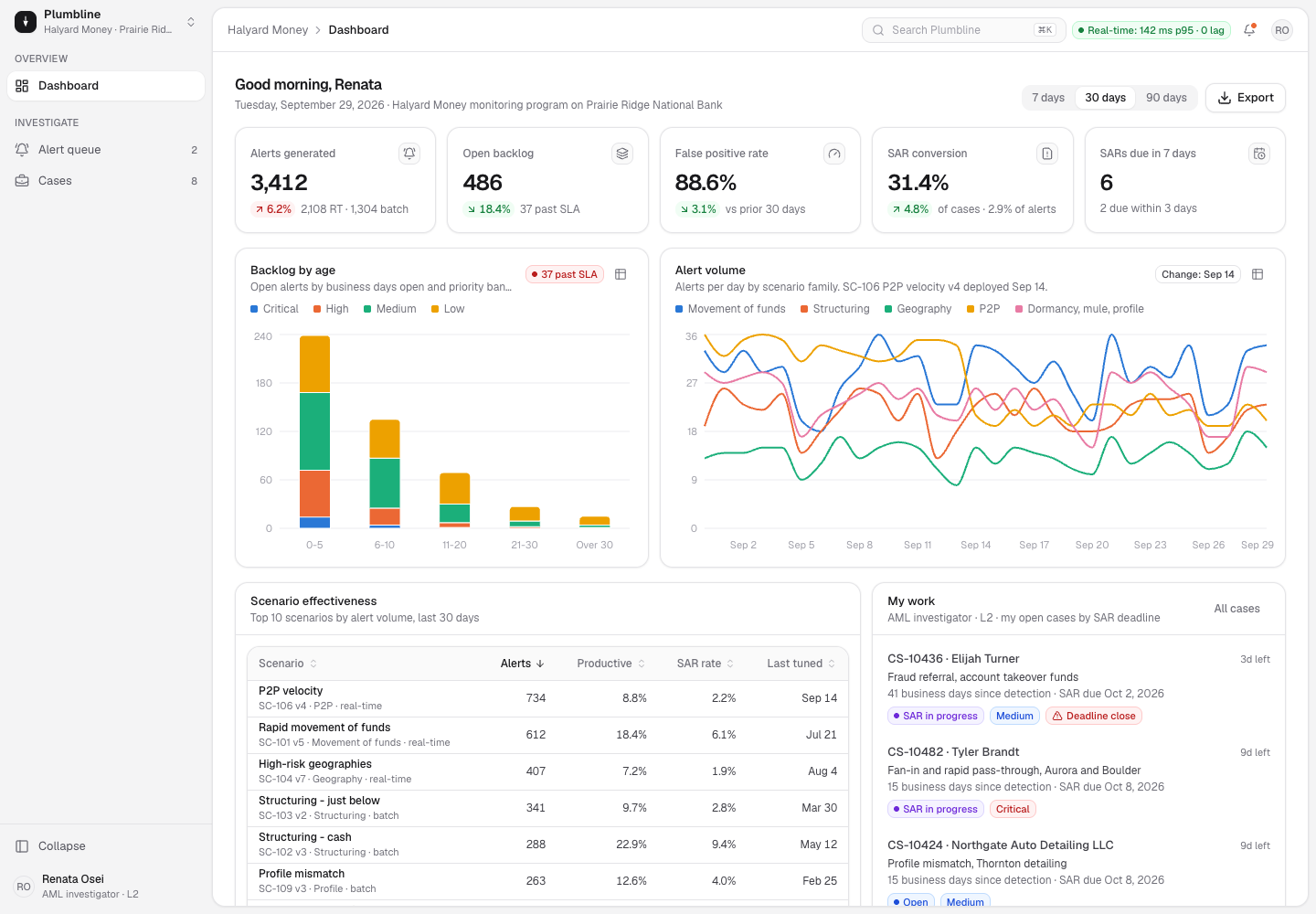
Plumbline - AML Transaction Monitoring with Alerts, Cases and SAR Deadlines in One System
Designed and built a clickable AML transaction monitoring system for a US neobank and its sponsor bank: scenario alerts ranked by a transparent priority score, an investigation workspace that shows why each alert fired, real-time payment holds, and cases that count down to the SAR filing deadline.
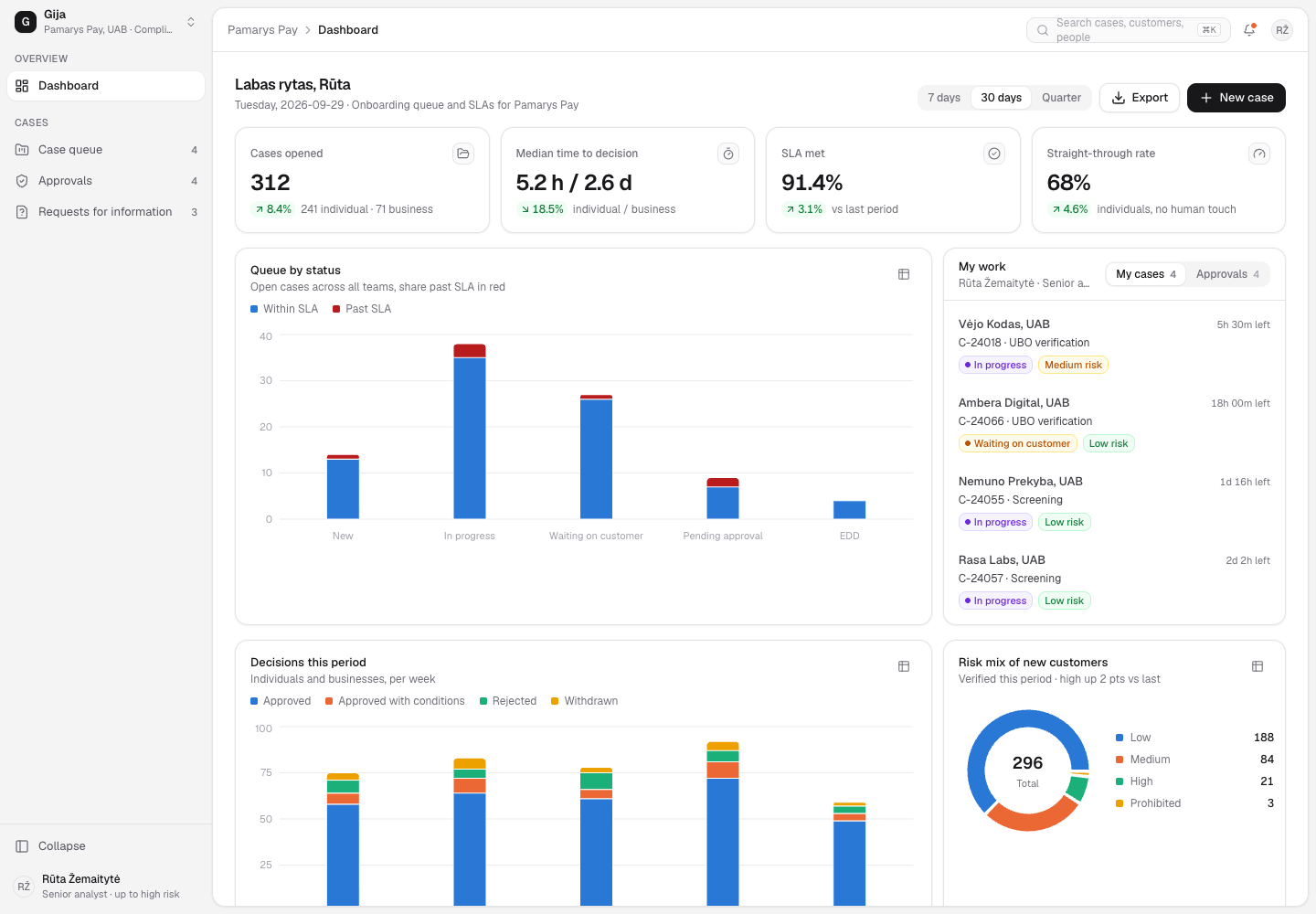
Gija - KYC and KYB Case Management with Ownership Tracing and Four-Eyes Approval
Designed and built a clickable KYC and KYB case-management platform for a Vilnius electronic money institution: a case queue with SLAs, individual and business cases with registry comparison and beneficial ownership traced through every layer, an explainable risk score, four-eyes approval and requests for information sent to customers.
Enterprise Software Engineering - Human + AI
Contact Us
© 2026 - Copyright. All Rights reserved Oceanlab
Location
Global Headquarters
21 Merchant Road, 3rd Floor, Singapore 058267
Main corporate office and leadership operations
North America Office
548 Market Street, PMB 12345, San Francisco, CA 94104
Client operations and business development
India Office
402 Shivalik Shilp II, SG Highway, Ahmedabad 380015
Engineering and delivery center

Enterprise Software Engineering - Human + AI
Contact Us
Locations
Global Headquarters
21 Merchant Road, 3rd Floor, Singapore 058267
Main corporate office and leadership operations
North America Office
548 Market Street, PMB 12345, San Francisco, CA 94104
Client operations and business development
India Office
402 Shivalik Shilp II, SG Highway, Ahmedabad 380015
Engineering and delivery center
© 2026 - Copyright. All Rights reserved Oceanlab