Skanse - GRC Platform for Risk, Controls and DORA Incident Reporting
Governance, Risk and Compliance Platform for a Danish Financial Group
Designed and built a clickable GRC platform for a Danish bank and pension group: a risk register scored inherent and residual against the board's appetite, a dashboard with DORA readiness, and an ICT incident log that classifies incidents against the DORA criteria and runs the reporting clock to Finanstilsynet.
Most of our work is under NDA. Per agreement, we can share the work but not the company details - all names and identifying information shown here have been changed.
Impact
Dashboard, risk register, risk detail with its assessment panel, ICT incident log and incident detail with the DORA classification form and incident clock.
Initial notification at the earlier of 4 hours after classification and 24 hours after awareness, the intermediate report 72 hours later and the final report one month after that, with a separate GDPR 72-hour clock for Datatilsynet.
Inherent, residual and target scores on one matrix, with the highest of four impact dimensions driving impact. Each risk is checked against the residual limit for its category, across 8 appetite categories.
3 legal entities, 17 staff across the three lines, 18 controls mapped to DORA, ISO 27001 and internal policies, 12 KRIs with 12 months of values, 12 issues and 12 ICT incidents.
The Problem
Nørrevig's second line ran on SharePoint folders and about forty Excel workbooks: a risk register per entity, a control matrix per department, a separate outsourcing register and an incident log kept by IT operations. Building the first DORA register of information took three people six weeks, nobody could say which DORA articles had no tested control behind them, and the quarterly board pack was assembled by hand over eight working days.
Our Solution
Skanse puts the group's risks, controls, issues and ICT incidents in one place for both the bank and the pension company. Risks are scored on one matrix and checked against the board's appetite, the dashboard shows DORA readiness and what needs attention this week, and every ICT incident is classified against the DORA criteria with its reporting deadlines counting down.
The Challenge: One Group, Many Rulebooks
Nørrevig Bank A/S and Nørrevig Pension A/S are both supervised by Finanstilsynet and both in scope of DORA since 17 January 2025. Risk, compliance and internal audit have to work from the same records while keeping the three lines of defence apart.
Forty Workbooks, No Single Picture
Each entity and department kept its own register or matrix, so scores, owners and control results did not line up. Numbers in the board pack did not always match between slides, because each one came from a different file.
DORA Reporting Runs in Hours
A major ICT incident is generally reported with an initial notification within 4 hours of classification and no later than 24 hours after becoming aware of it. Classification depends on clients, transactions, downtime, spread, data losses, economic and reputational impact, and has to be right the first time.
Coverage Nobody Could Prove
Controls had to map to DORA articles, ISO/IEC 27001:2022 Annex A and internal policies at once. With testing evidence sent by email, there was no way to show which requirements had a tested, effective control behind them.
Three Lines, Separate Permissions
Risk and control owners, the risk and compliance functions and internal audit each do different things. Testers cannot test controls they own, closing an internal audit finding needs internal audit's validation, and every score change has to be traceable.
Our Approach: From DORA Rules to a Clickable Platform
Spec and Rules Research
Mapped 13 user roles across the three lines, 43 screens across the staff app, an employee attestation portal and a provider evidence page, and the data model for legal entities, risks, appetite, controls, framework requirements, tests, issues, KRIs, policies, ICT providers and incidents. Wrote down the rules the design follows: DORA and its technical standards, the EBA outsourcing guidelines, TIBER-DK, ISO/IEC 27001:2022, ISAE 3402 assurance, GDPR and the Danish Data Protection Act, and Finanstilsynet orders and reprimands.
Clickable Demo on a Production UI Kit
Built 5 key screens on a production dashboard kit: the dashboard with KPI cards, a clickable residual heatmap, the DORA readiness strip, a remediation burn-down and a needs attention list, the risk register in table or heatmap view, risk detail with an Assess panel that previews the new score and appetite status, the ICT incident log, and incident detail with live classification, timeline and report tracking. An entity switcher filters every screen, and all actions run on local state.
What a Production Build Adds
Entra ID sign-in and user sync, ServiceNow or Jira Service Management for incidents and changes, SharePoint evidence links, GLEIF and CVR lookups for providers, Tenable or Qualys and Sentinel or Splunk feeds for KRIs, and Microsoft 365 notifications. An append-only audit trail of every score, test, classification and export, and the remaining screens: controls and frameworks, testing campaigns, policies and attestations, the ICT third-party register and register of information, resilience testing and the board reporting packs.
Why It Works: Rules Visible Where the Work Happens
Every Risk Measured Against the Board's Line
Each residual rating is compared with the limit for its appetite category and shown as within, near limit or outside. On the dashboard heatmap, cells above the appetite line are outlined, and clicking a cell opens the register filtered to those risks.
Classification Shows Its Reasoning
The incident form lists each DORA criterion with the recorded value, the threshold and whether it was met, then states the result as Major or Not major with the reason. Sign-off by the ICT risk manager is shown alongside.
The Clock Starts at Awareness
Log incident sits in the top bar on every screen. The incident clock shows each report's due time or submitted time, marking a report submitted starts the next deadline, and a personal data breach gets its own 72-hour Datatilsynet clock next to the DORA one.
Assessments That Update Everywhere
The Assess panel takes residual likelihood, the four impact dimensions and a rationale, and previews the new score, rating and appetite status before saving. The result flows to the register, heatmap and dashboard, with the rationale kept in the assessment history.
Related case studies
View all: RegTech & compliance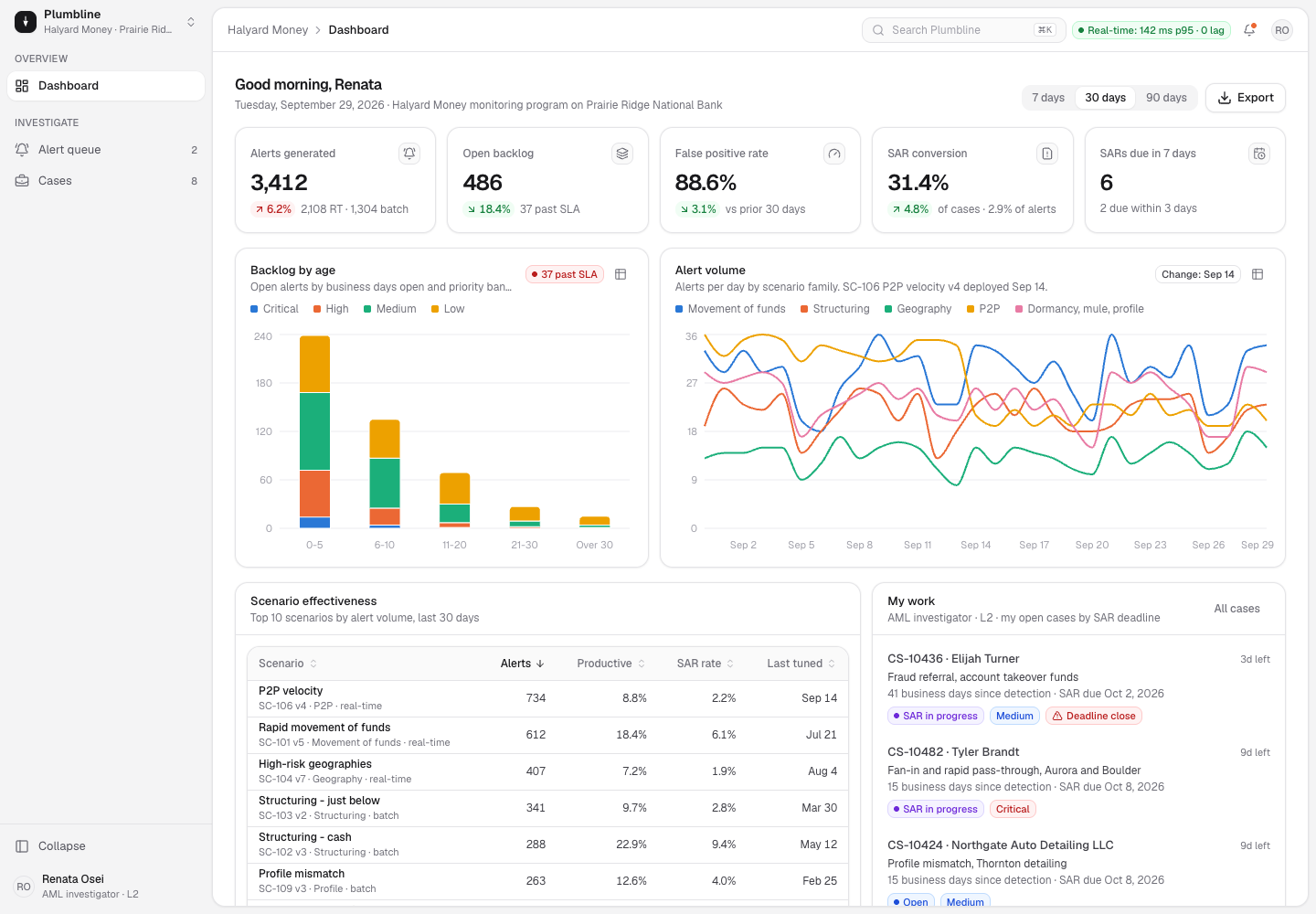
Plumbline - AML Transaction Monitoring with Alerts, Cases and SAR Deadlines in One System
Designed and built a clickable AML transaction monitoring system for a US neobank and its sponsor bank: scenario alerts ranked by a transparent priority score, an investigation workspace that shows why each alert fired, real-time payment holds, and cases that count down to the SAR filing deadline.
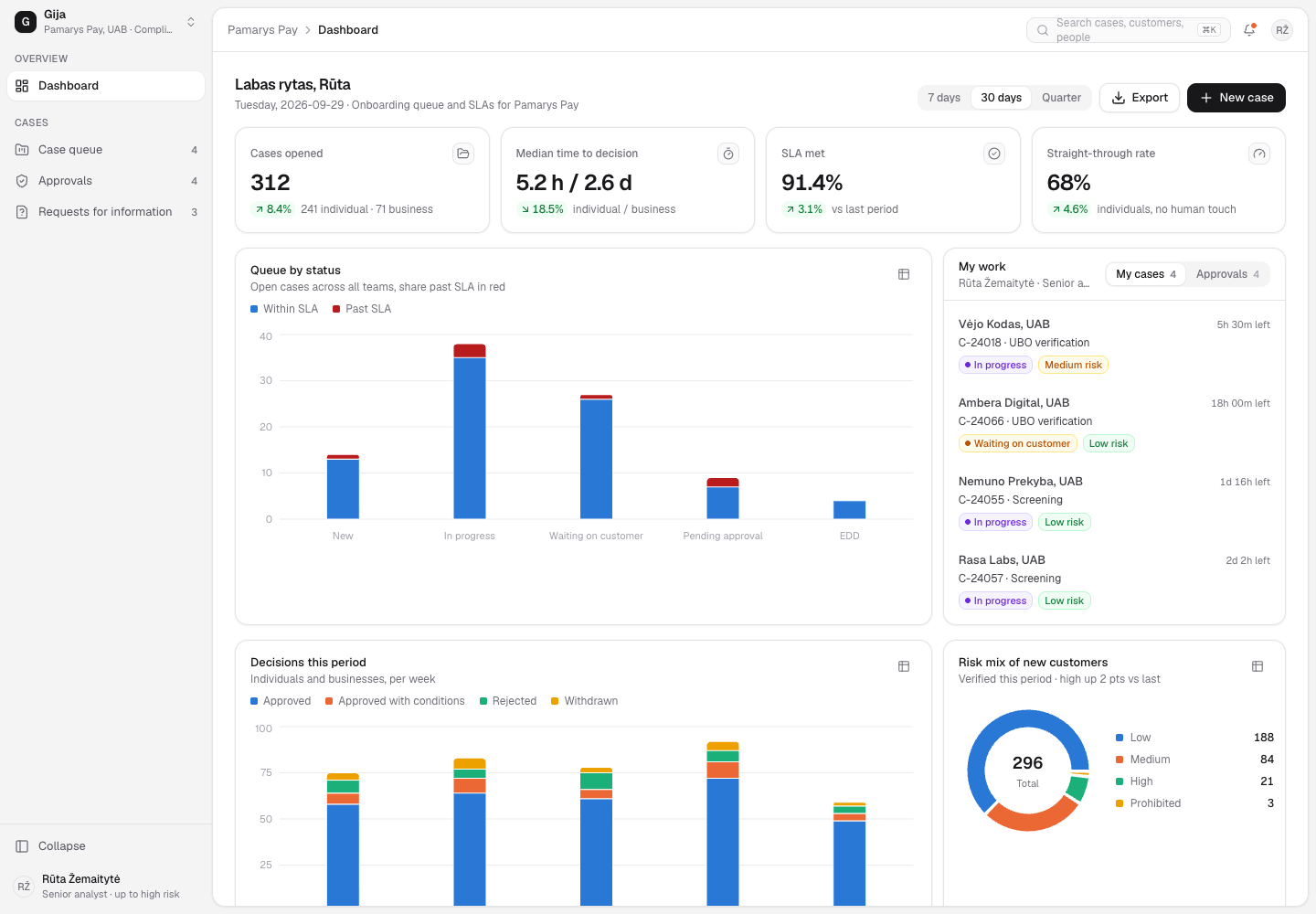
Gija - KYC and KYB Case Management with Ownership Tracing and Four-Eyes Approval
Designed and built a clickable KYC and KYB case-management platform for a Vilnius electronic money institution: a case queue with SLAs, individual and business cases with registry comparison and beneficial ownership traced through every layer, an explainable risk score, four-eyes approval and requests for information sent to customers.
Enterprise Software Engineering - Human + AI
Contact Us
© 2026 - Copyright. All Rights reserved Oceanlab
Location
Global Headquarters
21 Merchant Road, 3rd Floor, Singapore 058267
Main corporate office and leadership operations
North America Office
548 Market Street, PMB 12345, San Francisco, CA 94104
Client operations and business development
India Office
402 Shivalik Shilp II, SG Highway, Ahmedabad 380015
Engineering and delivery center

Enterprise Software Engineering - Human + AI
Contact Us
Locations
Global Headquarters
21 Merchant Road, 3rd Floor, Singapore 058267
Main corporate office and leadership operations
North America Office
548 Market Street, PMB 12345, San Francisco, CA 94104
Client operations and business development
India Office
402 Shivalik Shilp II, SG Highway, Ahmedabad 380015
Engineering and delivery center
© 2026 - Copyright. All Rights reserved Oceanlab