Cocrico - User Access Review and Certification Platform for a Securities Exchange
Access Reviews for a Caribbean Exchange and Depository
Designed and built a clickable access review platform for a securities exchange and central securities depository operator in Port of Spain: review campaigns in which managers, application owners and the security team keep or remove each person's access, with the risky items surfaced first, revoke tickets tracked to removal and a later sync that proves the access really went.
Most of our work is under NDA. Per agreement, we can share the work but not the company details - all names and identifying information shown here have been changed.
Impact
Dashboard, My reviews, the review workspace, campaigns and revocations. Each of the reviewer's 3 open campaigns, privileged, manager and a delegated depository review, opens its own workspace.
Leaver still active, mover mismatch, no HR record, dormant, peer outlier, SoD conflict and privileged. Flagged items sort first, then by risk from critical to low, each with a one-line reason.
Revoke decided, ticket raised, ticket closed and verified gone. A removal counts only when a later sync no longer finds it, and the demo shows 3 failures: still present, re-granted and could not confirm.
Review items across 3 campaigns, 33 identities including service, break-glass and unmatched accounts, 11 applications, 23 catalogued entitlements, 16 campaigns and 24 revocations.
The Problem
Poui Bay's access reviews ran on spreadsheets. Each quarter the IAM team exported user lists from eleven systems and emailed them to about 90 managers and application owners, who ticked keep on whole sheets in seconds. Removals were emailed to the service desk with no check that anything changed, an external auditor found two leavers still holding active depository accounts months after their last day, and building one audit's evidence took roughly three weeks.
Our Solution
Cocrico pulls identities from HR and the identity provider and accounts from the trading engine, depository, surveillance, finance and cloud consoles, then runs review campaigns that put the risky items first. Every revoke becomes a tracked ticket, the next sync checks the access is really gone, and each decision records who made it, what they saw and why.
The Challenge: Proving Who Can Do What
Poui Bay runs a securities exchange and a central securities depository, so access to the trading engine, the depository and market surveillance is market-critical. Its auditors expect it to show that only the right people hold that access and that removals really happen, and it expects TTSEC examiners to ask the same.
Reviews That Were Rubber-Stamped
Reviewers received whole workbooks with no sign of which rows were risky: a leaver whose account was still enabled looked the same as a daily user. Ticking keep on the whole sheet was the fastest way through.
Removals Nobody Checked
A revoke was an email to the service desk. Nobody confirmed the access had gone, birthright roles could quietly grant it back, and some systems only report users through a file export.
Evidence an Auditor Can Test
The auditors test against familiar IT general control concepts: a complete and accurate population, reviewers independent of the access they review, timely removal and proof that removal happened. The spreadsheets could not show the list reviewed was the complete list.
Conflicts and Independence
No one may both create and approve a depository transfer, or create a vendor and release its payment. Nobody certifies their own access, delegation cannot send an item back to its subject, and the CPMI-IOSCO cyber guidance expects strong control of privileged accounts and of staff who leave or move.
Our Approach: From Access Rules to a Clickable Platform
Spec and Rules Research
Mapped 10 user roles, from line managers and application owners to fulfillers, risk and compliance and external auditors, and 35 screens: 31 staff screens, a 3-screen auditor portal and a mobile quick review. Modelled identities, accounts, entitlements, grants, campaigns frozen as snapshots, review items, revocations with verifications, SoD rules, exceptions and evidence packs. Wrote down the rules the design follows: TTSEC oversight under the Securities Act 2012, the PFMI and CPMI-IOSCO cyber resilience guidance, the Data Protection Act 2011 and IT general control concepts.
Clickable Demo on a Production UI Kit
Built 5 key screens on a production dashboard kit: the dashboard with KPIs, campaign progress, the revocations funnel and access hygiene counts, My reviews with delegation, the review workspace with recommendation filters, the access item panel, bulk actions and sign-off, the campaigns list with status filters, and revocations with the revoke ticket panel. Decisions, delegation, sign-off and ticket actions run on seeded demo data.
What a Production Build Adds
Connectors to Entra ID or Okta, Workday or SuccessFactors, the trading engine and depository, Nasdaq SMARTS, NetSuite, AWS IAM Identity Center, Azure and CyberArk, revoke tickets in ServiceNow or Jira, reminders in Outlook and Teams, and evidence packs hashed with SHA-256 and kept in write-once storage. Staff sign-in by role, an append-only audit trail, and the remaining screens: SoD rules and exceptions, inventory, reports, settings, the auditor portal with MFA and the mobile quick review.
Why It Works: Decisions an Auditor Can Trust
Risky Access Comes First
Filter chips count each recommendation, and the default sort puts flagged items first, then critical, high, medium and low. Each badge says why, such as "Terminated 2026-08-29, account enabled" or "1 of 9 peers in Depository Settlement have this".
Rubber-Stamping Is Hard to Do
Bulk Keep skips any flagged, critical or privileged row and says how many it skipped. An item recommended for revoke cannot be kept without a comment, and sign-off stays disabled until every item has a decision, then locks the review behind an attestation.
Removal Is Proven, Not Assumed
Every revoke runs from ticket to verified gone, against Poui Bay's target of 5 working days, or 1 for privileged access. When a sync still finds the access, the revocation is marked as failed with the reason: still present after the ticket closed, re-granted by a birthright role, or not confirmed.
Nobody Reviews Their Own Access
A break-glass account owned by the reviewer is sent back to a fallback reviewer, and delegated campaigns route any item whose subject is the delegate the same way. Delegations show who handed over which campaign and until when.
Related case studies
View all: Cybersecurity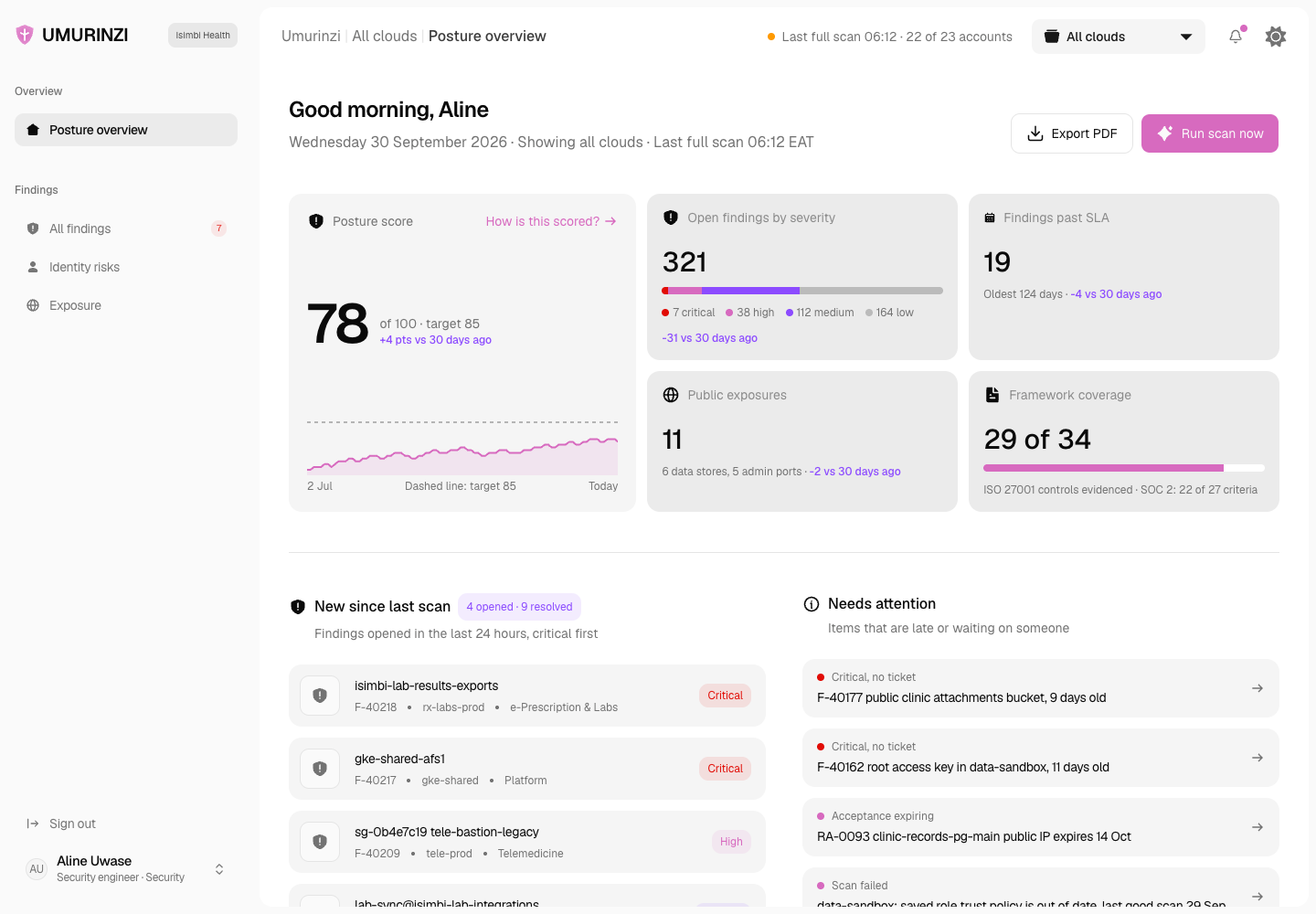
Umurinzi - Cloud Security Posture and Control Mapping Dashboard
Designed and built a clickable cloud security posture dashboard for a Kigali healthtech on AWS and Google Cloud: one findings queue checked against the CIS Benchmarks, identity risks and internet exposure in one view, every check mapped to ISO 27001 and SOC 2 controls, and a residency check for Rwandan patient data.
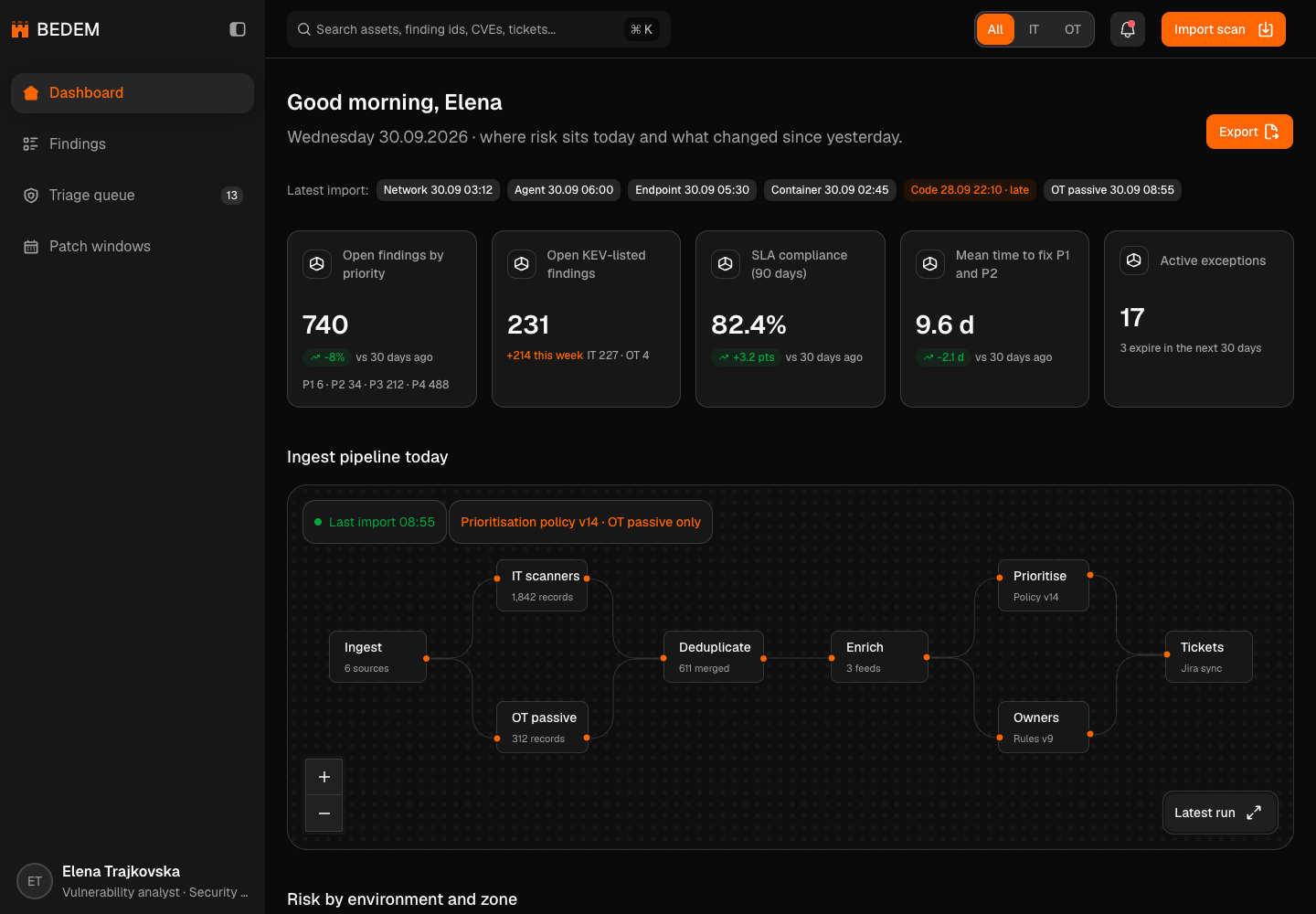
Bedem - Vulnerability Management Across Corporate IT and Substation OT
Designed and built a clickable vulnerability management platform for a Skopje electricity distribution operator: scanner findings merged into one list, ranked by real-world risk, triaged to owner teams with SLA dates, and OT fixes planned into maintenance outages - with substations assessed passively, never scanned.
Enterprise Software Engineering - Human + AI
Contact Us
© 2026 - Copyright. All Rights reserved Oceanlab
Location
Global Headquarters
21 Merchant Road, 3rd Floor, Singapore 058267
Main corporate office and leadership operations
North America Office
548 Market Street, PMB 12345, San Francisco, CA 94104
Client operations and business development
India Office
402 Shivalik Shilp II, SG Highway, Ahmedabad 380015
Engineering and delivery center

Enterprise Software Engineering - Human + AI
Contact Us
Locations
Global Headquarters
21 Merchant Road, 3rd Floor, Singapore 058267
Main corporate office and leadership operations
North America Office
548 Market Street, PMB 12345, San Francisco, CA 94104
Client operations and business development
India Office
402 Shivalik Shilp II, SG Highway, Ahmedabad 380015
Engineering and delivery center
© 2026 - Copyright. All Rights reserved Oceanlab